


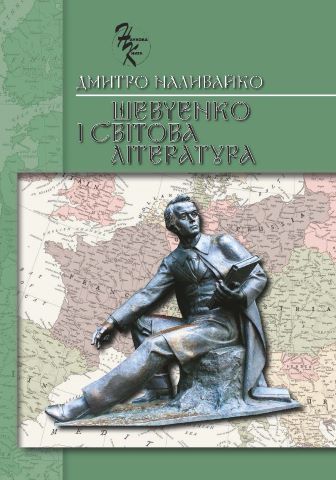
In 2026, the scientific monograph "Shevchenko and World Literature" by the prominent Ukrainian comparative literature scholar, academician of the NAS of Ukraine Dmytro Nalyvaiko (1929–2023), who worked for more than 35 years at the Taras Shevchenko Institute of Literature of the NAS of Ukraine, was published by the Publishing House "Akademperiodyka" of the NAS of Ukraine.
The author of this work for the first time carried out a comparative interpretation of Taras Shevchenko's creativity mainly based on Western European literatures. The study presents an attempt to identify the paradigm of the European context of the "Kobzar," which is constructed on manifestations of typological or intertextual commonalities and correspondences between Shevchenko's poetry and the works of prominent European poets of the Romantic era from Burns and Leopardi to Heine and Hugo. Its main task is to show Shevchenko as a phenomenon of European scale and significance, inherently fitting into the general context of the ideological and public life, spiritual culture, and literature of the continent, marked by a vivid national distinctiveness. Shevchenko's work, despite its originality, is unthinkable outside the connections and correspondences with Slavic literatures, biblical-Christian and ancient heritage, as well as with modern Western European culture and literature. It reveals stages, regularities, and leading trends characteristic of the general European literary process of the 19th century. A characteristic and at the same time deeply original phenomenon of Romantic artistic consciousness is Shevchenko's mythologism, his myth of Ukraine, which forms the implicit semantic-mental paradigm of the "Kobzar." For the poet, the fate of Ukraine, its past and future, was the problem of problems, but in his interpretation, he also did not rely on rational, "realistic" analysis: it takes on the outlines of a mythologeme based on biblical and ethno-national archetypes and is more perceived intuitively than rationally understood. The leading significant function in his myth-making is the function of organizing Ukrainian spiritual and cultural identity, ultimately the function of nation-building.
Shevchenko was characterized by an active interest in world culture in general and literature in particular, as well as a high aesthetic sensitivity. He was well acquainted with foreign literatures, as convincingly evidenced by his "Diary," correspondence, and stories. Shevchenko does not belong to artists whose works show international cultural and literary influences on the surface, but they undoubtedly played a significant role in his creative formation and development. For example, a prominent place in his interest in Western European Romanticism belongs to the British romantics George Byron and Walter Scott. In the European context, Shevchenko's poetry is one of the most complete and perfect embodiments of the "folk-folklore" current of Romantic literature. However, other currents and tendencies of Romanticism also manifested in his work. At times, motifs close to "Byronic poetry" with its gloomy pathos of sorrow and denial sound in it. In historical poems, from "Haidamaky" to "The Blind," there are many elements that bring them closer to the "Walter Scott current"; meditative poems contain echoes of philosophical or universal Romanticism. Many commonalities and resonances with corresponding phenomena of European Romantic literature are found in Shevchenko's satirical and critical works—from the poem "Dream" ("Everyone has their own fate...") to the biblical paraphrases of the last period. Shevchenko's creative path coincided with the development of realism in European literatures, which undoubtedly influenced his literary output. From this perspective, Shevchenko is a rather characteristic figure of the contemporary European literary process. Typologically, he is connected with the first stage of European realistic literature. Realistic tendencies grow in Shevchenko's work during his exile.
The dominance of the lyrical element in the structure of Shevchenko's poetry does not contradict its genre-thematic richness and diversity; this also fits it into the context of European poetry of his time, created by the works of Hugo and Heine, Mickiewicz and Słowacki, Petőfi and other poets. Despite its vivid individuality and national distinctiveness, Shevchenko's poetry deeply belongs to the main mainstream of contemporary European literature and is inherently connected with its semantic and artistic dominants.
News about the book on the publisher's website
According to information from the Taras Shevchenko Institute of Literature of the NAS of Ukraine

