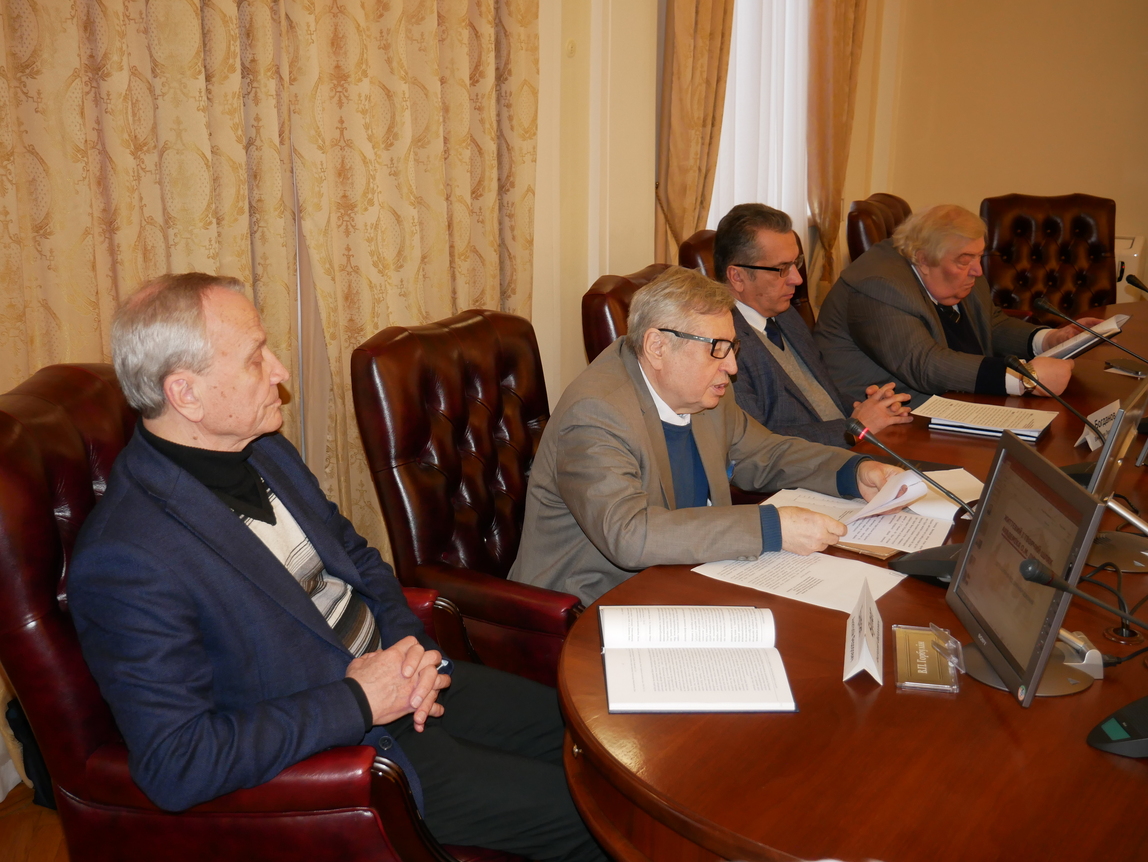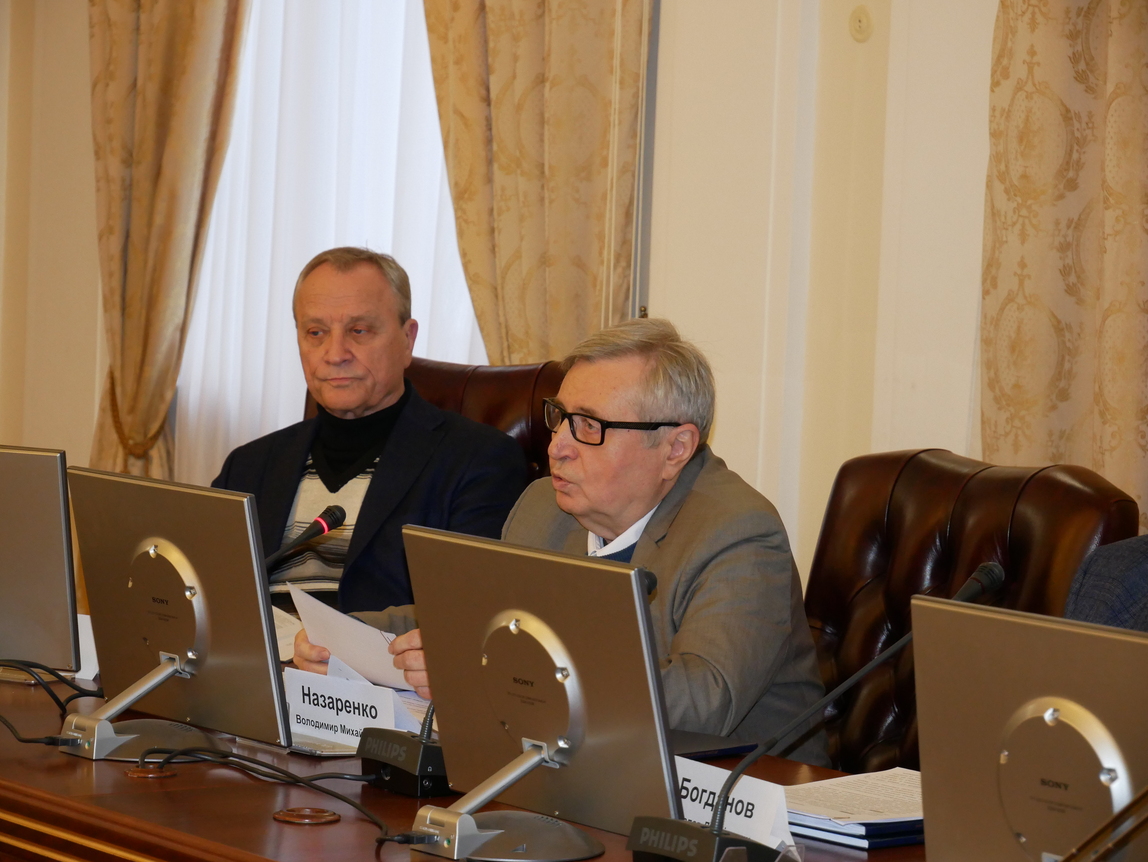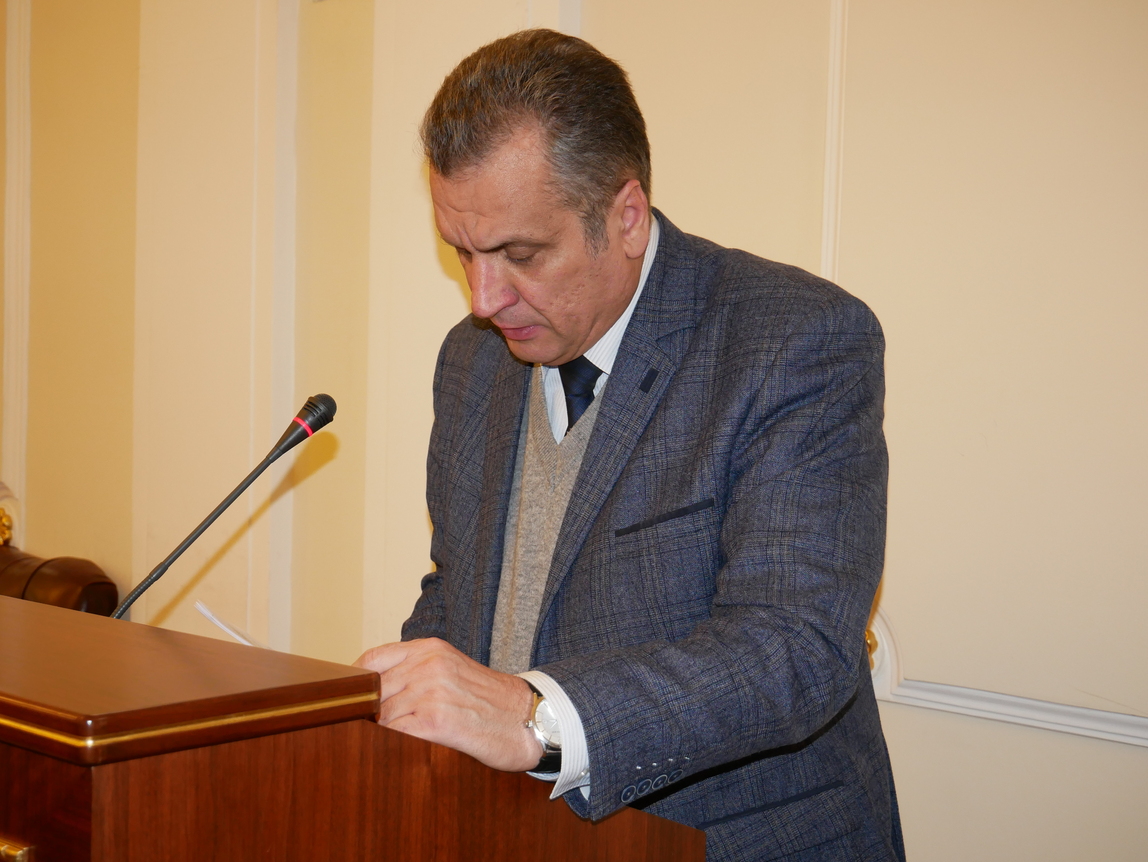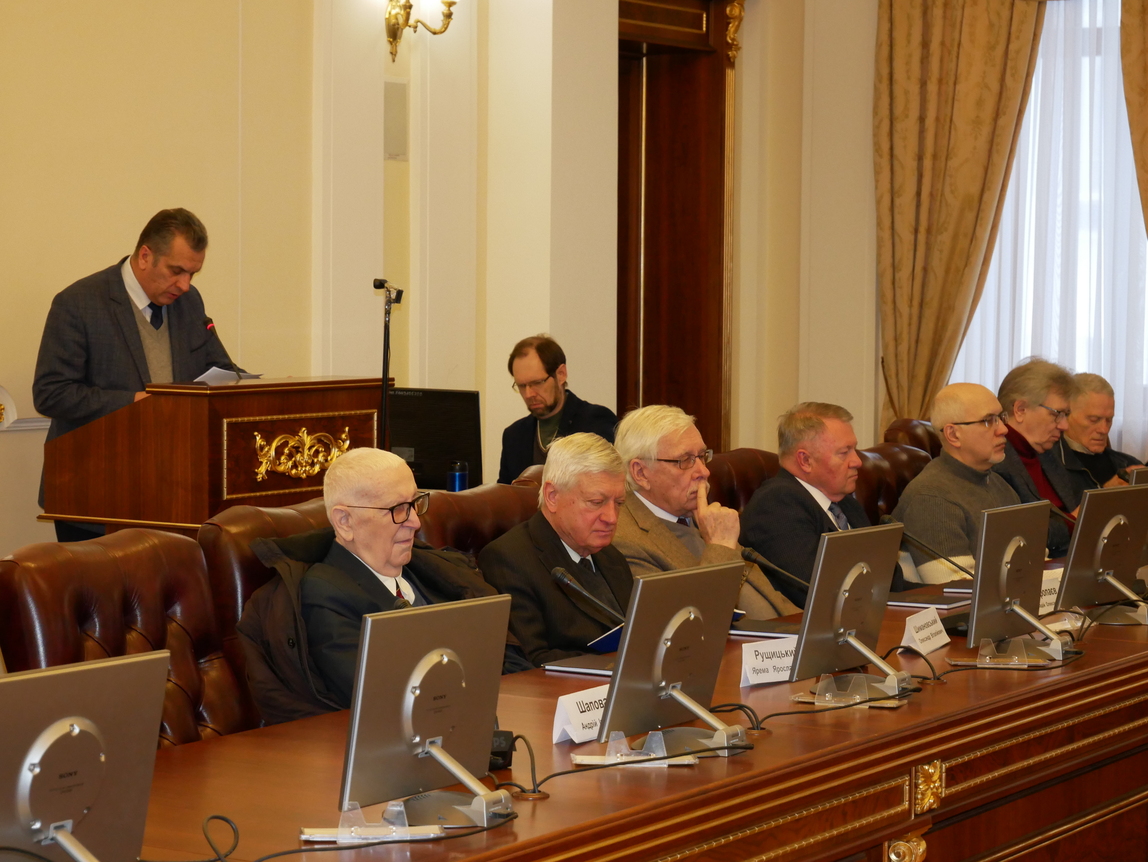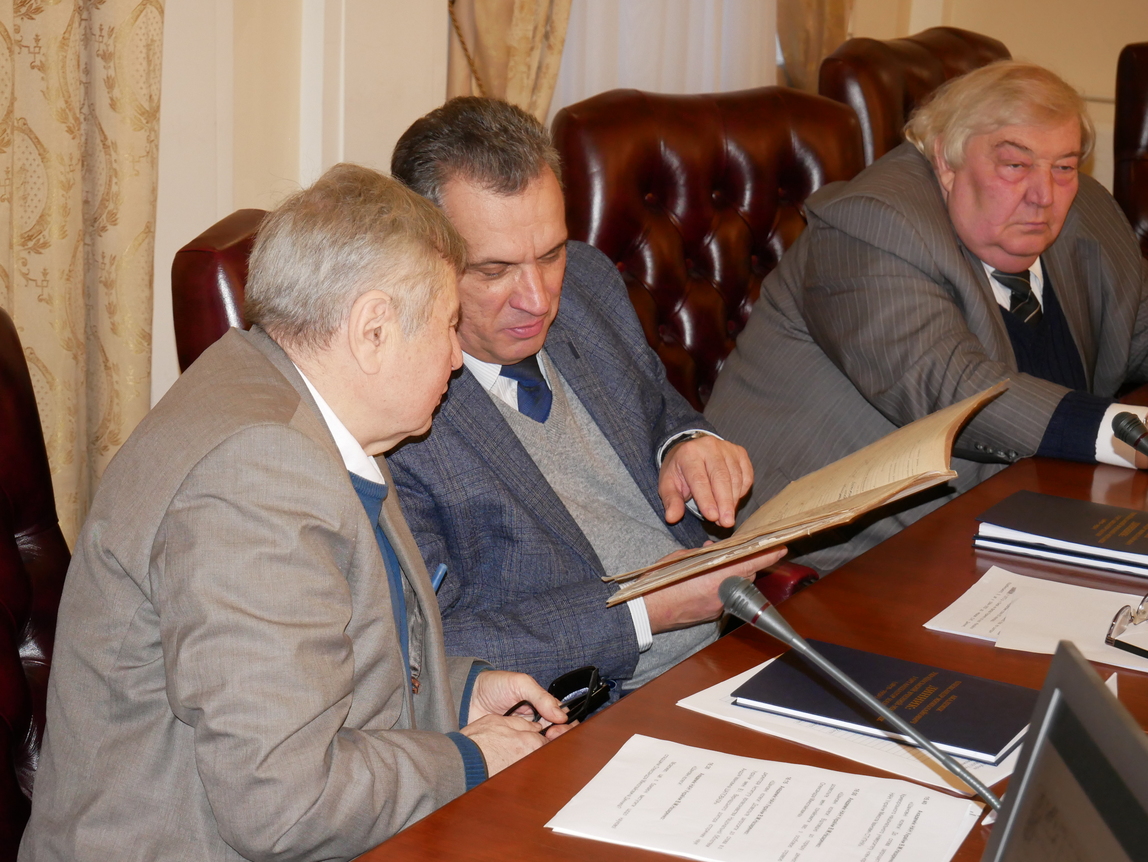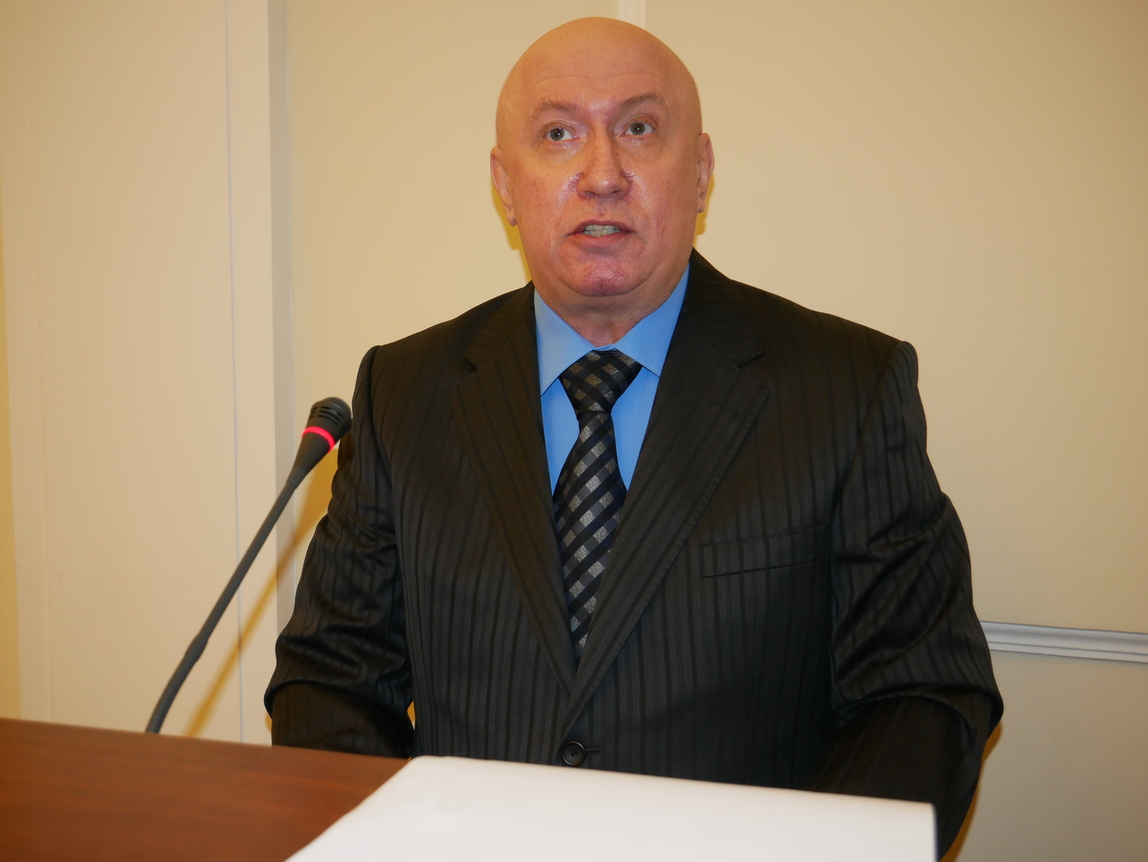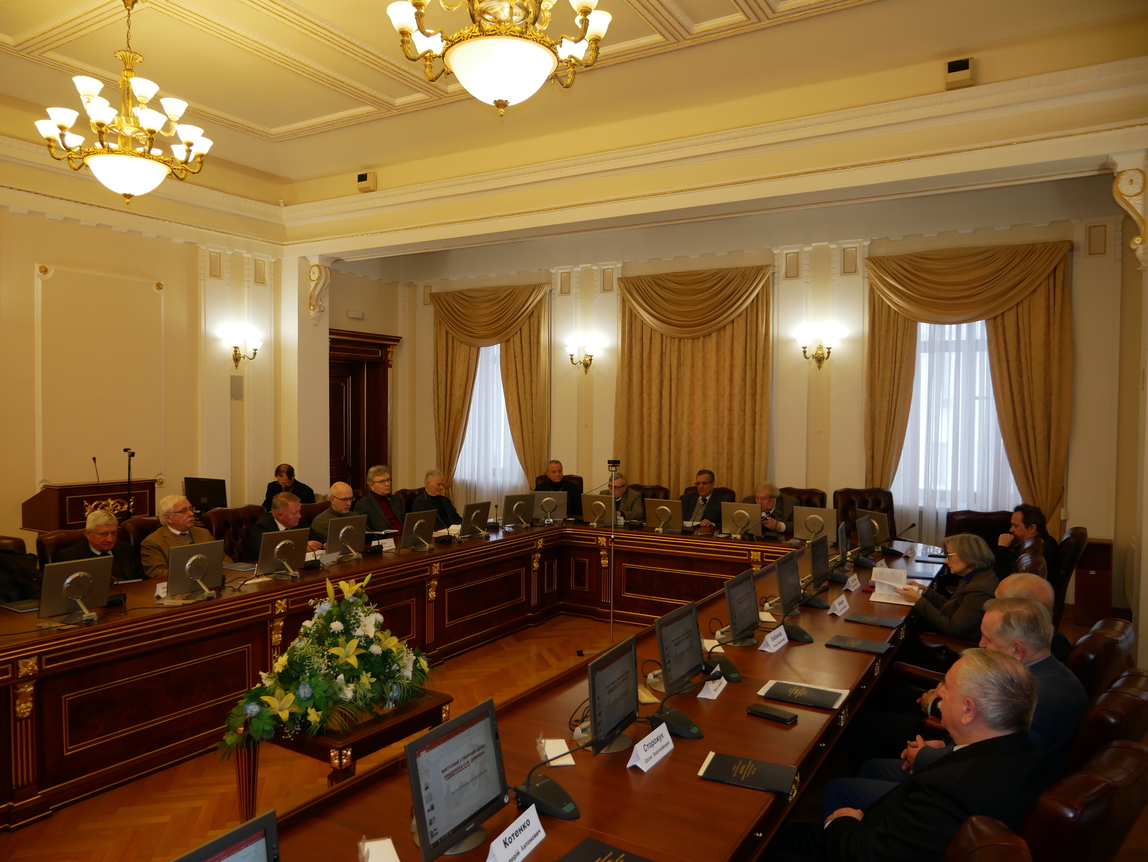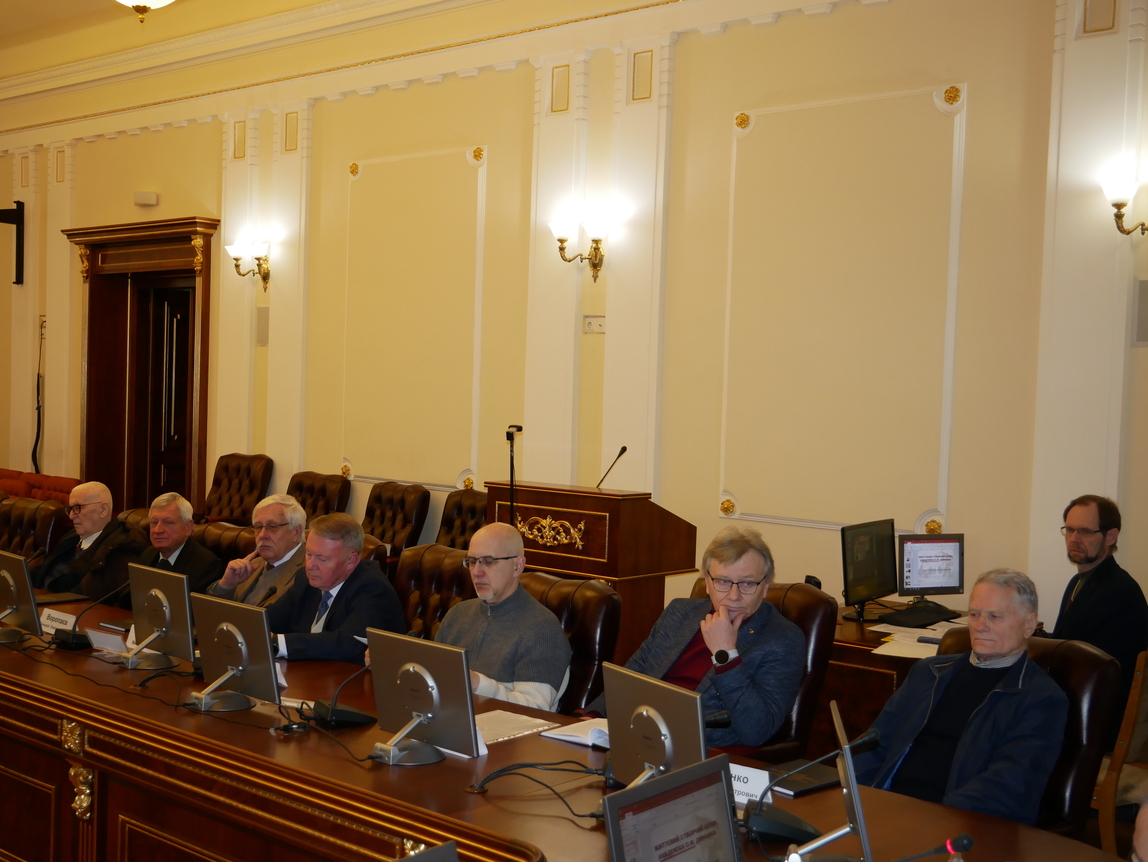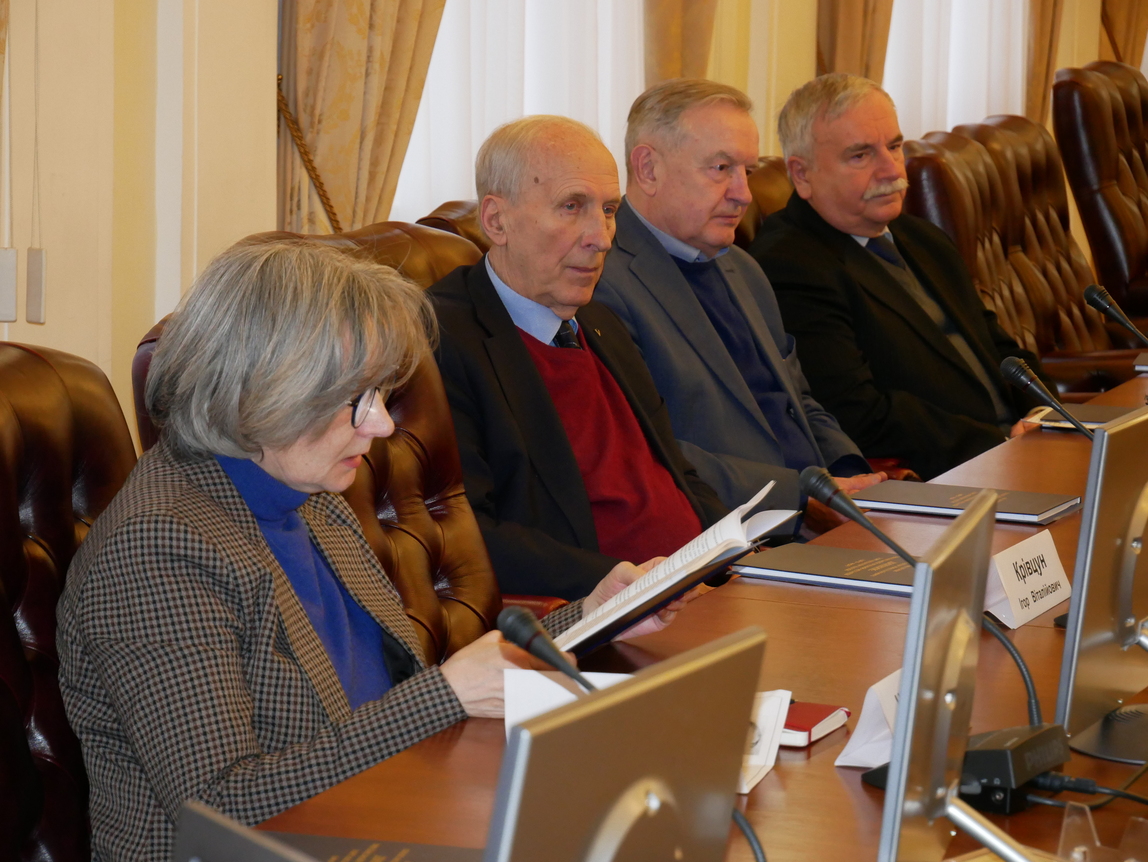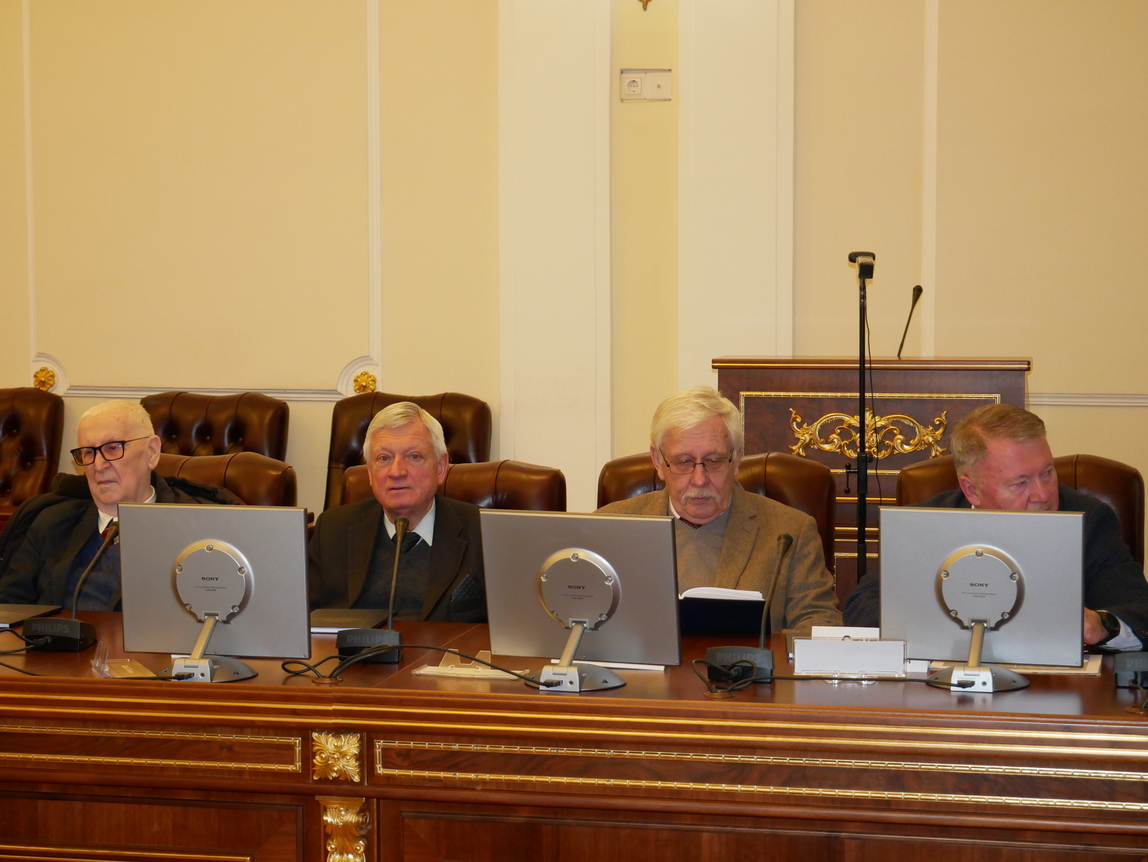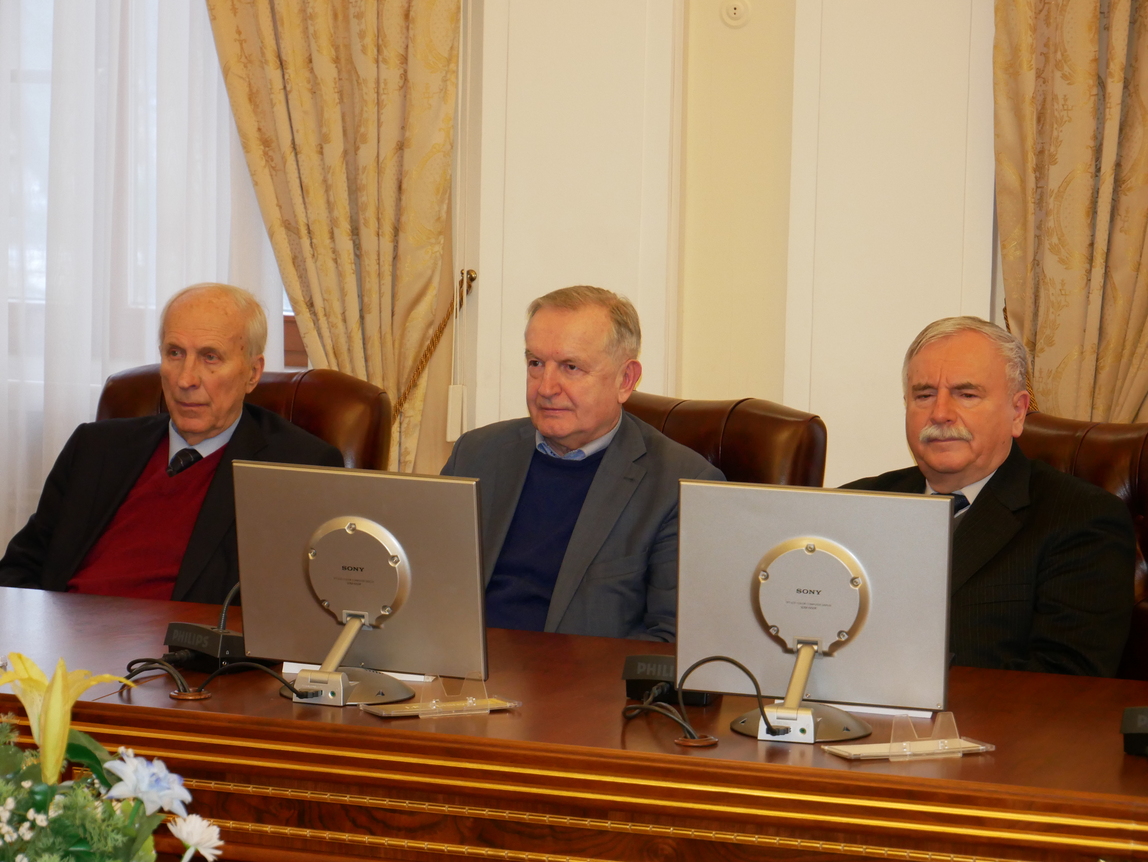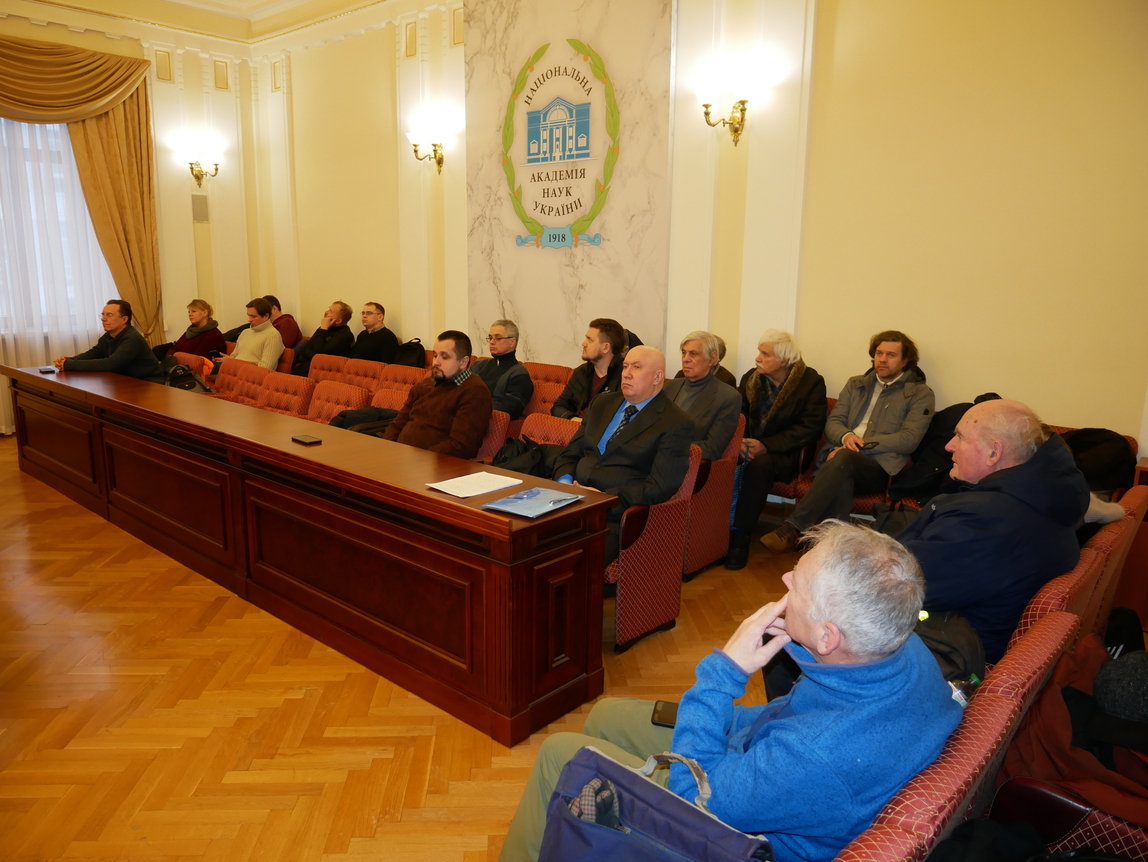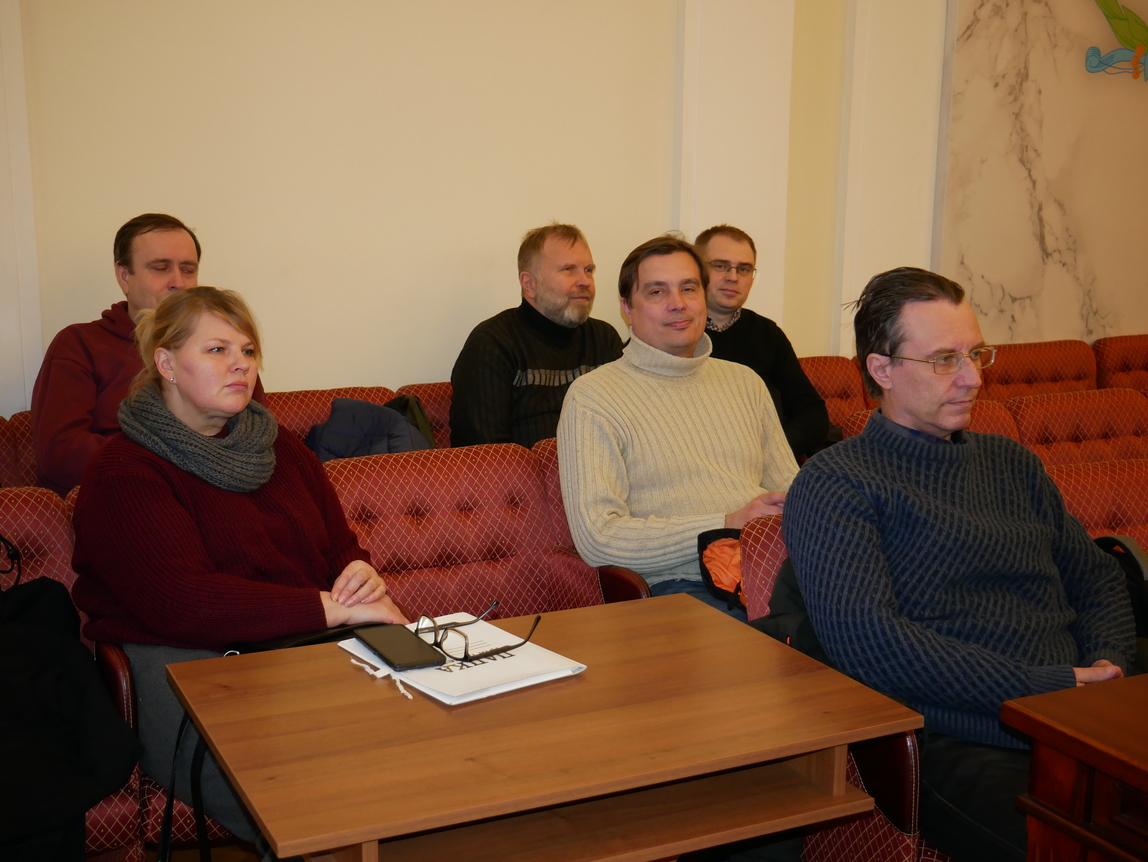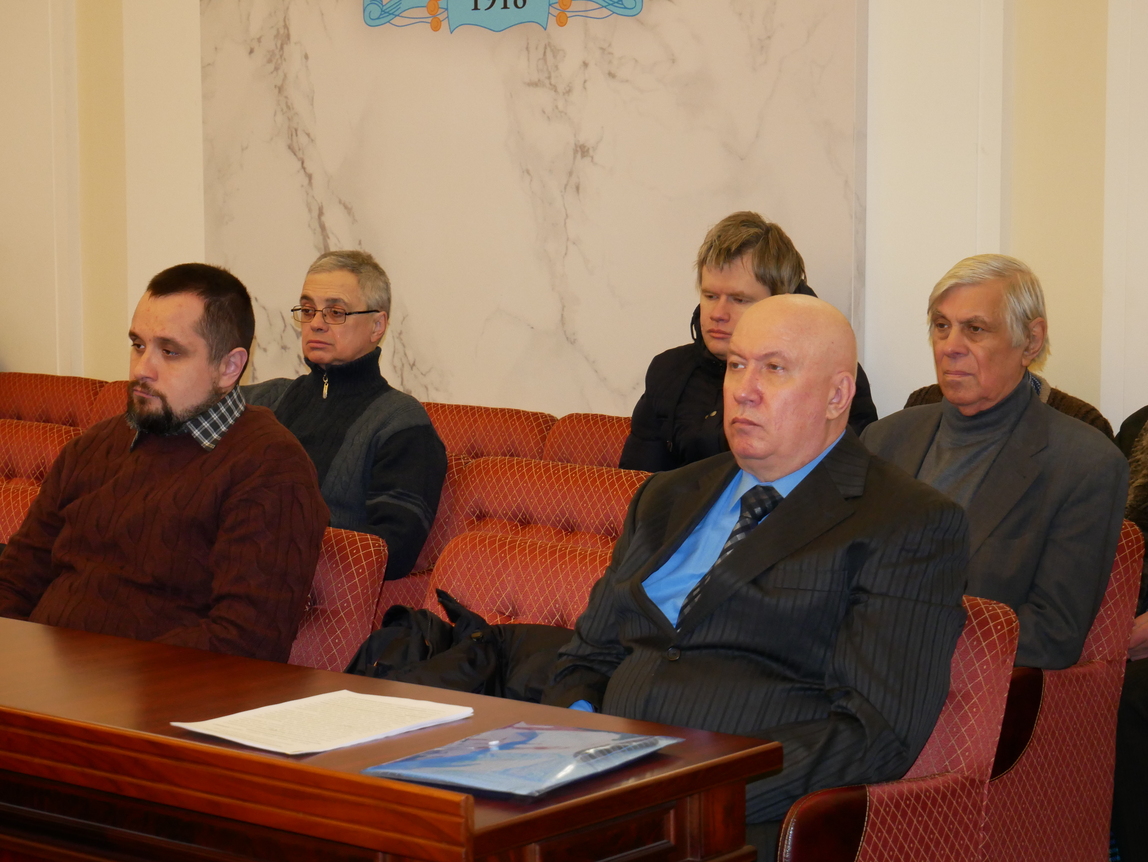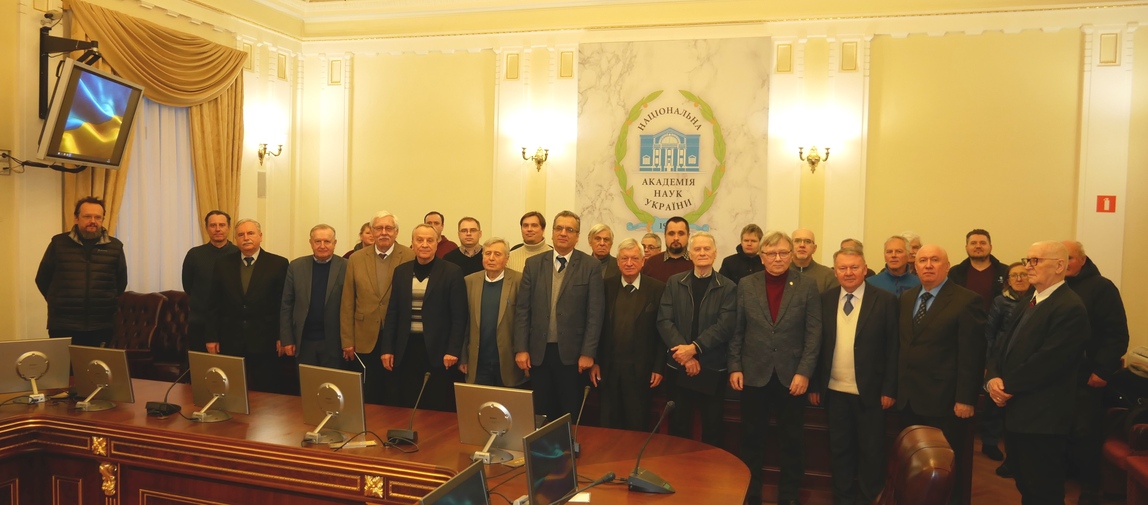
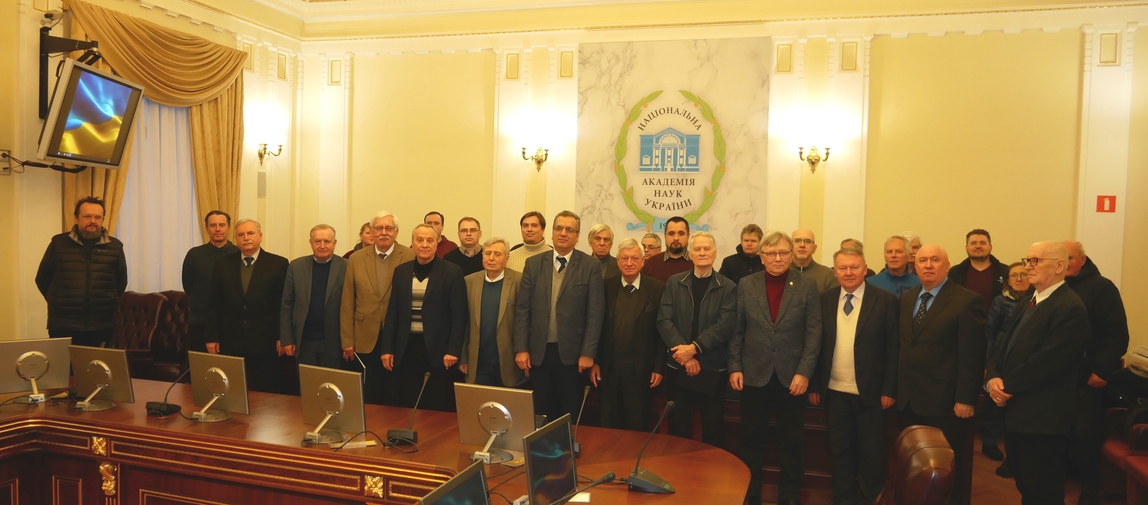
On January 30, 2026, the Jubilee meeting of the General Assembly of the Department of Mechanics and Machine Science of the National Academy of Sciences of Ukraine was held in the building of the Presidium of the National Academy of Sciences of Ukraine, dedicated to the 150th anniversary of the birth of the outstanding Ukrainian scientist-mechanic and science organizer Academician Oleksandr Mykolayovych Dynnyk (1876–1950). Members of the Presidium of the NAS of Ukraine, Academy members, and scientists of academic institutions participated in the event.
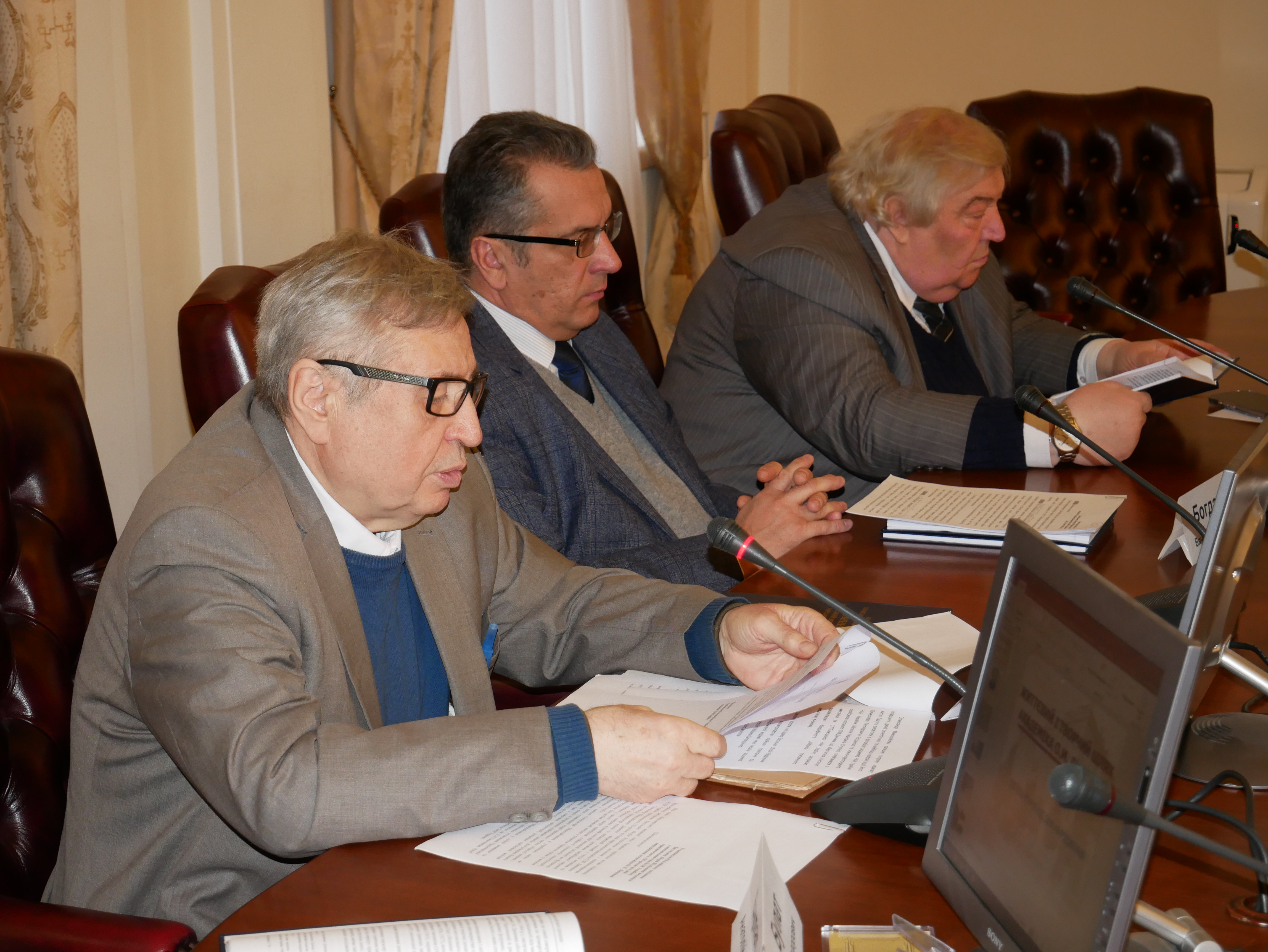
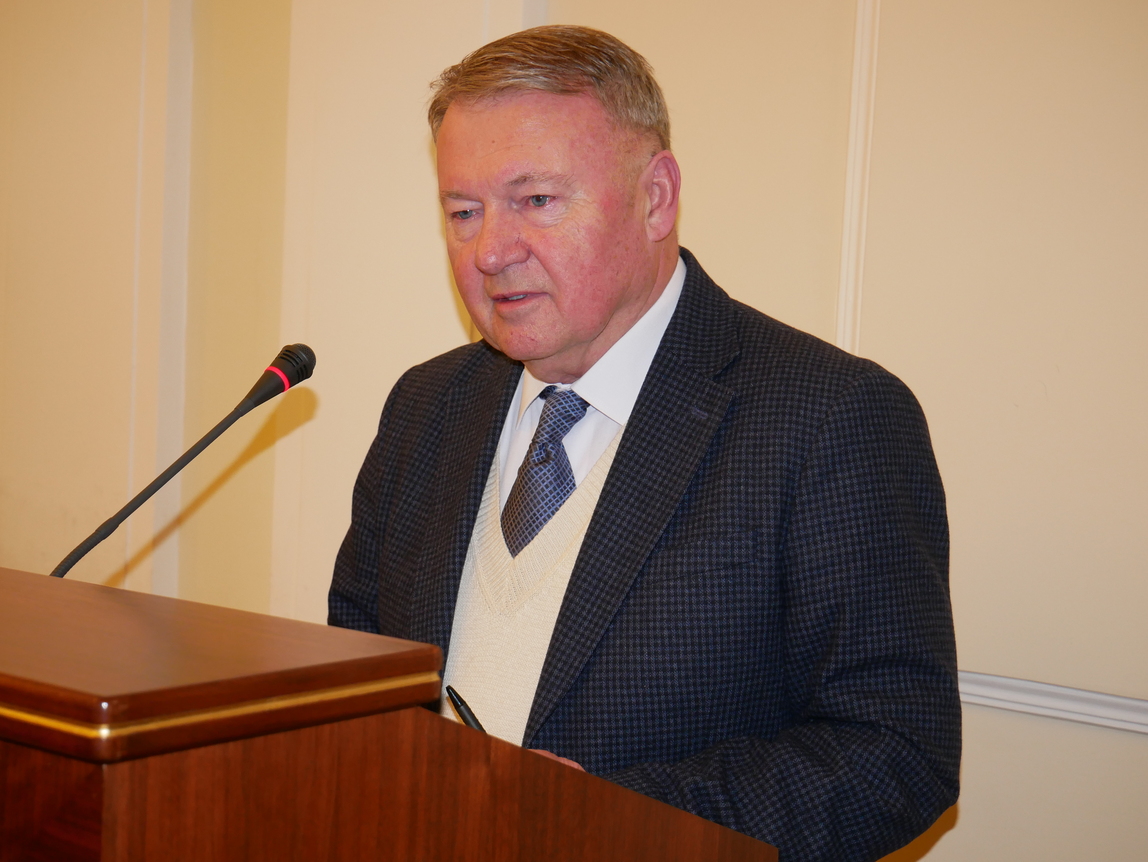
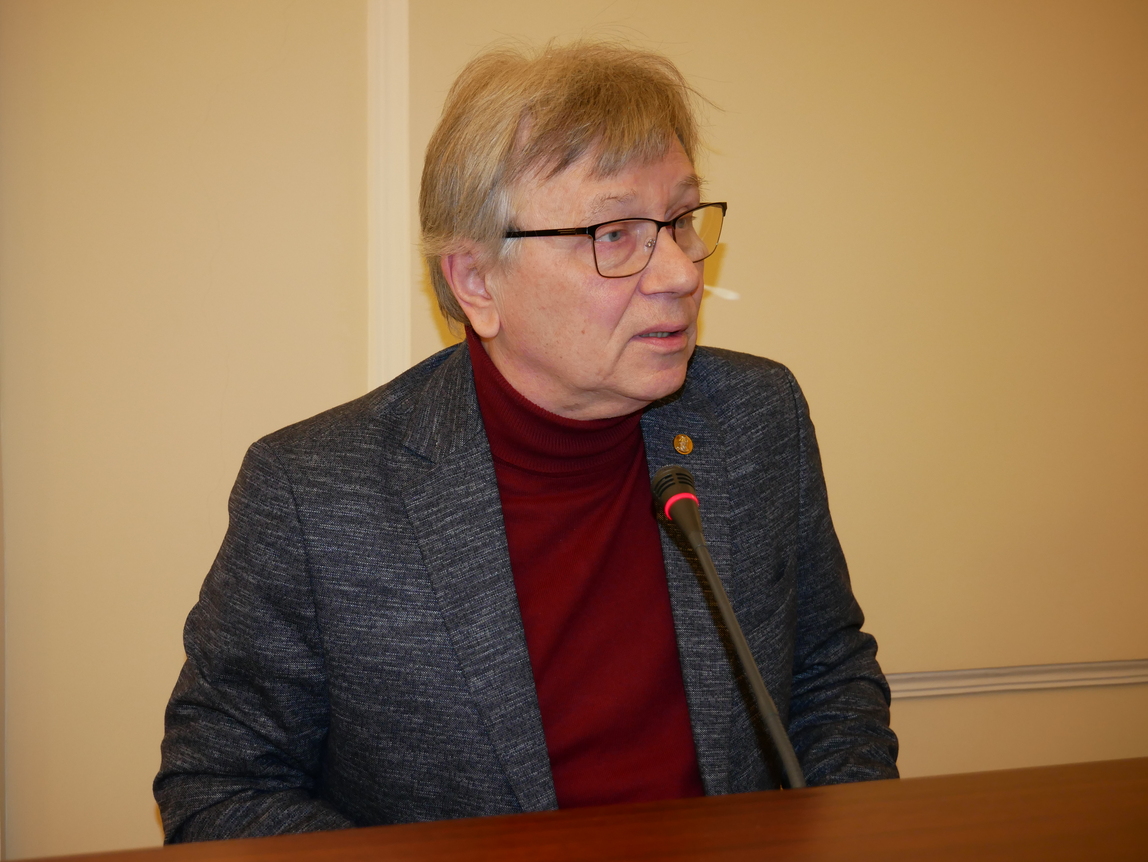
The meeting was opened by Academician-Secretary of the Department of Mechanics and Machine Science of the NAS of Ukraine, Acting Director of the S.P. Timoshenko Institute of Mechanics of the NAS of Ukraine, Academician Volodymyr Nazarenko. He recalled that Academician Oleksandr Dynnyk left a powerful scientific legacy, including a significant contribution to the development of methods and approaches in the theory of elasticity, calculations of shell and rod systems, and developed new scientific directions in the field of strength of materials, durability, and stability of machines and structures. Oleksandr Mykolayovych’s work in mining mechanics, mine hoisting ropes, and the development of the theory of rock pressure is also significant. Additionally, this outstanding scientist devoted much time to teaching and scientific-organizational activities.
Continuing the introductory part of the meeting, Academician Volodymyr Nazarenko announced greetings from the President of the National Academy of Sciences of Ukraine, Academician Anatoliy Zahorodniy.
"On behalf of the National Academy of Sciences of Ukraine, I warmly greet the participants of the Jubilee meeting of the General Assembly of the Department of Mechanics and Machine Science of the NAS of Ukraine, dedicated to the 150th anniversary of the birth of Academician O.M. Dynnyk.
Oleksandr Mykolayovych Dynnyk was an outstanding scientist in the field of mechanics and the theory of elasticity, a science organizer and educator, founder of the Ukrainian scientific school of elasticity theory, widely known to the world scientific community as the founder of scientific directions in the field of strength of materials, stability of structural elements, and mining mechanics. He made a considerable contribution to the development of mining science and the doctrine of rock pressure.
Oleksandr Mykolayovych’s invaluable contribution to Ukrainian science includes founding scientific schools in applied elasticity theory, issues of machine and structure strength, and the school in the theory and calculation of hoisting ropes. He created many experimental bases and scientific laboratories and developed approximate methods for solving elasticity theory problems.
Oleksandr Mykolayovych’s professional activity in mechanics and mining was largely connected with scientific institutions of the NAS of Ukraine, including the S.P. Timoshenko Institute of Mechanics and the Z.I. Nekrasov Institute of Ferrous Metallurgy.
O.M. Dynnyk made a significant contribution to the development of educational programs and training of specialists in theoretical mechanics and related disciplines at Taras Shevchenko National University of Kyiv, National Technical University of Ukraine "Igor Sikorsky Kyiv Polytechnic Institute," National Technical University "Dnipro Polytechnic," and the National Metallurgical Academy of Ukraine.
Through his diligent and devoted work, O.M. Dynnyk shaped the development of many directions of modern mechanics and mining science. Thanks to the strong foundation laid by Oleksandr Mykolayovych and the achievements of his students and followers, Ukraine is known worldwide as a country-developer and producer of rocket-space, aviation, engine-building, railway, automotive, energy, mining, and military equipment.
Remembering this leading scientist and honoring his achievements, we must constantly care about the future of our State, unite our efforts to solve urgent defense issues and post-war recovery of the country.
Dear participants of this honorable gathering, I sincerely wish you all peace, good health, and new creative achievements for the sake of our Ukraine!"
The participants then listened to several scientific reports.
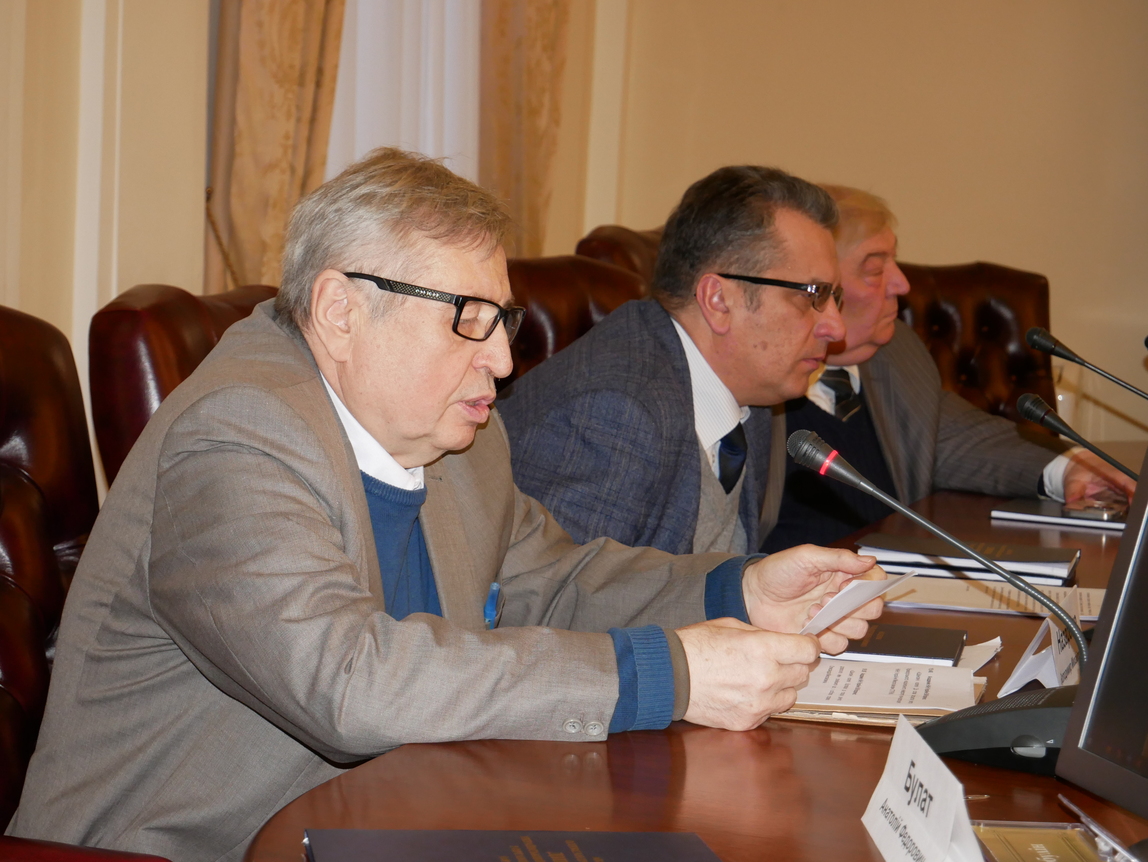
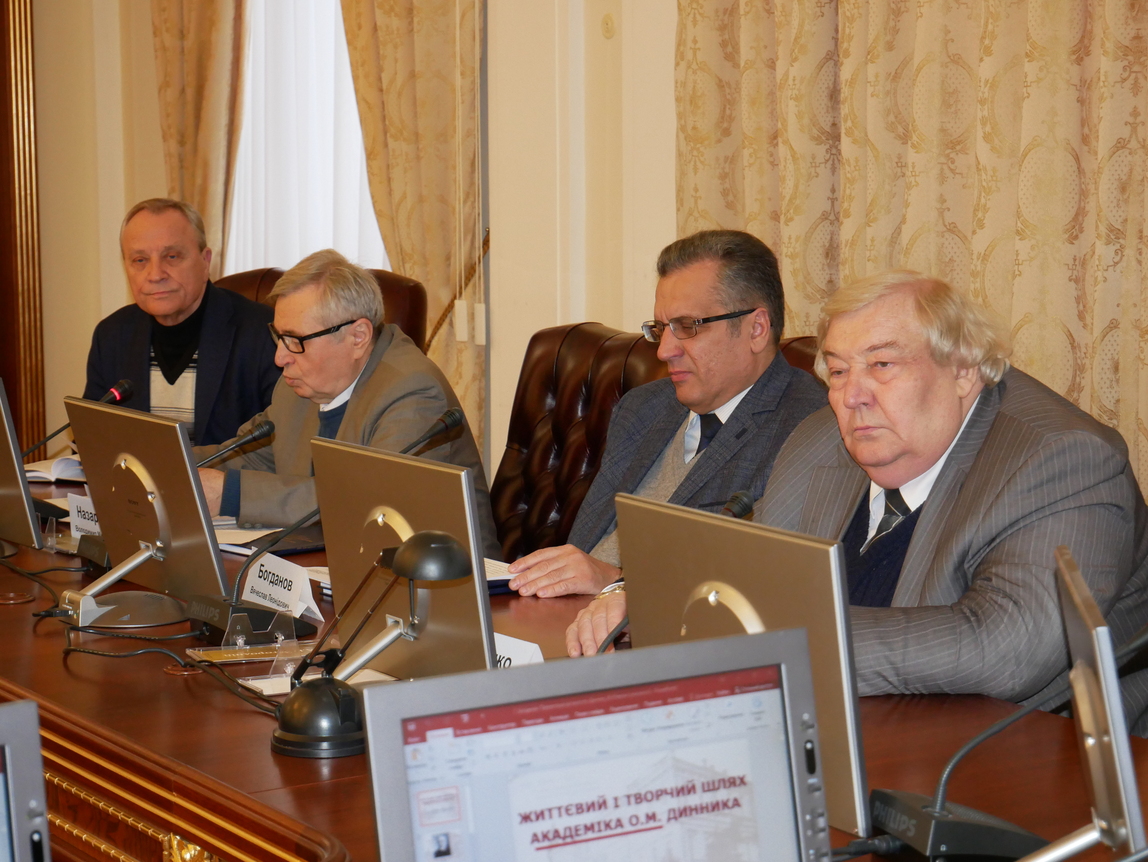
The main report titled "Life and Creative Path of Academician O.M. Dynnyk. On the 150th Anniversary of His Birth" was presented by the First Vice-President of the National Academy of Sciences of Ukraine, Head of the Section of Physical-Technical and Mathematical Sciences of the NAS of Ukraine, Academician Vyacheslav Bohdanov, who briefly outlined the main stages of the life and creative path of this great Ukrainian.
Academician Vyacheslav Bohdanov recalled that the Jubilee meeting of the General Assembly of the Department of Mechanics and Machine Science of the NAS of Ukraine took place on the eve of the 150th anniversary of Academician Oleksandr Dynnyk – an outstanding scientist-mechanic, science organizer, and educator, founder of the Ukrainian scientific school of elasticity theory, founder of many scientific directions in the field of strength of materials, durability and stability of machines and structures, and mining mechanics. This scientist was the first to solve a number of contact problems, problems of longitudinal bending and torsion, conducted fundamental research on stability and vibrations of elastic systems, developed the theory of mining pressure and methods for calculating mine hoisting ropes. A great merit of Academician O.M. Dynnyk is that he trained several generations of highly qualified specialists, engineers, and mechanical scientists.
"In an autobiography dated May 13, 1929, Oleksandr Mykolayovych indicates that he was born in 1876 in Stavropol in the Caucasus, the son of a teacher, with his grandfather having moved to the Caucasus from the Chernihiv province. In another version of the autobiography, he adds that his father was a physics teacher and his mother a natural sciences teacher. In personal data, the scientist identified himself as Ukrainian," emphasized Academician Vyacheslav Bohdanov. "Oleksandr Mykolayovych’s father, Mykola Yakovych Dynnyk (1847–1917), graduated from the natural sciences department of the physics and mathematics faculty of Moscow University and after studying returned to his homeland – the city of Stavropol. There he worked as a natural sciences teacher at the Olhynska Women’s Gymnasium, later as a physics teacher at the Oleksandrivska Men’s Gymnasium and the Cossack Junker School. Soon he married his former student Hanna Vasylivna Martynova. In 1882, she graduated from the physics and mathematics faculty of the Higher Women’s Courses (Bestuzhev Courses) and later taught natural history – also at the Olhynska Women’s Gymnasium.
In his free time from teaching, Mykola Yakovych traveled around the Caucasus, studying the nature of the mountains. He was a member of the St. Petersburg Society of Naturalists and Physicians, author of over 60 scientific works devoted to glaciers and vertebrate animals of the Caucasus. For outstanding research in Caucasus studies, he was awarded the Gold Medal of the Russian Geographical Society and the Akhmatov Prize of the St. Petersburg Academy of Sciences. The father often took his son Oleksandr on his trips and managed to instill in him a love of nature and interest in its study.
Overall, O.M. Dynnyk’s parents belonged to the progressive people of their time; the family atmosphere was creative and devoted to education and science. The entire lifestyle in the Dynnyk household was an example of dedication to work and serious fulfillment of duties, which shaped Oleksandr Mykolayovych’s character. Throughout his life, he was a creative, responsible, and organized person.
In 1886, O.M. Dynnyk was admitted to the local men’s gymnasium, where he consistently studied well and showed abilities and a strong inclination toward mathematics. During his gymnasium studies, his interest in physical and mathematical sciences was formed, to which the young man decided to dedicate his life.
In 1884, O.M. Dynnyk graduated from gymnasium with a gold medal and entered the physics and mathematics faculty of Novorossiysk University (now Odessa National I.I. Mechnikov University). However, the following year he transferred to the third semester of the physics and mathematics faculty of St. Vladimir University in Kyiv (now Taras Shevchenko National University of Kyiv).
Choosing between the two subdivisions of the faculty – mathematics and physics – Oleksandr preferred physics as a more practical science at that time. His first scientific work, "Outline of the Doctrine of Magnetization in Connection with Theoretical and Experimental Studies of Recent Times," was written by O.M. Dynnyk as a seventh-semester student, for which he received the university gold medal and the M.I. Pirogov Prize in December 1898.
The next year he graduated brilliantly from the university and was appointed junior laboratory assistant at the physics department of Kyiv Polytechnic Institute (KPI), and in 1901 was promoted to senior laboratory assistant of this department. In the early years at KPI, O.M. Dynnyk regularly attended lectures and completed all assignments and projects at the institute’s mechanical faculty, gaining solid engineering knowledge.
In 1905, his first scientific papers were published in the "Bulletin of Kyiv Polytechnic Institute" – "Determination of the Stress of the Earth’s Magnetic Field in Kyiv" and "Reduction of the Order of Linear Difference and Differential Equations with Constant Coefficients Using Partial Integrals."
For some time, O.M. Dynnyk conducted practical classes for KPI students both in the physical laboratory and in the laboratory of the mechanical strength of materials department, where Professor S.P. Timoshenko then lectured on strength of materials and graphical statics.
It was with the assistance of Stepan Prokopovych and the dean of the mechanical department of KPI, Professor Oleksandr Oleksandrovych Radtsig, that O.M. Dynnyk transferred from the physics department to the strength of materials department – initially as an extra-staff laboratory assistant, and later as a lecturer.
During this period, he became interested in the problem of collision of elastic bodies. Noticing inconsistencies in the theory of longitudinal impact of thin cylinders by Ademar Saint-Venant and Heinrich Hertz’s formulas, O.M. Dynnyk conducted thorough experiments to verify them and, based on experimental data, developed a static theory of impact of elastic bodies. The results were published in a series of articles in the "Journal of the Russian Physical and Chemical Society" and the "Bulletin of KPI."
These works, based on theoretical and experimental studies, revealed several important phenomena. For example, it was found that when a sphere is pressed into a surface, the most dangerous points (i.e., points with the greatest stress) are not on the contact surface but at a certain depth. It was also discovered that due to the rapid increase of compressive forces during impact, the yield strength of iron and steel is significantly higher than in the case of static loading. These studies far preceded foreign scientists’ experiments and eventually found wide application in engineering.
The work "Impact and Compression of Elastic Bodies" by O.M. Dynnyk, published in 1909, summarized these studies and received high praise from the scientific community, including such prominent mechanics as H.V. Kolosov, M.E. Zhukovsky, and S.P. Timoshenko, making the author’s name well-known among scientists.
In 1910, Oleksandr Mykolayovych published a solution to the problem of stability of a compressed circular plate with supported, fixed, and free edges – both solid and with holes – two years ahead of George Bryan’s publication, whose solution concerned only a partial case of this problem, namely compression of a plate with a rigidly fixed edge.
That same year, O.M. Dynnyk defended his dissertation "Impact and Compression of Elastic Bodies" at KPI and obtained the degree of adjunct in applied mechanics. In the dissertation, he deeply and originally solved the contact problem for direct contact, determining the magnitude of the maximum tangential stress and the positions of the points where it occurs.
From January 1910 to November 1914, O.M. Dynnyk, as a professor’s stipend recipient and during internships, periodically traveled abroad for scientific trips, attending lectures by Professors Arnold Sommerfeld at Munich University and August Föppl at the Royal Higher Technical School in Munich (now Munich Technical University).
During his studies abroad in 1912, O.M. Dynnyk prepared the work "On the Stability of the Flat Form of Bending," in which, using cylindrical functions, he obtained an exact solution to an important engineering problem, in a more general formulation than Ludwig Prandtl and Anthony Mitchell had done. This research was highly appreciated by European scientists, including the prominent German physicist, mathematician, and engineer Hendrik Lorentz, who was a professor of mechanics at the Technical University and director of the Materials Testing Institute in Danzig (now Gdańsk, Poland). O.M. Dynnyk successfully defended this work as a dissertation before Professor H. Lorentz, earning the scientific degree of Doctor of Engineering.
At the beginning of 1911, O.M. Dynnyk was appointed professor of theoretical mechanics at the Don Polytechnic Institute in Novocherkassk. There he continued research applying cylindrical functions to mechanics problems. In 1913, he published the work "Application of Bessel Functions to Problems of Elasticity Theory," in which he solved many theoretically interesting and practically important problems of stability, strength, and vibrations of strings, rods, plates, and volumetric bodies. In 1915, this work was presented as a dissertation at Kharkiv University, and after its successful defense, he obtained the scientific degree of Master of Applied Mathematics.
It should be noted that all three dissertations by O.M. Dynnyk – "Impact and Compression of Elastic Bodies," "On the Stability of the Flat Form of Bending," and "Application of Bessel Functions to Problems of Elasticity Theory" – are now classical works in mechanics. His research and works, characterized by clarity in problem formulation, conciseness of presentation and formulations, along with the depth of the issues addressed, established the priority of Ukrainian science in solving a number of scientific problems and received high recognition in the European scientific community, bringing the scientist deserved fame.
In 1913, O.M. Dynnyk won the competition for the position of professor of theoretical mechanics at the Katerynoslav Mining Institute (from 1926 – Dnipropetrovsk Mining Institute, now National Technical University "Dnipro Polytechnic"). Soon he headed the department of theoretical mechanics, later renamed the department of technical mechanics.
Thus began the Katerynoslav (later Dnipropetrovsk) stage of Oleksandr Mykolayovych’s life and work, which lasted almost 30 years until the beginning of World War II.
The profile of the Mining Institute in Katerynoslav and its proximity to Donbas and Kryvbas influenced the thematic focus of Professor O.M. Dynnyk’s scientific research. He studied dynamic stresses in mine hoisting ropes and the stability of various structures, publishing a series of theoretical works on longitudinal bending, torsion, vibrations, and others.
The above facts from O.M. Dynnyk’s scientific biography indicate that by the time of the change of state system in 1917, he was already a fully formed scientist-mechanic and educator, known both at home and in Europe.
The period of socio-political upheavals and revolutionary processes in Ukraine from 1917 to 1922 was spent by O.M. Dynnyk far from the epicenter of these events, but he not only conscientiously fulfilled his duties as a scientist and educator but was also somewhat involved in public life.
For example, in 1918 he prepared the textbook "Theoretical Mechanics" in two parts; in the early 1920s, he published a series of works on longitudinal impact, stability of equilibrium, dynamic stresses in hoisting ropes, allowable stresses in bridges, bending of drilling wells during drilling, etc., published in the journals "Science in Ukraine" and "Proceedings of the Katerynoslav Mining Institute." From 1920, O.M. Dynnyk worked on a voluntary basis as deputy head of the Department of Higher Educational Institutions of Katerynoslav (from 1926 – Dnipropetrovsk, now Dnipro), managing higher and secondary technical educational institutions. In 1921, he was elected a deputy of the Katerynoslav City Council and was repeatedly re-elected to the city and regional councils of Dnipropetrovsk.
Simultaneously with his work at the Mining Institute, where in 1921 O.M. Dynnyk served as acting director, he also worked as a professor at the Dnipropetrovsk Institute of Public Education (1933–2000 – Dnipropetrovsk State University, now Oles Honchar Dnipro National University), which he actively helped to establish and taught at since 1918.
From 1930, he worked at the Dnipropetrovsk Metallurgical Institute, created on the basis of the Faculty of Mining and Metallurgical Mechanics and the Metallurgical Faculty of the Dnipropetrovsk Mining Institute (now the National Metallurgical Academy of Ukraine), where he headed the Department of Structural Mechanics (later Strength of Materials) and managed the mechanical laboratory.
O.M. Dynnyk actively participated in the work of the Dnipropetrovsk Physical and Mathematical Society, created in the 1920s. At that time, to improve the scientific qualifications of young scientists and to involve mechanics lecturers, graduate students, students, and young engineers in scientific activities, he organized a seminar on the theory of elasticity and strength of materials, which operated almost until the scientist’s death.
In June 1929, Oleksandr Mykolayovych was elected a full member of the All-Ukrainian Academy of Sciences. At that time, within the natural and technical sciences department of the Academy, he created the Department of Elasticity Theory, setting its task to develop elasticity theory according to the needs of mining.
In the 1930s, the scientist continued intensive research related to the application of elasticity theory methods to solve applied problems of the mining and metallurgical industries. He paid much attention to stability issues, which had been among his interests since the 1910s. O.M. Dynnyk’s work on this topic was summarized in the monographs "Stability of Elastic Systems," "Longitudinal Bending. Theory and Application," and "Stability of Arches," which considered methods for determining critical force, studied the stability of straight and curved rods, strips, rings, plates, shells, frames, and plates reinforced with ribs, etc.
In 1938, the scientist’s monograph "Torsion. Theory and Application" was published, deriving the main equations of elasticity theory and presenting various methods for solving torsion problems of prismatic rods. The publication addressed the torsion of a circular shaft with variable cross-section and the related problem of stress concentration at changes in shaft diameter. The theoretical developments were illustrated with numerous practical examples, which was important for engineers.
O.M. Dynnyk led both theoretical and experimental (optical method) studies of stress concentration near mining workings of various shapes. A dynamometric stand was invented for measuring rock pressure in mining workings, which became widely used in Donbas and Kryvorizhzhia mines.
The scientific achievements of Academician O.M. Dynnyk, positively evaluated by the Academy’s leadership, contributed to establishing his scientific authority. His contemporary characterization noted: "Academician Dynnyk performed a number of important works with great theoretical significance in the field of elasticity theory, widely popular among specialists both in the USSR and abroad. In recent years, Academician Dynnyk has also worked in the field of stability issues. Some of his works have been translated into English and German. Academician Dynnyk published over 60 works. He made a great contribution to training young scientific personnel. Several of them now head departments."
It is worth noting that O.M. Dynnyk, as far as possible, tried to avoid administrative positions, preferring scientific work and promoting young and promising scientists to leadership positions. When in autumn 1940, against his will, he was appointed director of the Institute of Mining Mechanics, in a letter to the President of the Academy of Sciences of the Ukrainian SSR, Oleksandr Oleksandrovych Bohomolets, the scientist wrote: "The issue with the directorship of the IMM can be resolved as follows. On October 28, [G.M.] Savin will defend his doctoral dissertation early, then he can be appointed director. A preliminary agreement with him already exists. He is a young, energetic, and intelligent person and will cope with this work." O.M. Dynnyk’s proposal was heeded, and his student Huri Mykolayovych Savin headed the IMM from 1940 to 1945, became a full member of the Academy in 1948, and directed the Institute of Structural Mechanics of the Academy (now the S.P. Timoshenko Institute of Mechanics of the NAS of Ukraine) in 1958–1959.
From October 1939, by decision of the Presidium of the Academy, O.M. Dynnyk headed the Department of Technical Sciences of the Academy of Sciences of the Ukrainian SSR, which then included six academic institutes: structural mechanics, mining mechanics, ferrous metallurgy, energy, electric welding, and hydrology. In June 1940, under O.M. Dynnyk’s chairmanship, a scientific session of the Department of Technical Sciences of the Academy took place, presenting 27 scientific reports. The scientist himself presented a report on equilibrium forms and thrust of circular arches under loads exceeding the critical load. His conclusions were important for arch stability calculations.
O.M. Dynnyk made a significant contribution to organizing the Academy’s work during World War II. On July 21, 1941, due to the outbreak of the German-Soviet war, the Presidium of the Academy of Sciences of the Ukrainian SSR tasked him and Academician Heorhiy Vyacheslavovych Kurdiumov with managing the Academy’s research institutions in Dnipropetrovsk, which then operated in the frontline zone. In August, the Institute of Mining Mechanics (IMM) was evacuated from Dnipropetrovsk to Ufa, and O.M. Dynnyk moved there with the staff. During the war, he headed the elasticity theory department at the institute, was a member of the academic council, and performed extensive theoretical and experimental work on arch stability.
In August 1944, O.M. Dynnyk was elected a member of the Presidium of the Academy, where he worked until February 1948. Within the distribution of duties among Presidium members, he headed the Graduate Commission and the Scientific Propaganda Commission.
From December 29, 1944, Academician O.M. Dynnyk was a member of the academic council of the Institute of Structural Mechanics. On January 31, 1947, he became a member of the expanded academic council of this institute, which had the right to conduct doctoral dissertation defenses. On June 1, 1948, he transferred from the Institute of Mining Mechanics to the Institute of Structural Mechanics, where he worked until the end of his life.
In 1946, O.M. Dynnyk was elected a full member of the USSR Academy of Sciences, which was a well-deserved recognition of his outstanding scientific achievements.
From 1947, O.M. Dynnyk was seriously ill but did not cease his creative work. He worked on his last monograph "On the Stability of Elastic Systems" while bedridden. The book was published in 1950, two months after his death.
On June 7, 1950, the last meeting of the scientific seminar on the theory of elasticity and strength of materials under O.M. Dynnyk’s leadership took place. More than 50 scientists belong to the scientific school of elasticity theory he founded, including such notable figures as Huri Mykolayovych Savin, Vsevolod Arutyunovich Lazaryan, Mykhailo Yakovych Leonov, Oleksandr Mykhailovych Penkov. The main scientific directions of this school are:
- stability of rods and rod systems;
- stability and vibrations of plates, membranes, curved rods;
- experimental studies of arch and rod system stability;
- approximate methods for solving elasticity theory problems, study of thermal stresses;
- plane problems of elasticity theory of isotropic and anisotropic media, elastic-plastic problems, including stress concentration near holes;
- dynamics of hoisting ropes;
- contact and spatial problems of elasticity theory;
- physico-mechanical properties of building materials and rocks.
As we see, a characteristic feature of the school is a wide range of scientific research from purely theoretical issues to practical engineering calculations of individual structural elements.
O.M. Dynnyk died on September 22, 1950, in Kyiv. He was buried at Lukyanivske Cemetery.
The outstanding contribution of Academician O.M. Dynnyk to Ukrainian and world science is honored in our country, particularly in the National Academy of Sciences.
In 1972, the O.M. Dynnyk Prize of the NAS of Ukraine was established in honor of the scientist, awarded for outstanding scientific works in mechanics and mechanical engineering. The first laureate of this prize was Oleksandr Mykolayovych’s student, Academician of the Academy of Sciences of the Ukrainian SSR Huri Mykolayovych Savin – for a series of works on the mechanics of solid deformable bodies. To date, 37 awards have been given, and 83 scientists have become laureates.
In 1973, a bronze memorial plaque was installed on the facade of the building at 9 Mykhailo Kotsiubynsky Street in Kyiv, where O.M. Dynnyk lived from 1944 to 1950. Memorial plaques to Academician O.M. Dynnyk were also installed in Dnipro by the staff of higher education institutions where this scientist taught for decades.
In particular, a bas-relief of O.M. Dynnyk was installed in front of the main building of the National Technical University "Dnipro Polytechnic," and a memorial plaque in honor of the scientist was placed on the commemorative stele of Oles Honchar Dnipro National University dedicated to outstanding figures and scientists of the university. A street and lane in the city of Dnipro are named after Academician O.M. Dynnyk.
At the end of the report, Academician Vyacheslav Bohdanov emphasized that Oleksandr Mykolayovych Dynnyk belongs to the cohort of outstanding sons of the Ukrainian people who glorified Ukraine and Ukrainian science worldwide with their talent and creative work.
The report "Academician O.M. Dynnyk – Projection of a Giant of Mechanics on Mining" was delivered by the Rector of Kryvyi Rih National University, Corresponding Member of the NAS of Ukraine Mykola Stupnik, focusing on the Dnipropetrovsk stage of Academician Oleksandr Mykolayovych Dynnyk’s life and work:
"The figure of Oleksandr Mykolayovych Dynnyk occupies an exceptional place in the history of Ukrainian and world mechanics not only due to the fundamentality of his scientific results but also because of the ability of these results to find practical application in engineering activities. Of course, Oleksandr Mykolayovych is best known as the founder of elasticity theory. But at the same time, his enormous talent influenced a whole range of problems that arose during the development of coal and ore deposits in southern Ukraine.
We dare to hypothesize that the diffusion of O.M. Dynnyk’s scientific interests into the then mining and metallurgical industry began as early as 1911, when he started working as a professor at the Don Polytechnic Institute in Novocherkassk. The general scientific climate of this institute, known for its close ties with mining enterprises, primarily coal enterprises, could not but attract the attention of a very active professor to mining problems, or as it was then called, mining affairs, or even mining art.
From 1913, Professor O.M. Dynnyk began working at the Katerynoslav Mining Institute, whose profile and location between the Donetsk coal and Kryvyi Rih iron ore basins significantly influenced O.M. Dynnyk’s research topics.
Already in 1916, O.M. Dynnyk’s works related to the mining industry began to be published.
It is appropriate to highlight three main groups of such works, using a chronological approach to their review.
First, a series of works by O.M. Dynnyk on steel ropes for mine hoisting, whose depth increased every year. The thoroughness of his research still impresses a century later. He studied a wide range of rope constructions – from single-layer spirals to two-, three-, and multi-layer spirals, as well as double and triple twist ropes.
It should be noted O.M. Dynnyk’s constant striving for practical implementation of his research results. He formed the basis of safety rules for mining operations and methods for testing hoisting ropes.
O.M. Dynnyk paid very serious attention to calculating ropes under dynamic loads in operating hoisting ropes.
Studying the basic properties of mine hoisting ropes, Academician O.M. Dynnyk applied elasticity theory to solve problems of controlling dynamic stresses in hoisting ropes, rope strength, and the danger of resonance in hoisting installations with bi-cylindrical conical drums.
Working since 1913 at the Katerynoslav Mining Institute and interacting with miners, O.M. Dynnyk could not but notice the arbitrariness of rope calculations. Considering this, from 1916, O.M. Dynnyk’s works "On Dynamic Stresses in Hoisting Ropes" and "On Stresses in Ropes during Cage Jamming" were published.
The result of these studies was the development of basic "Safety Rules for Conducting Mining Operations in Areas Related to Hoisting Ropes and Methods of Testing Hoisting Ropes." These "Rules," compiled by Academician O.M. Dynnyk and his closest students under his guidance, were approved as mandatory for all rescue stations in the USSR.
Further fundamental works were published: "Hoisting Ropes from the Perspective of Their Safety" (1928), draft of Chapter V "Safety Rules during Mining Operations," etc.
O.M. Dynnyk also paid attention to the possibility of resonance in hoisting installations with bi-cylindrical conical drums, which arise under static and dynamic loads on ropes.
For example, in his article "On Dynamic Stresses in Hoisting Ropes" (1916), Oleksandr Mykolayovych noted that determining dynamic stresses in a rope is based on considering those elastic waves that arise in the rope during sudden stopping of its movement.
Based on the studies, Academician O.M. Dynnyk proposed a formula for determining stresses in the rope, which remains relevant today.
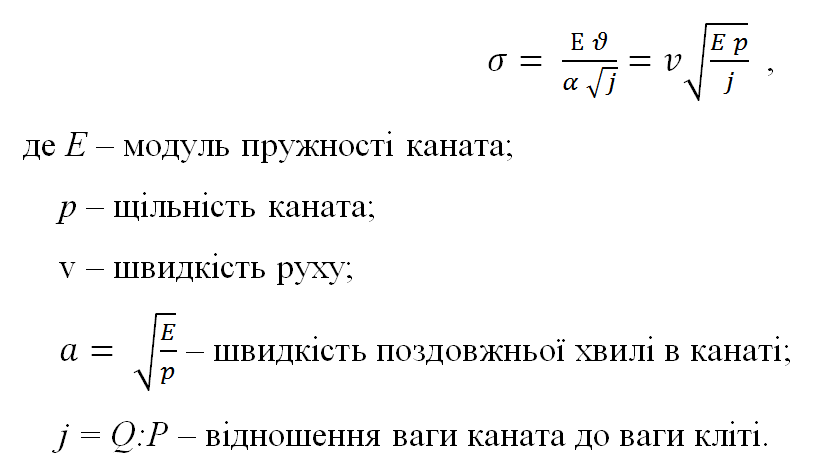
Precisely because of Academician O.M. Dynnyk’s fundamental research, the main provisions of the "Safety Rules for Mining Operations Regarding Hoisting Ropes and Methods of Their Testing" were developed, which are basic in modern Mining Safety Rules. These are:
Calculation of Safety Factor. Ropes should be selected with a safety factor coefficient (usually 𝑘 ≥ 6÷9 for people, depending on depth), considering static, dynamic loads, and bending.
Dynamic Loads. O.M. Dynnyk proposed considering inertia forces during start and braking, which is critical for calculating maximum tension.
Testing Methods. Regular (usually every 6 months) rope inspection is regulated, namely:
– visual inspection (detecting wire breaks, corrosion, diameter reduction);
– laboratory tests (checking rope samples for breaking and bending).
Safe Operation Rules:
– prohibition of operation with critical diameter reduction or increased number of broken wires;
– mandatory lubrication of the rope to prevent corrosion.
These testing methods and safety standards developed by O.M. Dynnyk ensure mining safety even today.
Thus, the main theoretical studies of hoisting ropes belong to Academician O.M. Dynnyk and his scientific school, and Oleksandr Mykolayovych himself is a universally recognized world authority.
In 1925, O.M. Dynnyk’s article "Causes of Deviation of Drilling Wells during Rotary Drilling" was published in the Mining Journal, revealing the multifaceted interests of Oleksandr Mykolayovych in "mining art" and initiating a whole direction in his further research. In this article, the author identifies the main causes of well deviation and the conditions under which the well remains vertical.
Two cases were studied:
1) the drill rod rotates so slowly that its angular velocity can be neglected (static theory);
2) rotation cannot be neglected (dynamic theory).
The author proved that to avoid well deviation, the moment twisting the drill rod by the rig must be less than critical.
The radical solution is to install the engine near the bottom so that it rotates the drill, while the rods remain stationary.
The conclusion made by O.M. Dynnyk a hundred years ago has been implemented today in downhole pneumatic hammers.
Thus, Academician O.M. Dynnyk predicted and substantiated the emergence of modern drilling technologies a century ago.
The scientist’s work coincided with the period when technical sciences were reorienting from empirical approaches to rigorous mathematically justified methods.
O.M. Dynnyk headed the elasticity theory department of the Institute of Mining Mechanics of the Academy of Sciences of the Ukrainian SSR for a long time, which largely determined the direction of his main scientific activity.
Among the scientist’s significant achievements in mining, the scientific community especially notes fundamental studies of the elasticity theory of anisotropic rock media. To solve this problem, Oleksandr Mykolayovych developed approximate methods for solving elasticity theory problems and created a scientific school in elasticity theory, which he led for 25 years.
O.M. Dynnyk formulated one of the basic laws of mining, according to which errors in assessing the stress-strain state of the rock mass can lead to accidents and collapses, threatening miners’ lives. Oleksandr Mykolayovych’s ideas aimed at understanding the mechanical behavior of rock mass under load proved strategically necessary for the development of deep mines in the Kryvyi Rih iron ore basin.
O.M. Dynnyk’s scientific worldview was shaped under the influence of classical mechanics, elasticity theory, and mathematical analysis. This determined his aspiration to create universal models of material and structural deformation. The scientist considered any material object – from a structure to a natural massif – as a mechanical system obeying general laws. In mining, this approach was revolutionary, as for a long time the rock mass was perceived as a collection of random geological bodies. Thanks to O.M. Dynnyk’s ideas, the rock mass began to be viewed as a quasi-continuous medium with its own regularities of stressed and deformed state.
Developing the theory of strength of materials and mechanics of deformable media, the scientist paid special attention to stress concentration problems near artificial mining workings of various purposes. In the mining context, these problems directly corresponded to mine shafts, drifts, crosscuts, extraction chambers, and other workings. O.M. Dynnyk showed that even holes of simple geometric shape generate zones of peak stresses several times greater than the average in the massif. For Kryvyi Rih mines, which by the mid-20th century operated at depths of 400–500 m, this knowledge became critically important.
In the practice of constructing the "Kryvorizka," "Pokrovska," "Kozatska," "Ternivska," and "Yuvileina" mines, O.M. Dynnyk’s theoretical ideas formed the basis for substantiating the parameters of preparatory workings at deep horizons. During the construction of crosscuts and drifts at horizons 840, 940, and 1040 m, considerable attention was paid to the shape of the working contour. Analytical solutions proved that rounded or arched cross-sections reduce stress concentration in the roof and sides, increasing the stability of workings under complex geomechanical conditions.
Further development of O.M. Dynnyk’s theory provided the scientific basis for analyzing the "working – support – massif" system as an integral mechanical complex. In Kryvbas, where strong quartzites neighbor weakened rocks and zones of tectonic disturbances, this allowed unifying approaches to support design. Theoretical conclusions about the interaction of system elements justified the transition from fully rigid support to combined schemes combining anchor and frame structures.
At mines in northern and central Kryvbas, deformations of workings at horizons 900–1100 m in the first months of operation were explained by stress redistribution and the transition of the contour zone from elastic to elastic-plastic state. This changed support approaches: instead of increasing rigidity, supports with controlled compliance capable of working together with the massif and dissipating stresses were used.
O.M. Dynnyk’s concepts played an important role in designing chamber mining systems common in Kryvyi Rih mines. Stability assessment of inter-chamber and inter-level pillars was based on the notion of the stressed state of a solid body with multiple cutouts, directly derived from classical elasticity theory. At the "Kozatska" and "Ternivska" mines, these approaches allowed optimizing pillar widths when moving to greater depths, reducing ore losses without lowering safety levels, while ensuring predictable operation of non-bearing zones of the massif.
Development of greater depths posed new tasks for engineers – ensuring long-term stability of complex underground connections, primarily shaft yards and other shaft chambers. These are objects concentrating loads from numerous workings and operated for decades. O.M. Dynnyk’s theoretical provisions on the stressed state of rock masses with cavity systems became the basis for analyzing such engineering structures.
At the "Kozatska" and "Yuvileina" mines at horizons 900–1000 m, it was established that traditional rigid support schemes do not always ensure expected durability. From the perspective of continuum mechanics, this was explained by overlapping zones of stress concentration arising around shafts, shaft chambers, crosscuts, and drifts. Application of analytical models allowed engineers to justify changes in working geometry – increasing rounding radii, spacing workings in space, and phased inclusion of support in operation, significantly reducing local stress levels.
Equally important was the practical impact of O.M. Dynnyk’s ideas on shaft design. A vertical shaft is an elongated circular cavity in a stressed massif, and its stability is determined by a combination of mining pressure, rock strength, and support parameters. Solutions to elasticity problems developed in the classical mechanics school were directly used in shaft calculations at the "Ternivska" and "Kryvorizka" mines. Particular difficulties arose when shafts passed through tectonic disturbance zones, where rock properties are heterogeneous and stresses are distributed asymmetrically. O.M. Dynnyk’s views on analyzing heterogeneous media allowed not only qualitative description but also quantitative assessment of transitional zones of increased stresses and timely adjustment of support design and reinforcement schemes.
Special attention deserves the application of O.M. Dynnyk’s mechanical concepts for analyzing the stability of ventilation and transport workings running parallel to extraction blocks. At the "Pokrovska" and "Kozatska" mines, it was repeatedly noted that after extraction of blocks, the stressed state in drifts changes, sometimes causing gradual deformations that cannot be explained solely by rock strength. From the perspective of elasticity theory and continuum mechanics, this phenomenon was considered a natural result of stress redistribution due to increased volume of underground cavities. This approach allowed transitioning from reactive repair to proactive reinforcement of support and local rerouting of workings in areas with predicted increased risks.
Further integration of O.M. Dynnyk’s ideas into design solutions manifested in the analysis of dynamic effects of mining pressure. With increasing mining depth, manifestations of sudden collapses and mining shocks in Kryvbas became more frequent. Although O.M. Dynnyk worked within classical elasticity theory, his concepts of deformation accumulation and reaching the massif’s limit state became the methodological basis for further research on dynamic phenomena. At the "Yuvileina" and "Ternivska" mines, this formed the basis for massif unloading measures – changing the order of extraction works, location of chambers, and arrangement of unloading workings, reducing stress concentration in the most dangerous areas.
The practice of applying chamber mining systems in Kryvyi Rih basin once again confirmed the relevance of O.M. Dynnyk’s provisions on the stressed state of bodies with multiple cavities. At horizons 800–1100 m, pillar width calculations began to consider not only static strength parameters but also long-term mining pressure effects, accounting for plastic deformation accumulation. The continuum mechanics provisions developed based on O.M. Dynnyk’s ideas explained the gradual decrease in pillar bearing capacity as a predictable evolution of the stress-strain state of rocks. This allowed engineers to make balanced decisions on optimal chamber and pillar width ratios, minimizing ore losses without compromising geomechanical safety.
Development of underground workings at horizons 1135, 1200 m and deeper finally confirmed the correctness of approaches laid out in Oleksandr Mykolayovych Dynnyk’s works. At these depths, it became clear that the rock mass is not a passive medium simply accepting external loads from support but an active and equal element of the "massif – working – support" system. This provision, running as a red thread through O.M. Dynnyk’s scientific mining legacy, manifested in the need to consider system element interactions at the design stage.
Great importance for practice was given to O.M. Dynnyk’s provisions on the influence of boundary conditions on the stressed state of the medium. In real Kryvbas conditions, boundary conditions were not only the contours of specific workings but also adjacent mined-out chambers and the sequence of extraction works. At the "Kozatska" mine, when forming a chamber system at horizon 1040 m, it was found that changing the extraction order significantly affects the behavior of inter-chamber pillars and deformation development in adjacent workings. This fully agrees with the principle of superposition of stress states, a key provision of continuum mechanics developed by Oleksandr Mykolayovych.
Applying these provisions in practice allowed optimizing the sequence of extraction works – first extracting chambers located in zones of highest possible stress, which contributed to massif unloading and reduced the risk of sudden collapses in subsequent blocks. This reduced accidents, stabilized pillar operation, and significantly extended the service life of workings.
Equally illustrative, from the perspective of implementing O.M. Dynnyk’s theoretical provisions, are examples of applying his ideas to analyze the operation of inclined and vertical workings – shafts and blind hoists. In central Kryvbas, where rocks are characterized by significant fracturing, heterogeneity, and anisotropy of mechanical properties, traditional calculation schemes often gave contradictory results. Generalizing production observations combined with analytical models based on mechanics of elastic and elastic-plastic media allowed fairly accurate prediction of support deformations in shafts and choosing rational reinforcement solutions.
O.M. Dynnyk’s ideas gained particular importance in forming modern approaches to monitoring the stress-strain state of the massif. Although instrumental capabilities were limited during the scientist’s lifetime, his theoretical conclusions created the methodological basis for developing modern geomechanical control systems. At deep horizons of Kryvbas mines, methods for observing deformations of working contours, convergence of side surfaces, roof subsidence, and stress measurements in support are actively used today. The obtained data are interpreted within the concept of stress-strain state evolution, continuing O.M. Dynnyk’s scientific school.
In a broader scientific context, Oleksandr Mykolayovych’s legacy went far beyond individual engineering solutions. His works formed a new culture of technical thinking, within which each working is considered not as an isolated object but as part of a complex geomechanical system. The behavior of this system is determined by mechanics laws, and changing one element inevitably causes a reaction of the entire structure. This view allowed Kryvbas engineers to effectively master great depths, which a few decades ago were considered the limits for underground mining.
In summary, it can be stated that Oleksandr Mykolayovych Dynnyk’s contribution to the development of continuum mechanics and elasticity theory became the foundation of modern geomechanics of underground structures. His ideas, transformed and supplemented by the experience of several generations of practicing engineers, are comprehensively embodied in the design, construction, and operation of underground workings in Ukrainian mines. The combination of rigorous theoretical principles and their practical testing on complex mining-geological objects made mining operations at super-deep horizons safe and efficient. This is the best confirmation of the relevance and vitality of Oleksandr Mykolayovych Dynnyk’s scientific heritage and its significance for modern engineering practice."
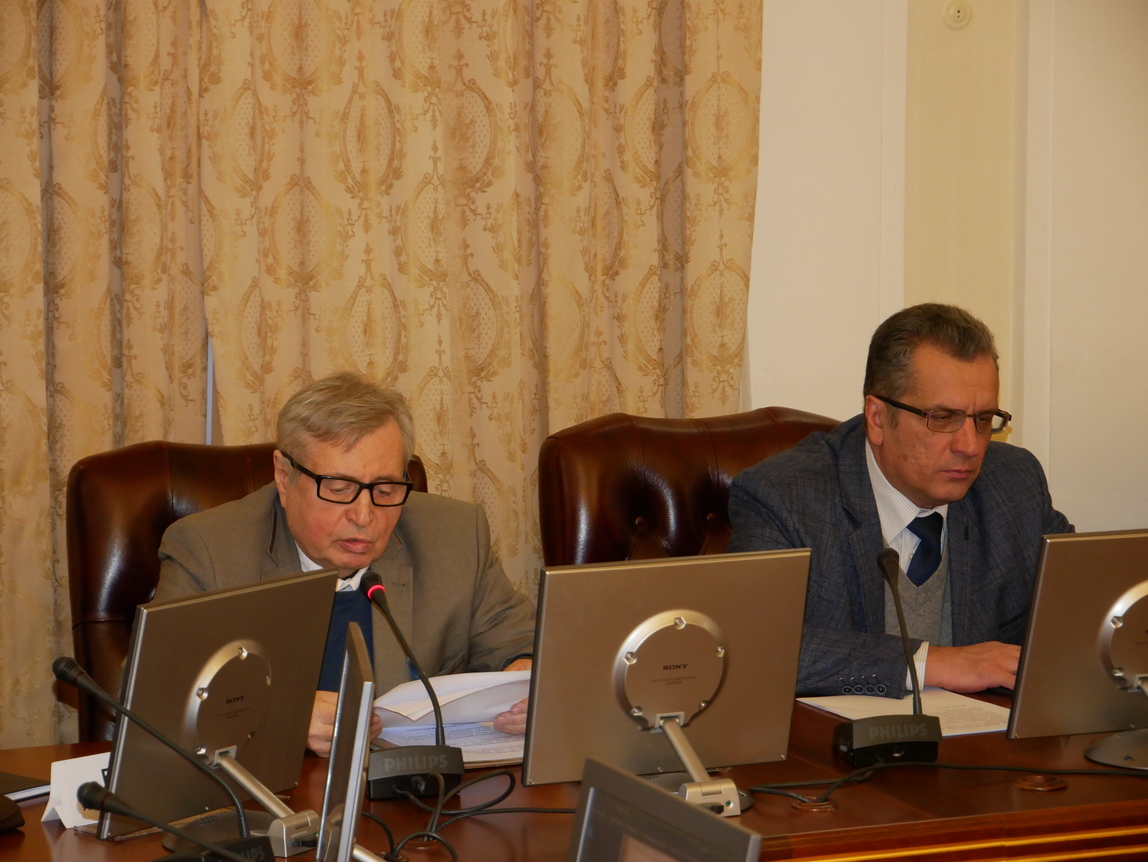
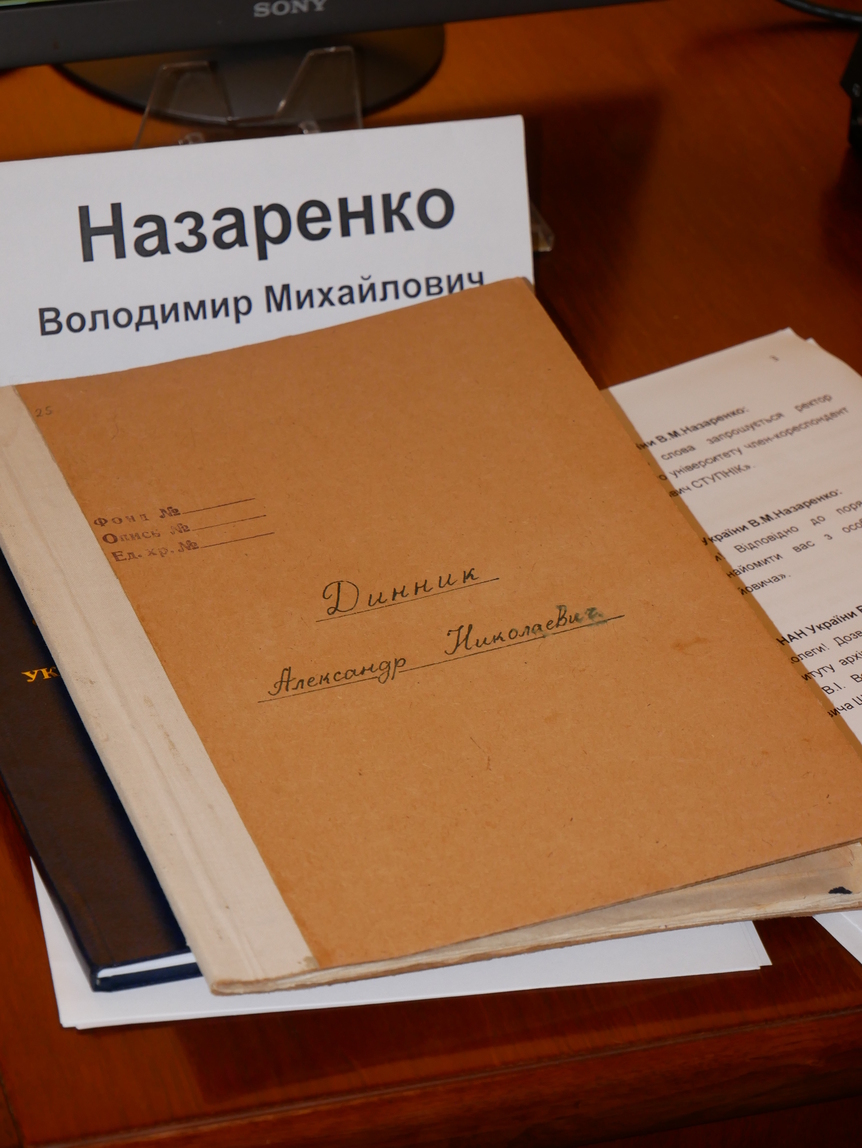
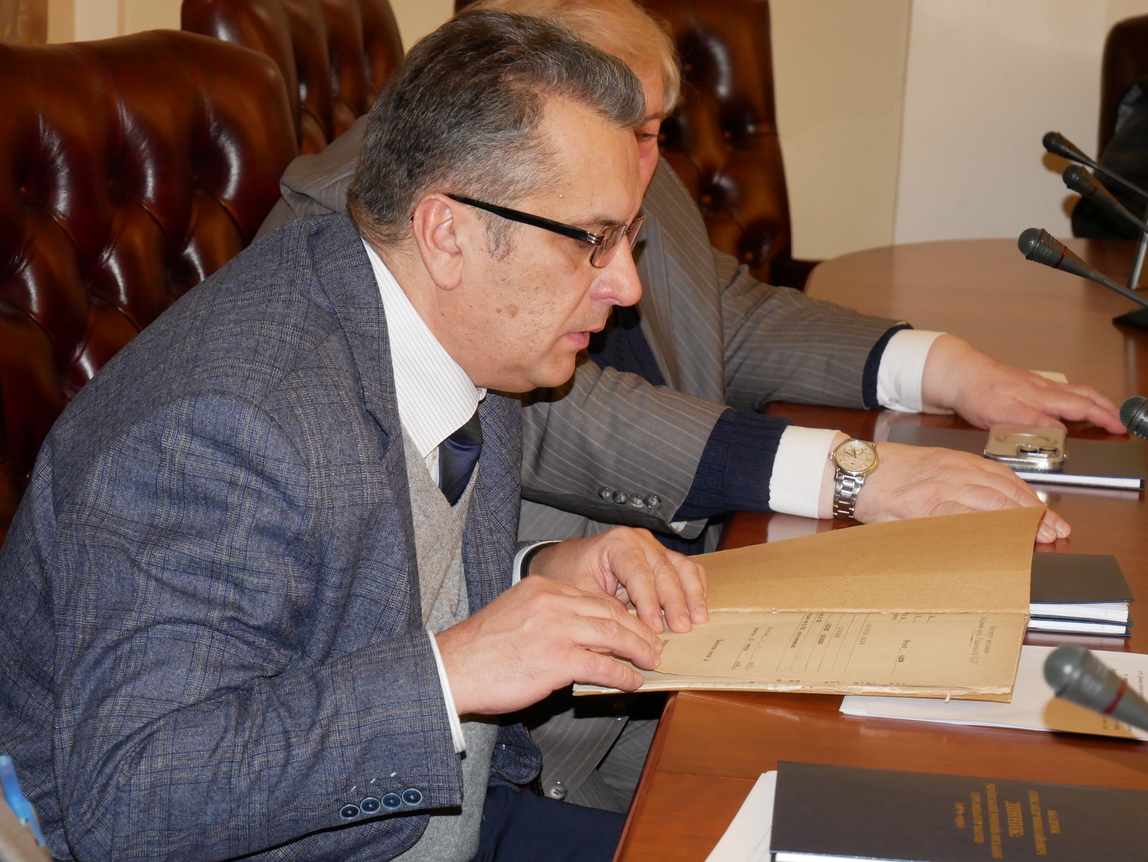
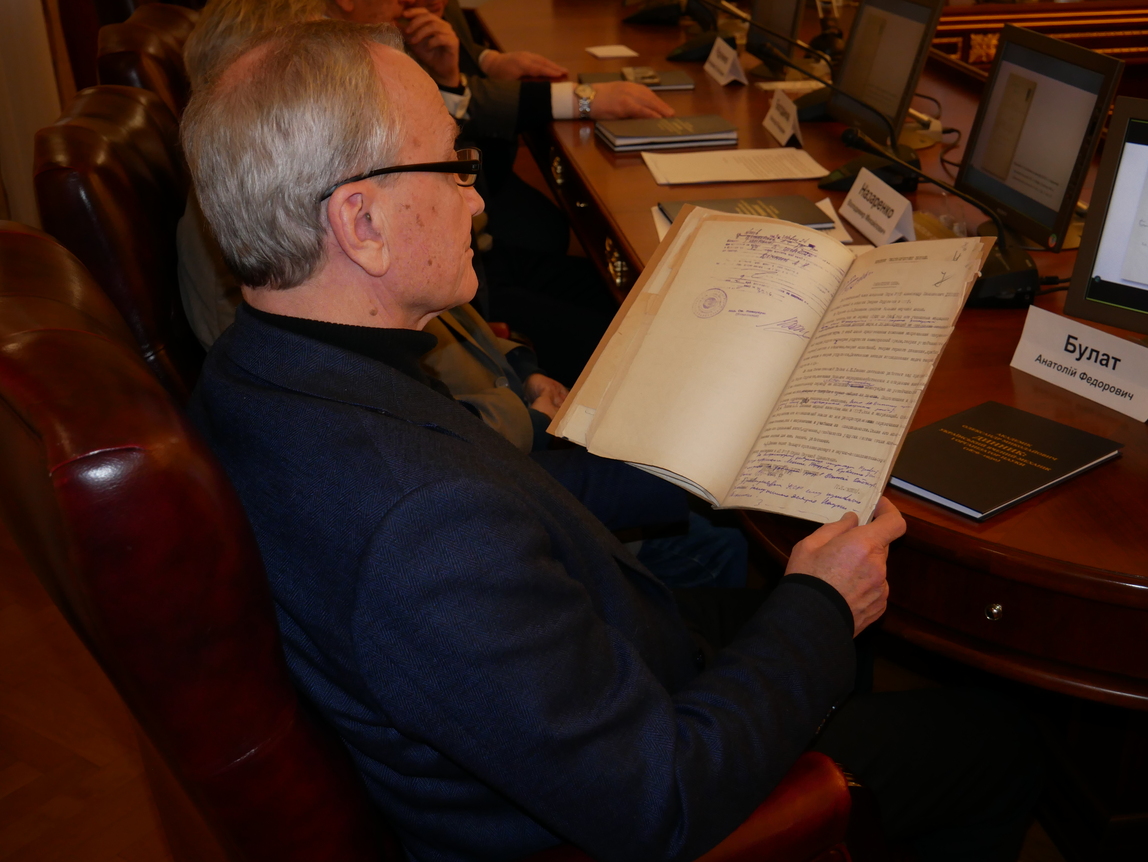
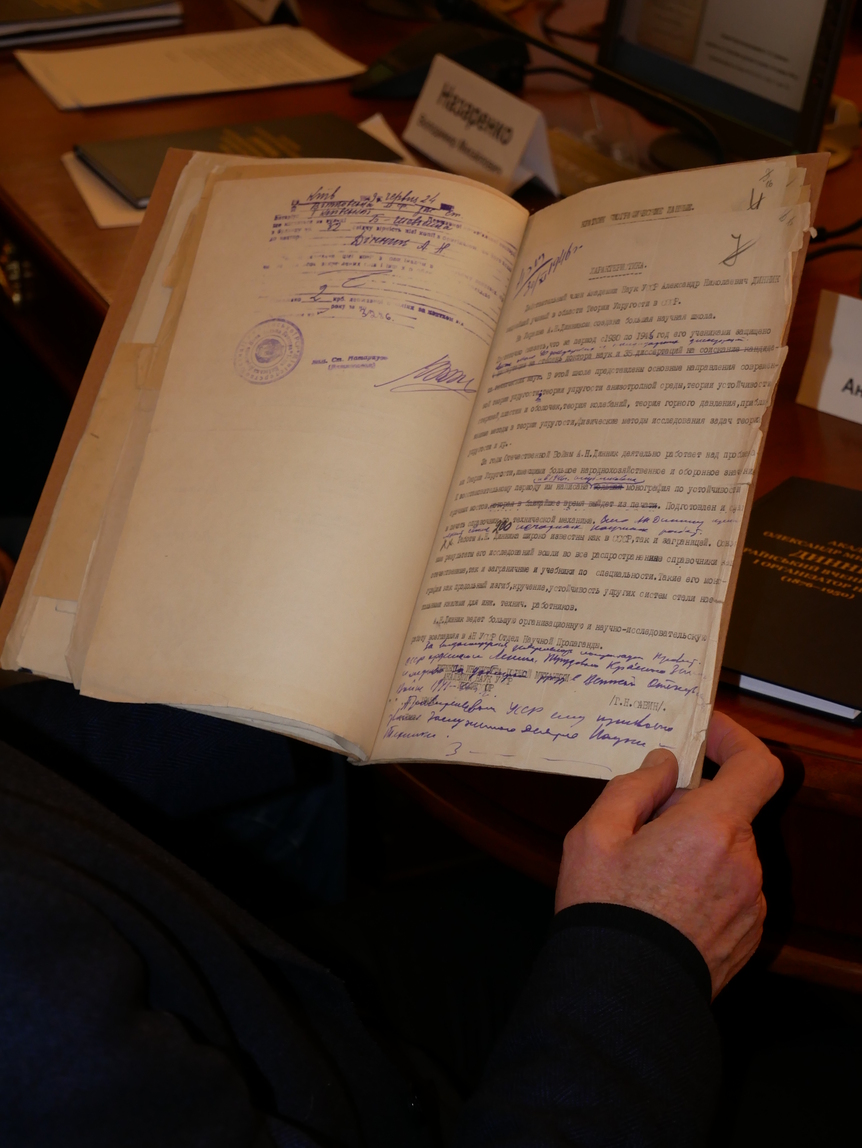
Next, Academician Volodymyr Nazarenko familiarized the meeting participants with the personal file of Academician Oleksandr Dynnyk, revealing one aspect of this scientist’s activity – his cooperation with the S.P. Timoshenko Institute of Mechanics of the NAS of Ukraine, which at that time was called the Institute of Structural Mechanics:
"Unfortunately, Oleksandr Mykolayovych worked at the Institute of Mechanics for a very short time – only the last two years of his life when he was already seriously ill. He headed the elasticity theory department of the Institute. Before that, he participated in the Institute’s life as a member of the academic council of the Institute of Structural Mechanics, and later as a member of the expanded academic council with the right to defend doctoral dissertations.
But O.M. Dynnyk’s influence on the further development of the Institute and the formation of new scientific directions turned out to be unexpectedly very significant – through his students, primarily Academician Huri Mykolayovych Savin, whose 120th anniversary we will celebrate next year, and then through a whole generation of Huri Mykolayovych’s students, especially the prominent scientist and long-time director of the Institute Academician Oleksandr Mykolayovych Huz.
In my opinion, Oleksandr Mykolayovych Dynnyk’s figure in terms of scientific achievements and as a science organizer is comparable to the founder and first director of the Institute of Mechanics – Academician Stepan Prokopovych Timoshenko. But unlike Stepan Prokopovych, he is, to use modern slang, less "promoted," so I think it is not superfluous to continue popularizing this outstanding scientist-mechanic and his scientific achievements – as the new bibliographic reference does.
In the National Academy of Sciences of Ukraine, the O.M. Dynnyk Prize was established, including at the initiative of Academician H.M. Savin, the first laureate of which was precisely Huri Mykolayovych. Time passed, and the first issue of the international journal "Applied Mechanics" this year (already prepared for printing) is dedicated precisely to Oleksandr Mykolayovych Dynnyk – the issue contains an article about him and articles by laureates of the O.M. Dynnyk Prize of various years. Such a journal issue, where new articles exclusively by laureates of one prize (as authors or co-authors) are collected, as far as I know, has no analogues.
O.M. Dynnyk’s personal file remains at the Institute of Mechanics (started in July 1948, ended in September 1950) – with the note "to be kept permanently." The file itself and the documents in it are, unfortunately, mostly in Russian, which was customary at that time.
There are documents filled out by O.M. Dynnyk by hand (with an ink pen) or typed on a typewriter – for young people, this is an unusual touch of those distant times. From the "Personal Record Sheet," it is very surprising to learn that a scientist of such rank, holding a high position in the Academy of Sciences, was non-partisan (and this was during Stalin’s times). O.M. Dynnyk identified himself as Ukrainian. The unusual name of his birthplace is "Stavropol-Kavkazsky": this was the name of Stavropol until 1935. Everything is very concise: work information – only four entries. Participation in elective bodies. Knowledge of French, English, German. Awards. Home address with a five-digit phone number.
Let us touch those times and just look through the personal file documents.
List of printed works (after the October Revolution – today it is like after gaining Independence). Confirmation of the scientific degree of Doctor of Technical Sciences (in Ukrainian!). A copy of the assignment of O.M. Dynnyk’s business trip to Dnipro (in Ukrainian).
Document on the nomination of O.M. Dynnyk for the Stalin Prize. Copy of the Doctor of Sciences diploma. Nomination as a full member of the USSR Academy of Sciences in the specialty "Theory of Elasticity." Copy of the Resolution on election as a full member of the USSR Academy of Sciences. Characteristic. Brief biographical information. Researcher card. Extract from the order on transfer to the position of head of the elasticity theory department of the Institute of Structural Mechanics. Certificate of work at the Dnipropetrovsk Mining Institute. Characteristic.
And an obituary…
The S.P. Timoshenko Institute of Mechanics of the NAS of Ukraine already has almost a 110-year history, and many outstanding scientists-mechanics have worked there over the years. But not so many memorial plaques have been installed in their memory. I believe that Oleksandr Mykolayovych Dynnyk’s figure deserves this, and the institute will make efforts to honor O.M. Dynnyk with a memorial plaque on its facade."
VIEW ACADEMICIAN OLEKSANDR DYNNYK’S PERSONAL FILE
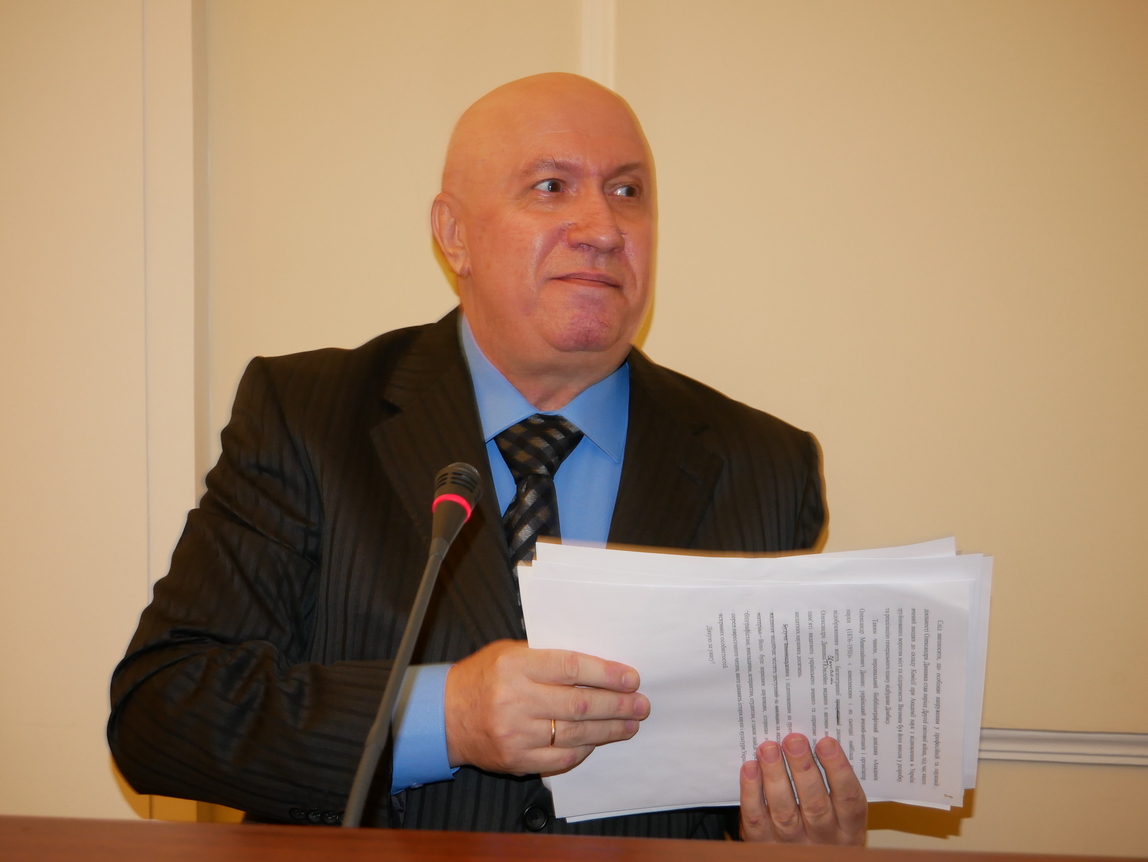
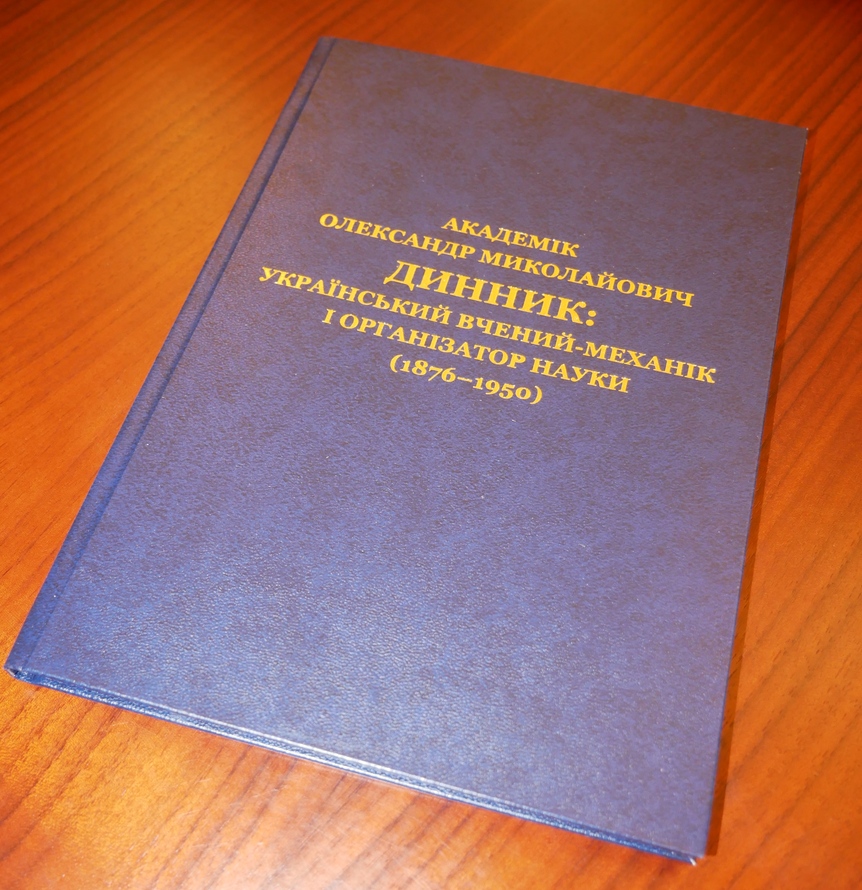
Next, Acting Director of the Institute of Archival Studies of the V.I. Vernadsky National Library of Ukraine, Doctor of Historical Sciences Andriy Shapoval presented the biobibliographic reference book "Academician Oleksandr Mykolayovych Dynnyk: Ukrainian Scientist-Mechanic and Science Organizer (1876–1950)".
"The personal biobibliographic reference book 'Academician Oleksandr Mykolayovych Dynnyk: Ukrainian Scientist-Mechanic and Science Organizer (1876–1950)' was prepared under the auspices of the National Academy of Sciences of Ukraine, the V.I. Vernadsky National Library of Ukraine, and the National Committee of Ukraine on Theoretical and Applied Mechanics," noted the speaker. "The preparation of the jubilee edition was initiated by Academician of the NAS of Ukraine Vyacheslav Leonidovych Bohdanov, who also acted as the responsible editor and co-author of the reference book. The author team included employees of the V.I. Vernadsky National Library of Ukraine, in particular the head of the Institute of Archival Studies, Doctor of Historical Sciences Andriy Ivanovych Shapoval, scientific staff of the Library Pavlo Mykhailovych Shtykh and Nataliya Mykolaivna Noskina, and the director of the State Archive of Kyiv, Candidate of Historical Sciences Ivan Mykolayovych Kisil.
The authors aimed to identify and process as broad and complete a range of archival, bibliographic, epistolary, memoir, and electronic sources about Oleksandr Dynnyk’s life, activities, and scientific creativity. To reconstruct the scientist’s life path based on their analysis, determine the role and significance of his scientific work, reveal the multifaceted activities of the scientist, and maximally outline and present to the scientific community the circle of Ukrainian and foreign scientists with whom Oleksandr Dynnyk cooperated scientifically and maintained professional and friendly relations. Also, to introduce previously unknown documents into scientific and socio-cultural circulation, clarify and supplement the bibliography and personality of O.M. Dynnyk.
Oleksandr Dynnyk’s figure and his creative scientific heritage have always aroused great interest among researchers of the scientist’s biography and historians of science. Particularly useful for preparing the jubilee reference book were the works of O.M. Dynnyk’s students and followers, namely Valentyna Volodymyrivna Heorhiievska, Nadiya Petrivna Hryshkova, Oleksandr Mykolayovych Huz, Vsevolod Arutyunovich Lazaryan, Oleksandr Mykhailovych Penkov, Tetiana Vasylivna Putyata, Huri Mykolayovych Savin, and others, whose studies paid great attention to illuminating the scientist’s life and analyzing his scientific work.
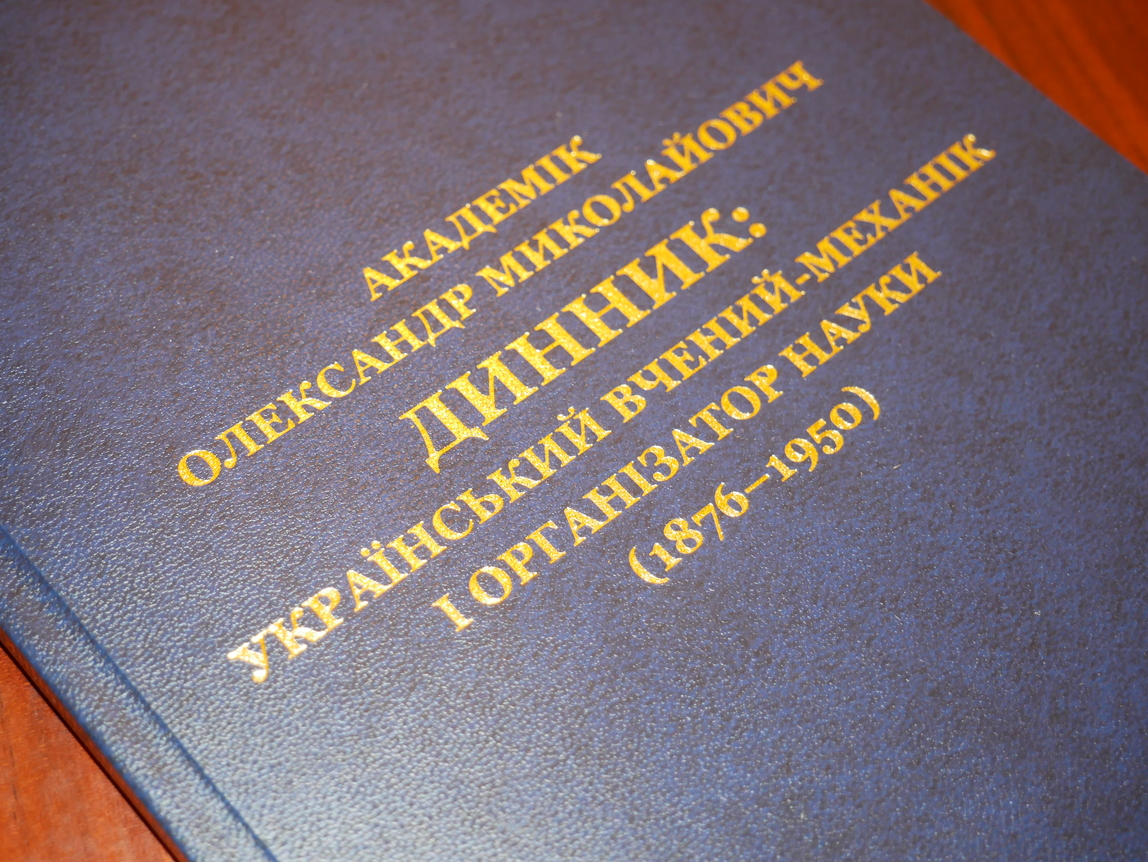
The personal biobibliographic reference book dedicated to Academician O.M. Dynnyk contains a title page, contents, and an extended annotation in Ukrainian and English.
Structurally, the reference book consists of an introduction and the following seven sections:
Section 1. Outline of O.M. Dynnyk’s Life and Activities. Honoring His Memory.
Section 2. Key Dates of O.M. Dynnyk’s Life and Activities.
Section 3. Laureates of the O.M. Dynnyk Prize.
Section 4. Little-Known Works of O.M. Dynnyk.
Section 5. Bibliography of O.M. Dynnyk’s Works.
Section 6. Archival Sources and Literature on O.M. Dynnyk’s Life and Activities.
Section 7. Archival Photodocuments, Digital Copies.
The guarantee of a truthful reflection of Oleksandr Mykolayovych Dynnyk’s life and creative path was the large range of sources presented in Section 6 "Archival Sources and Literature on O.M. Dynnyk’s Life and Activities," which contains 94 items.
It is worth emphasizing that for the first time during the preparation of the publication about Oleksandr Mykolayovych Dynnyk, such a wide array of archival documents was used, a significant part of which was also introduced for the first time into scientific and socio-cultural circulation. The set of archival sources included biographical documents and documents on the scientist’s professional activities contained in Oleksandr Dynnyk’s personal files, preserved in the Archive of the Presidium of the National Academy of Sciences of Ukraine and the Archive of the S.P. Timoshenko Institute of Mechanics of the NAS of Ukraine.
Significant for the publication were documents about Oleksandr Dynnyk’s education and the first years of his professional, scientific, and pedagogical activities, preserved in the State Archive of Kyiv. These include the case on awarding and issuing the M.I. Pirogov Prize to student Oleksandr Dynnyk of Kyiv University of St. Vladimir, fund No. 16 "Kyiv University of St. Vladimir," as well as the case on the service of junior laboratory assistant at the physics department of Kyiv Polytechnic Institute of Oleksandr Mykolayovych Dynnyk for 1899–1912, fund No. 18 "Kyiv Polytechnic Institute." This latter case contains valuable documents such as:
- the first known autobiography of Oleksandr Dynnyk dated July 24, 1899;
- the diploma of graduation from St. Vladimir University in Kyiv dated June 18, 1899;
- the petition of Professor Heorhiy Heorhiyovych De-Metz for appointing O.M. Dynnyk senior laboratory assistant of the physics department of KPI dated December 10, 1900;
- the certificate awarding O.M. Dynnyk the Order of St. Stanislaus, third class, dated June 30, 1906;
- the statement of the dean of the mechanical department of KPI Oleksandr Oleksandrovych Radtsig proposing O.M. Dynnyk, according to the report of Professor Stepan Prokopovych Timoshenko, to start work in the laboratory of the strength of materials department of KPI dated November 2, 1907;
- the notification of Oleksandr Mykolayovych’s appointment as lecturer in strength of materials and mechanics at KPI dated January 15, 1910;
- the form list of O.M. Dynnyk as lecturer in strength of materials and mechanics at KPI, etc.
The files also contain documents with information about the scientist’s private and family life. For example, there is a request submitted by laboratory assistant Oleksandr Dynnyk to the rector of KPI Viktor Lvovych Kirpichov for permission to enter into a lawful marriage with Miss Yuliia Fiber dated April 20, 1901.
Important for preparing the publication were documents preserved at the Institute of Archival Studies of the V.I. Vernadsky National Library of Ukraine, where the personal fund of Academician Oleksandr Mykolayovych Dynnyk No. 85 was formed and scientifically described, presenting the scientist’s publications, list of printed works, research about the scientist, and photodocuments.
Incidentally, the Institute of Archival Studies, which functions as the main archival unit in the system of institutions of the National Academy of Sciences of Ukraine and where the scientific archival heritage of outstanding Ukrainian scientists is preserved, as of January 1, 2026, has formed 498 archival funds and collections, including 478 personal funds of leading Ukrainian scientists.
The Institute of Archival Studies also preserves personal funds of prominent Ukrainian scientists-mechanics. For example, besides the already mentioned personal archive of Oleksandr Dynnyk, the institute holds funds of such notable mechanics as Fedir Pavlovych Belyankin, Mykola Oleksandrovych Kilchevskyi, Anatoliy Dmytrovych Kovalenko, Serhiy Mykhailovych Kozhevnikov, Viktor Olimpianovych Kononenko, Mykola Vasylovych Kornoukhov, Oleksandr Serhiyovych Kosmodamiansky, Panteleimon Stepanovych Kucherov, Anatoliy Oleksiyovych Lebedev, Heorhiy Stepanovych Pysarenko, Yaroslav Stepanovych Pidstryhach, Huri Mykolayovych Savin, Serhiy Volodymyrovych Serensen, Mykhailo Mykhailovych Fedorov, and others.
During the preparation of the reference book dedicated to Oleksandr Dynnyk, documents from several personal archives of leading Ukrainian scientists preserved at the Institute of Archival Studies were used. In particular, photodocuments depicting Oleksandr Dynnyk from the funds of Academicians Oleksandr Oleksandrovych Bohomolets, Mykola Vasylovych Kornoukhov, Volodymyr Borysovych Porfiriev. Special attention was paid to analyzing Oleksandr Dynnyk’s epistolary heritage preserved in the personal archives of Academicians Oleksandr Vasylovych Fomin, Huri Mykolayovych Savin, and Mykhailo Mykhailovych Fedorov.
For example, much important information and interesting facts are contained in correspondence between Oleksandr Dynnyk and the scientist specializing in mining mechanics, Academician Mykhailo Fedorov, in the 1920s–1930s. The scientists maintained professional and friendly relations since the 1910s when both worked at the Katerynoslav Mining Institute. From the context of these letters, it can be learned that Oleksandr Dynnyk maintained contacts and corresponded with Stepan Prokopovych Timoshenko, who, while in emigration, sent his scientific works published abroad to Dnipropetrovsk, which were of interest to many Ukrainian scientists, including Mykhailo Fedorov.
As the letters show, after being elected a full member of the All-Ukrainian Academy of Sciences in 1929, Oleksandr Dynnyk intended to fully focus on scientific work, planning to move from Dnipropetrovsk to Kyiv in the early 1930s. He was supported in this by Mykhailo Fedorov, who highly appreciated Oleksandr Mykolayovych’s scientific and organizational abilities. After the death of the head of the Institute of Structural Mechanics of the VUAN (now the S.P. Timoshenko Institute of Mechanics of the NAS of Ukraine), Academician Kostiantyn Kostiantynovych Siminsky in 1932, Mykhailo Fedorov recommended the VUAN leadership to offer the director’s position to Dynnyk. However, for certain reasons, including Oleksandr Mykolayovych’s illness and the lack of official housing in Kyiv at that time, these plans were not realized, so Dynnyk permanently lived and worked in Kyiv from 1944.
The most interesting archival documents concerning Oleksandr Dynnyk are presented in the seventh section of the reference book "Archival Photodocuments, Digital Copies," which allowed illustrating the scientist’s life and creative path and enriching and decorating the jubilee edition.
A novelty in preparing the reference book about Oleksandr Dynnyk was the use of the scientist’s popular science and journalistic memoir works as sources for the publication. Employees of the V.I. Vernadsky National Library of Ukraine performed painstaking search work to find articles by Oleksandr Dynnyk in periodicals that had not been included in any bibliography of the scientist’s works before. These include, in particular, such investigations by O.M. Dynnyk published in Dnipropetrovsk periodicals as: "Foreign Journals Needed by the Central Library," "Is the Department of Strength of Materials Ready for the Year Start," "On Printing Mechanics Courses," "From the History of the Mechanical Laboratory," and others.
I want to cite a small excerpt from Oleksandr Mykolayovych’s work "From the History of the Mechanical Laboratory," which vividly illustrates the difficult conditions in which Ukrainian scientists had to work in the 1920s and resonates with our difficult present. The scientist wrote, among other things: "I recall the working conditions. The laboratory is unheated, the room is about 10 degrees below zero, we are testing ropes. In the neighboring room lives the watchman, where the stove is heated. We work in turns for 10–15 minutes, then also in turns go to this room, take off our boots, warm our feet, and warm ourselves by the hot stove." As is known, O.M. Dynnyk was one of the first to study the dynamics of mine hoisting ropes, and the laboratory under Oleksandr Mykolayovych’s leadership, first at the Dnipropetrovsk Mining Institute and later at the Dnipropetrovsk Metallurgical Institute, became a powerful center of scientific research and experimental work performed for enterprises in Dnipropetrovsk, Zaporizhzhia, Kryvyi Rih, Kharkiv, Donbas, and other industrial regions.
The discovered publications of Oleksandr Dynnyk contributed to creating the fourth section of the jubilee edition "Little-Known Works of O.M. Dynnyk," which presents the scientist’s popular science and memoir investigations published in the "News of the All-Ukrainian Academy of Sciences," the all-union journal "For Industrial Personnel," and Dnipropetrovsk periodicals.
The results of the search for Oleksandr Dynnyk’s publications allowed clarifying and significantly expanding the "Bibliography of O.M. Dynnyk’s Works," included in the fifth section of the personal biobibliographic reference book. Currently, the bibliography of Oleksandr Mykolayovych Dynnyk’s works includes 241 items.
The large and diverse set of archival and bibliographic sources made it possible to prepare a thorough outline of Oleksandr Dynnyk’s life and activities, clarify and specify the main stages and dates of his life and creative path.
In particular, the publication comprehensively reflects O.M. Dynnyk’s active scientific and organizational activities within the Ukrainian Academy of Sciences. The documentary basis for reconstructing O.M. Dynnyk’s academic activities included identified and archaeographically processed documents incorporated into collections of documents and materials on the history of the NAS of Ukraine, prepared by the Institute of Archival Studies of the V.I. Vernadsky National Library of Ukraine.
The reference book highlights Oleksandr Mykolayovych’s effective work as head of the Department of Technical Sciences, the Department of Physical-Chemical and Mathematical Sciences, as a member of the Academy Presidium; reveals his productive work in such Academy research institutions as the Institute of Mining Mechanics, the Institute of Ferrous Metallurgy, and the Institute of Structural Mechanics.
It should be emphasized that the period of World War II was especially intense in O.M. Dynnyk’s professional and scientific activities, during which the scientist was a member of the Commission at the Academy of Sciences for the restoration of cities and enterprises destroyed by the enemy in Ukraine. His contribution to developing and implementing the general plan for the reconstruction of Donbas was significant.
Thus, the personal biobibliographic reference book "Academician Oleksandr Mykolayovych Dynnyk: Ukrainian Scientist-Mechanic and Science Organizer (1876–1950)" is a comprehensive and currently the most complete reflection of Oleksandr Dynnyk’s life, multifaceted activities, and creativity. We believe that the jubilee edition is a significant contribution to honoring the memory of the outstanding Ukrainian scientist and will promote the popularization of his outstanding scientific achievements."
VIEW BIOBIBLIOGRAPHIC REFERENCE BOOK
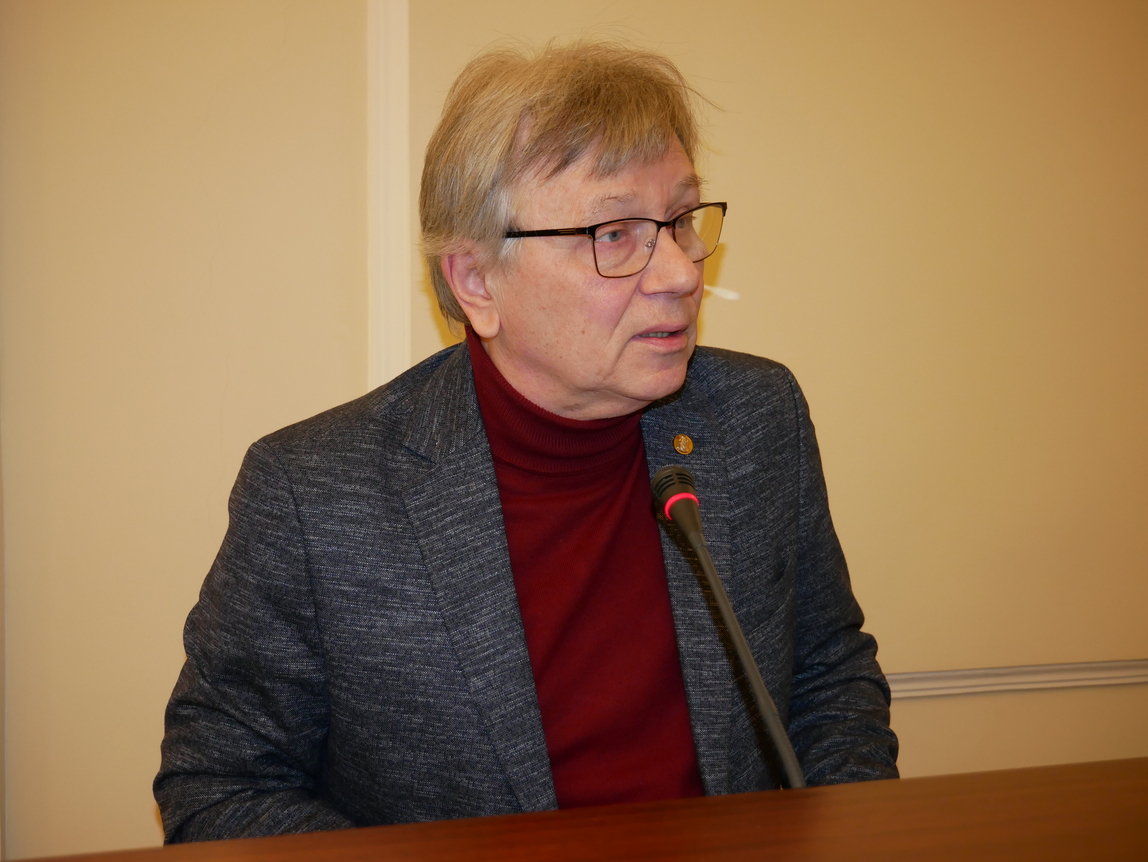
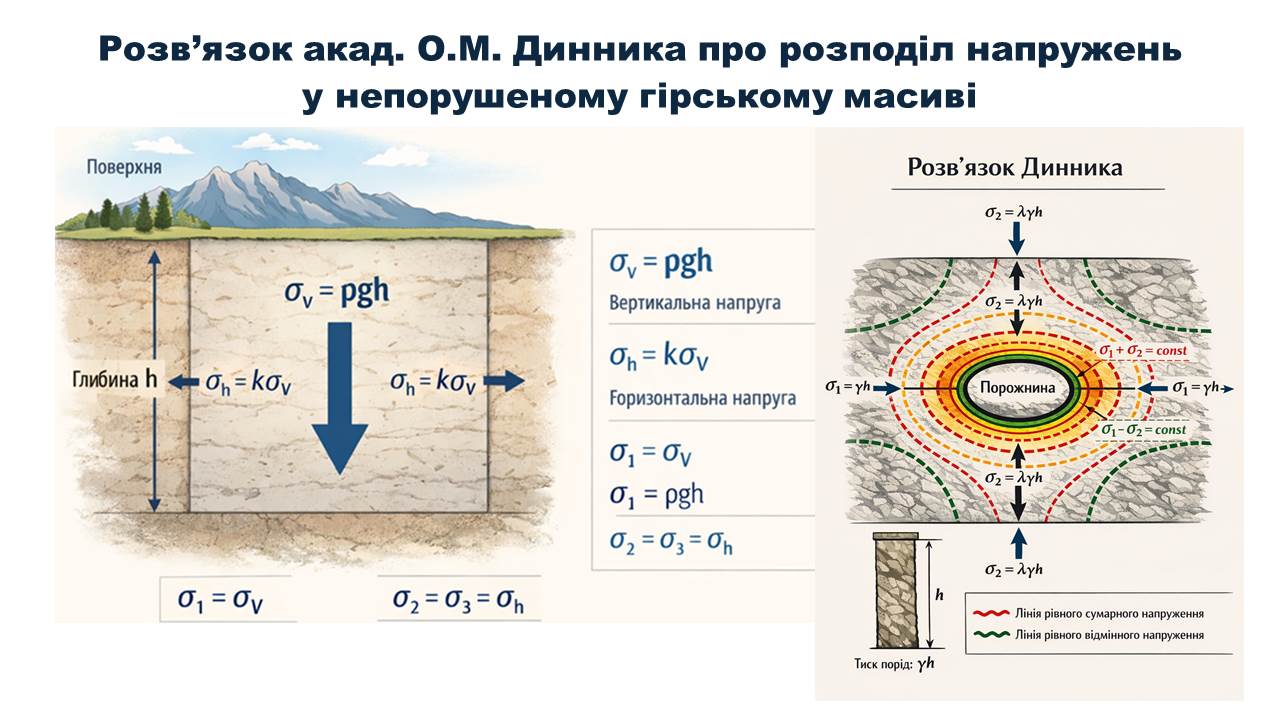
Deputy Academician-Secretary of the Department of Mechanics and Machine Science of the NAS of Ukraine, Director of the H.S. Pysarenko Institute of Strength Problems of the NAS of Ukraine, Corresponding Member of the NAS of Ukraine Oleksandr Chyrkov focused in his speech on one of the fundamental problems of geomechanics, the solution of which was proposed by Academician Oleksandr Dynnyk:
"This problem concerns determining the distribution of stresses and strains in an undisturbed rock massif. Its solution deserves special attention as it is widely used for analyzing an important class of scientific and applied problems in mining mechanics. In particular, it is used for mathematical modeling of stress, strain, and displacement fields around underground mine workings, support elements, and their interaction with the rock massif, as well as metro tunnels and other underground structures.
Thus, the first assumption adopted by O.M. Dynnyk in his proposed solution is the use of an elastic isotropic continuum model to determine the stress-strain state of an undisturbed rock massif. From a mathematical point of view, the rock massif in Dynnyk’s solution is modeled as a heavy semi-infinite space under volumetric compression. Each elementary volume of the medium is subjected to a mass volumetric force, the density of which is determined by the specific weight and depth of the overlying rock layers.
The next significant assumption in Dynnyk’s solution is that transverse deformations of the elementary volume of the undisturbed rock massif are absent, i.e., considered zero. This hypothesis follows from physical considerations since the elementary volumes of the undisturbed massif are in the same stress-strain state.
Based on these assumptions, Dynnyk obtained a solution in which the vertical compressive stress corresponds to the pressure of the rock layers at a given depth from the surface, and the transverse compressive stresses are determined using the so-called lateral pressure coefficient. This coefficient is usually called the lateral pressure coefficient according to Dynnyk’s solution. Thus, the transverse compressive stresses in Dynnyk’s solution are less than the vertical pressure, and the value of the lateral pressure coefficient depends on the Poisson’s ratio of the rock and ranges from 0.2 to 0.4. Therefore, Dynnyk’s solution indicates that the elementary volume of the undisturbed rock massif is under conditions of heterogeneous volumetric compression.
In further generalizations of Dynnyk’s solution, the influence of temperature on the stress-strain state of the undisturbed rock massif is taken into account. For deep mining workings, this factor is significant since the massif temperature increases with depth, leading to additional thermal stresses. Under modern conditions of workings located at depths of 1000–1500 m and more, the thermal contribution becomes substantial and must be considered within thermomechanical analysis. Accounting for the temperature factor causes an increase in vertical pressure and the lateral pressure coefficient in the rock massif.
Thus, Dynnyk’s solution for stress distribution in the undisturbed rock massif is a fundamental element of mathematical modeling of mining geomechanics problems. It provides the theoretical basis for analyzing the stress-strain state near mine workings, assessing their stability, and reasonably choosing methods for controlling rock pressure and support. Mathematically rigorous and physically justified within continuum mechanics, this solution remains the foundation for modern analytical and approximate methods of geomechanical problem research."
"We have heard many warm words and memories about Academician Oleksandr Mykolayovych Dynnyk, once again convinced that the extraordinary abilities of a science organizer, the foresight of a scientist and educator will forever keep his name in human memory and serve as an example of devoted service to science, the state, and society," summed up Academician-Secretary of the Department of Mechanics and Machine Science of the NAS of Ukraine, Acting Director of the S.P. Timoshenko Institute of Mechanics of the NAS of Ukraine, Academician Volodymyr Nazarenko, and at the end of the jubilee meeting thanked the speakers for their interesting presentations, the participants for their attention to the meeting, and wished everyone peace, happiness, good health, and creative success.
According to information from the Department of Mechanics and Machine Science of the NAS of Ukraine,
S.P. Timoshenko Institute of Mechanics of the NAS of Ukraine,
V.I. Vernadsky National Library of Ukraine
and H.S. Pysarenko Institute of Strength Problems of the NAS of Ukraine
Photo: Press Service of the NAS of Ukraine