


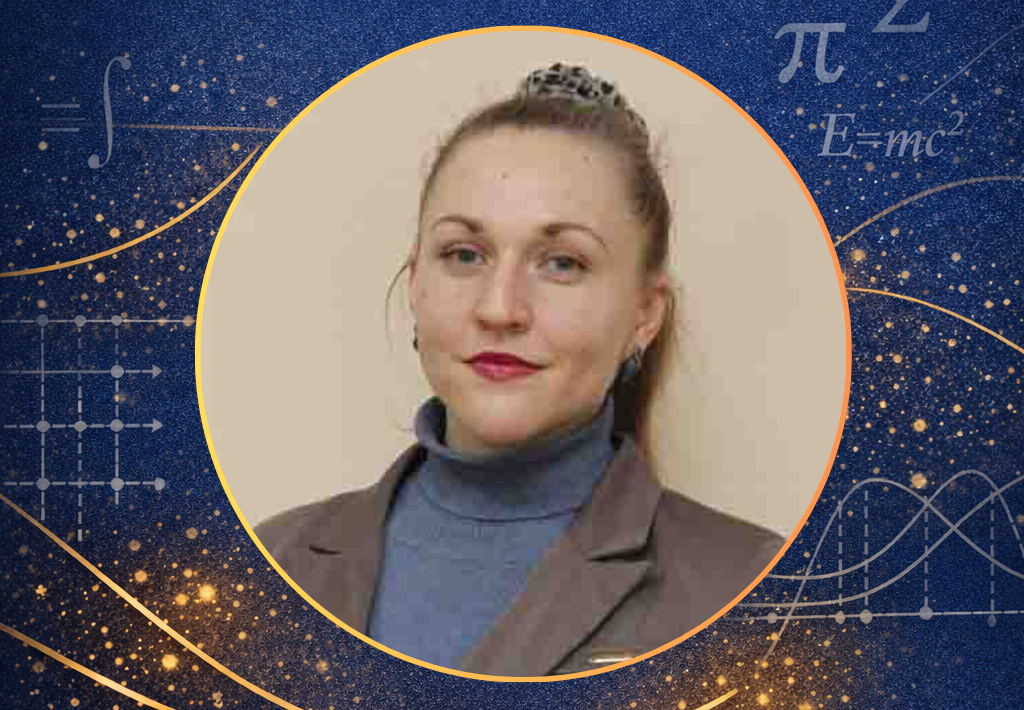
"Mathematics attracted me with its universality and inner harmony. It is a science where every statement has a clear justification, and the beauty of the result often lies in the simplicity and precision of the formulations. It was precisely the opportunity to explore complex phenomena using rigorous mathematical methods and to discover new patterns that became the main reason for my choice of this field," says candidate of mathematical sciences Maria Stefanchuk, a research fellow at the Institute of Mathematics of the NAS of Ukraine.
She managed to combine mathematics with motherhood without losing interest in research, continuing to develop herself and her scientific direction.
Mentors who believed in her potential and helped her played an important role in her life.
She believes that the visibility of women in the scientific space demonstrates real examples of successful careers and creates a culture of equal opportunities.
The scientist advises listening to your inclinations and aspirations and shares her thorny yet stellar experience of building a research career:
- "The scientific path is inevitably associated with difficulties: complex problems that resist solution for a long time, periods of uncertainty and doubts about one’s own abilities. Sometimes it seemed that progress was too slow or that the chosen direction was too difficult. However, it was precisely these moments that prompted me to delve deeper into the problem, reconsider approaches, and seek new ideas. Over time, I realized that doubts are a natural part of scientific work, and overcoming such stages only strengthens the confidence that science and mathematics are truly my path."
- "It is necessary to understand that it is practically impossible to do everything 100% at the same time – you always have to choose where to focus right now. Career and family can mutually enrich each other: the support of loved ones gives energy for professional achievements, and success in science adds confidence and self-realization. It is important to have clear boundaries, plan time, and accept that sometimes one gets more attention than the other. 'Having it all' is more about conscious balance and harmony than absolute equality in every sphere."
- "...competence, analytical thinking, and creativity in science do not depend on gender. Women are capable of achieving high results, making significant contributions to the development of science, and leading complex projects on par with any male colleague. It is only important to ensure equal opportunities and support, and women have enough talent and perseverance to successfully develop in any scientific field."
- "I would say to myself [10 years ago]: 'Believe in your own strength and do not be afraid to make mistakes. Difficulties and doubts are part of the path, not a sign that you are on the wrong path. Every complex problem you work on makes you stronger and more experienced. Trust your interest in science, and the results will definitely appear.'"
- "...do not be afraid to take the first step and trust your curiosity. Science requires persistence and the courage to ask questions, and there is nothing 'unfeminine' about this. It is important to surround yourself with mentors, like-minded people, and support that will help overcome doubts. Mistakes and difficulties are not defeat but an integral part of learning and growth. The most important thing is to believe in yourself, your ideas, and abilities: this is what allows you to achieve results and open new horizons in science."
We highly recommend reading this interview in full. It is extremely insightful. Text – here.
Let us remind you, this and other conversations with Ukrainian female mathematicians appeared thanks to the special project of the Institute of Mathematics of the NAS of Ukraine "Her Scientific Story".