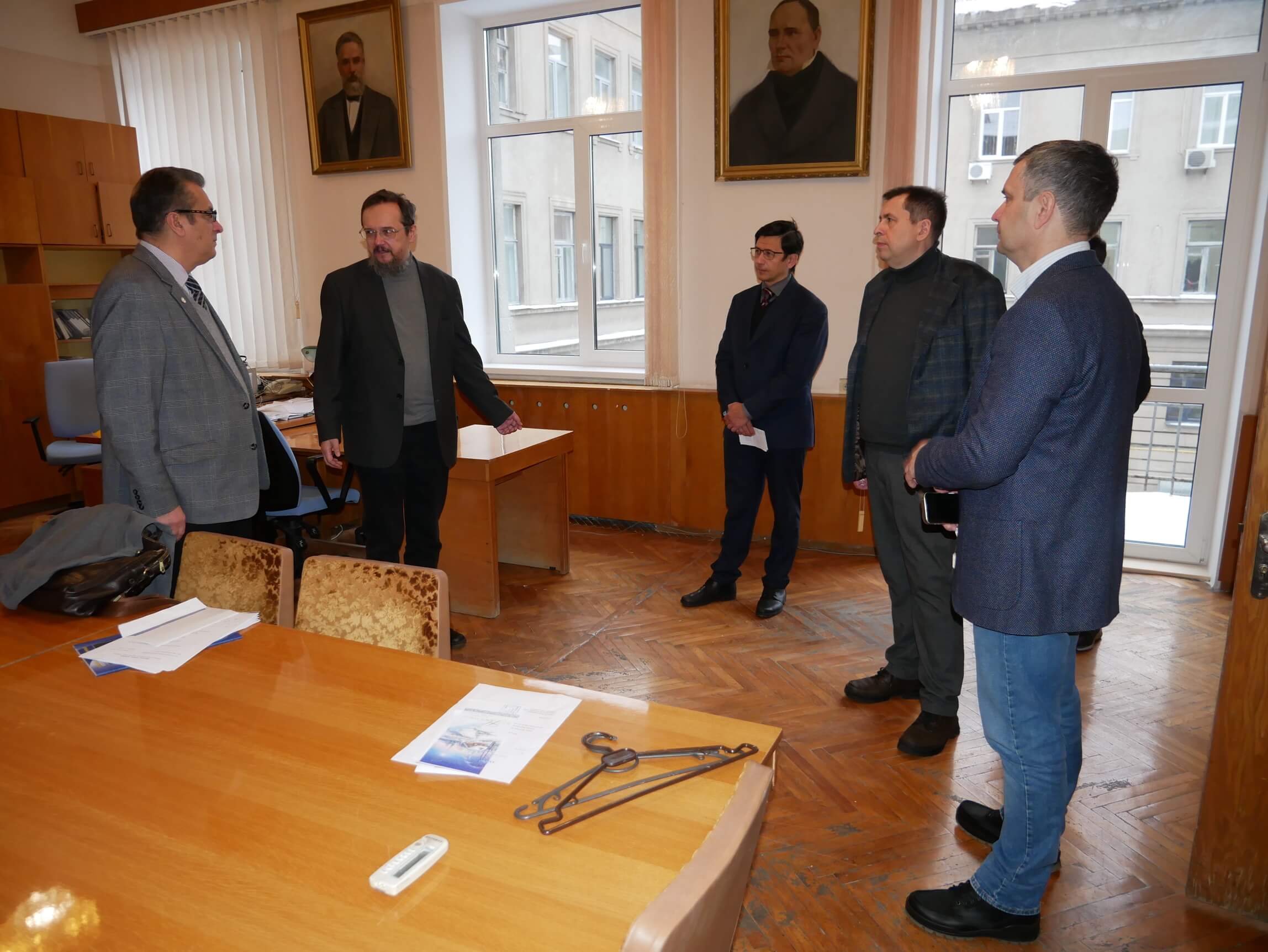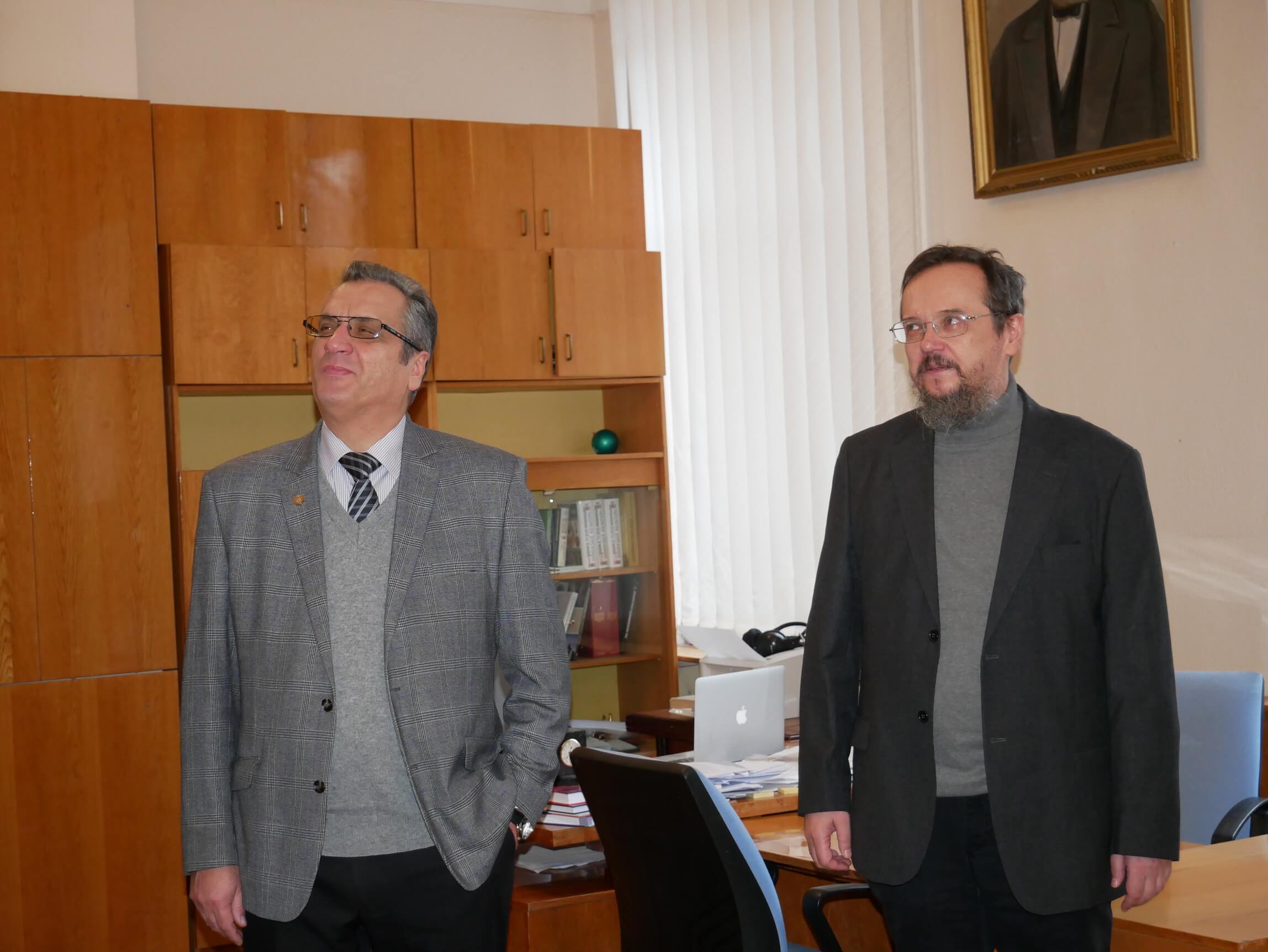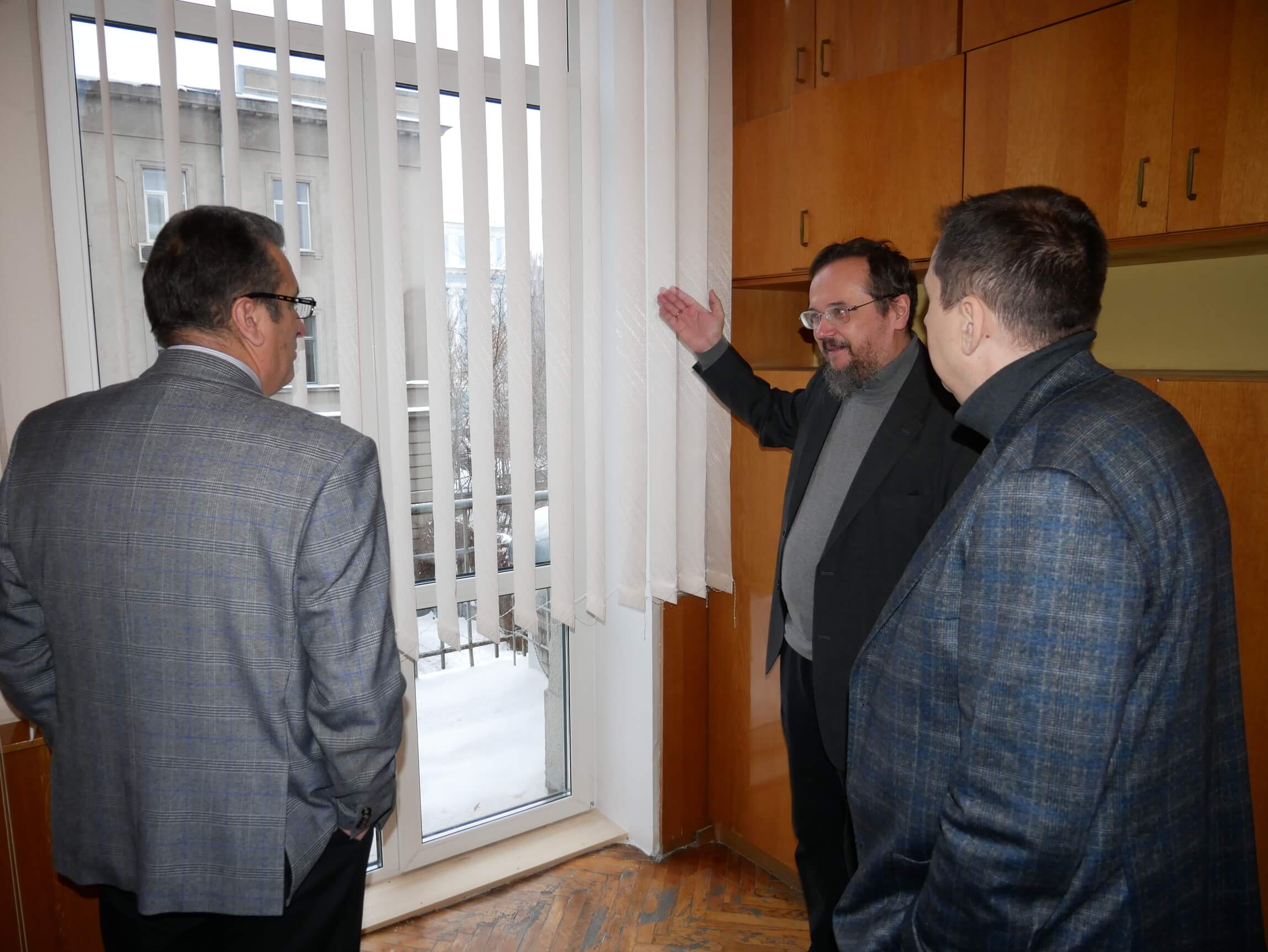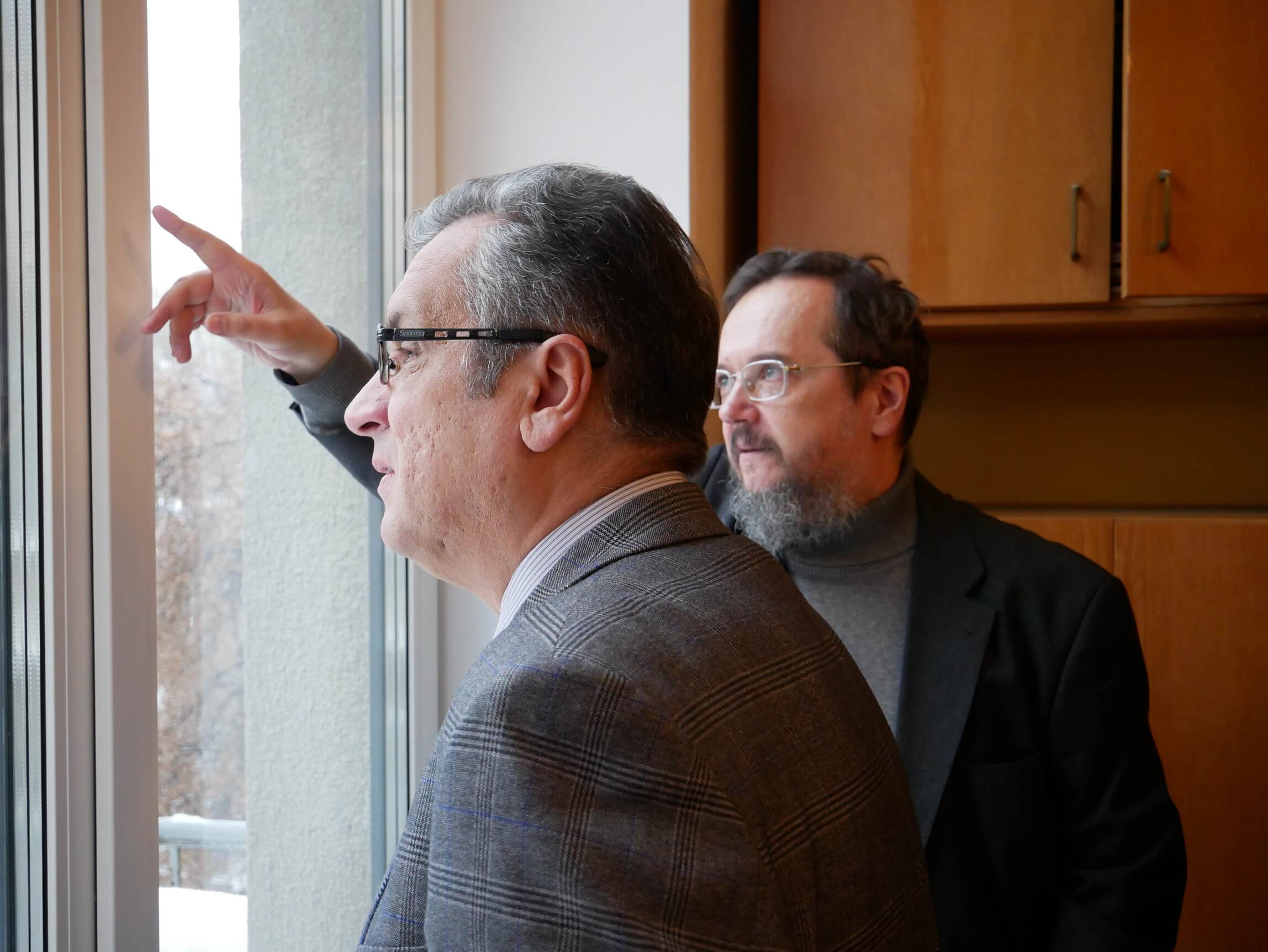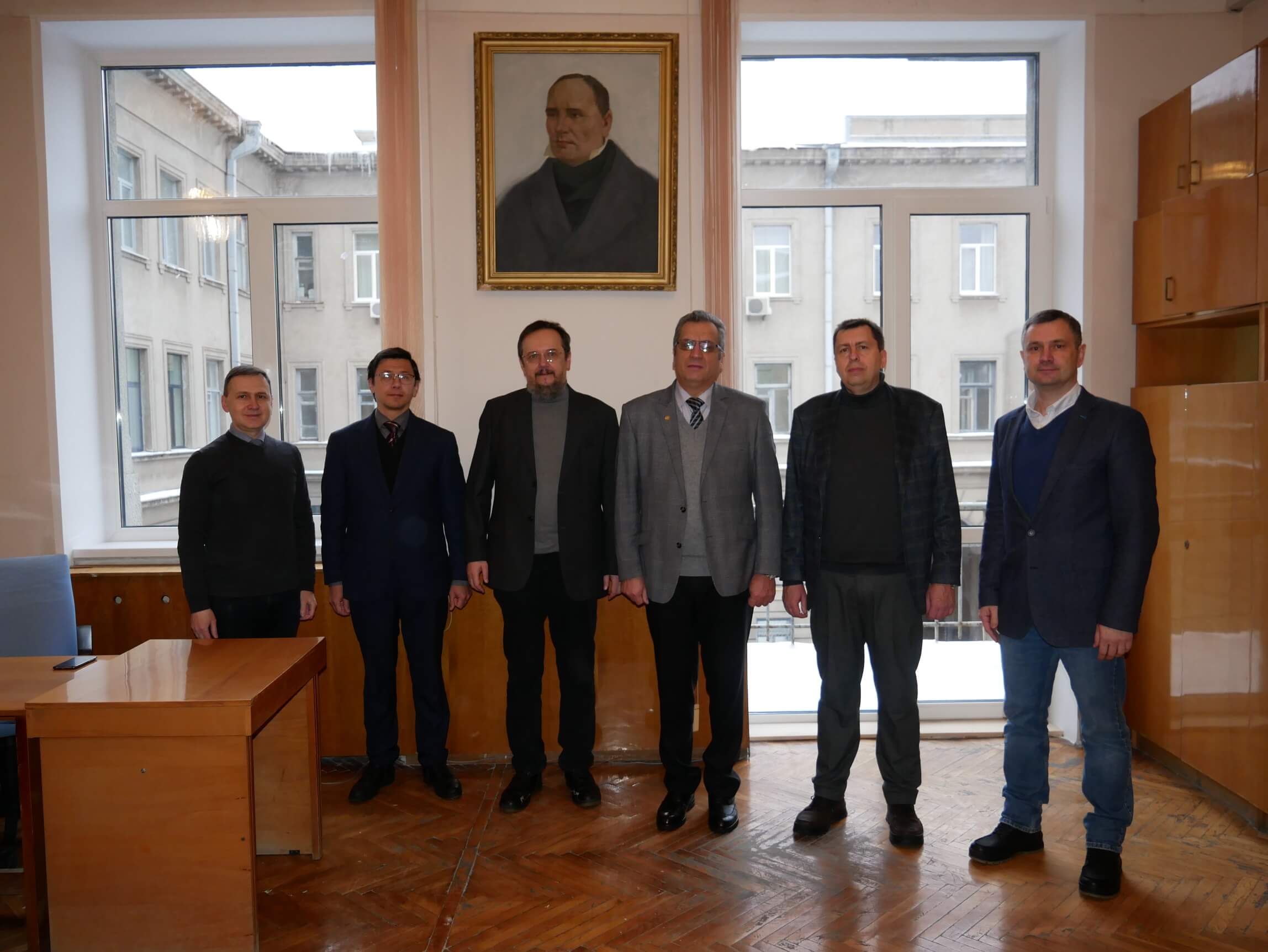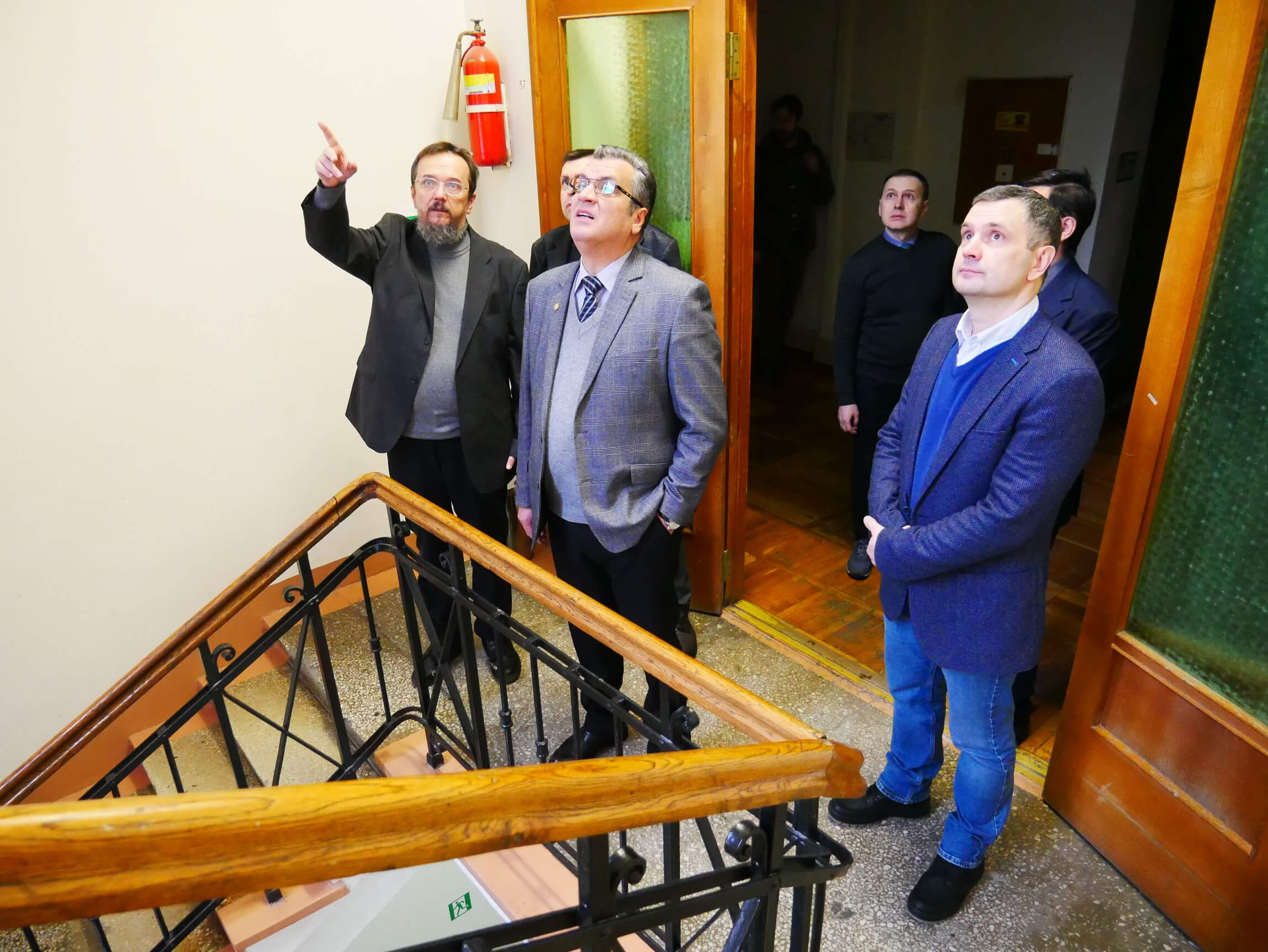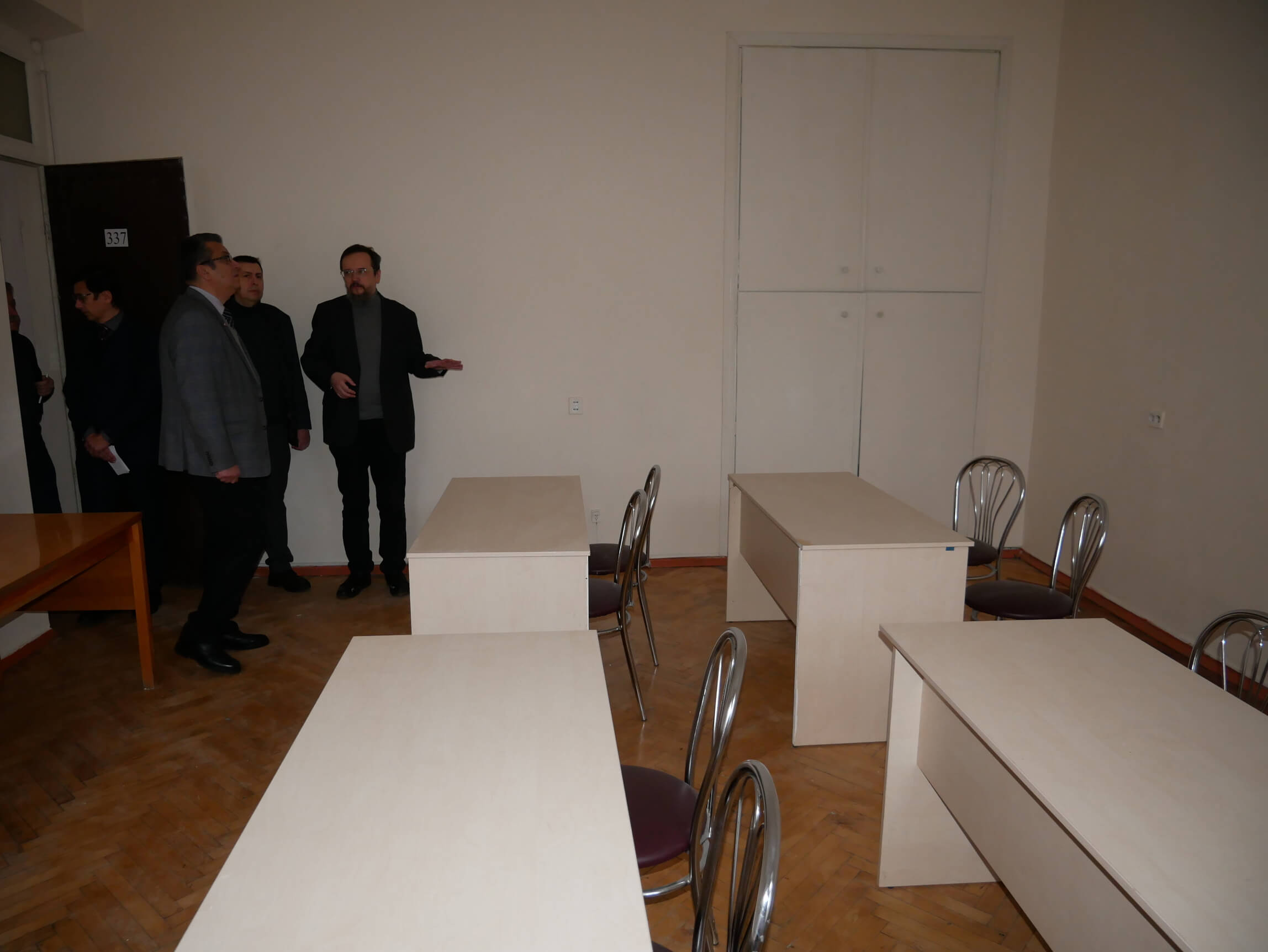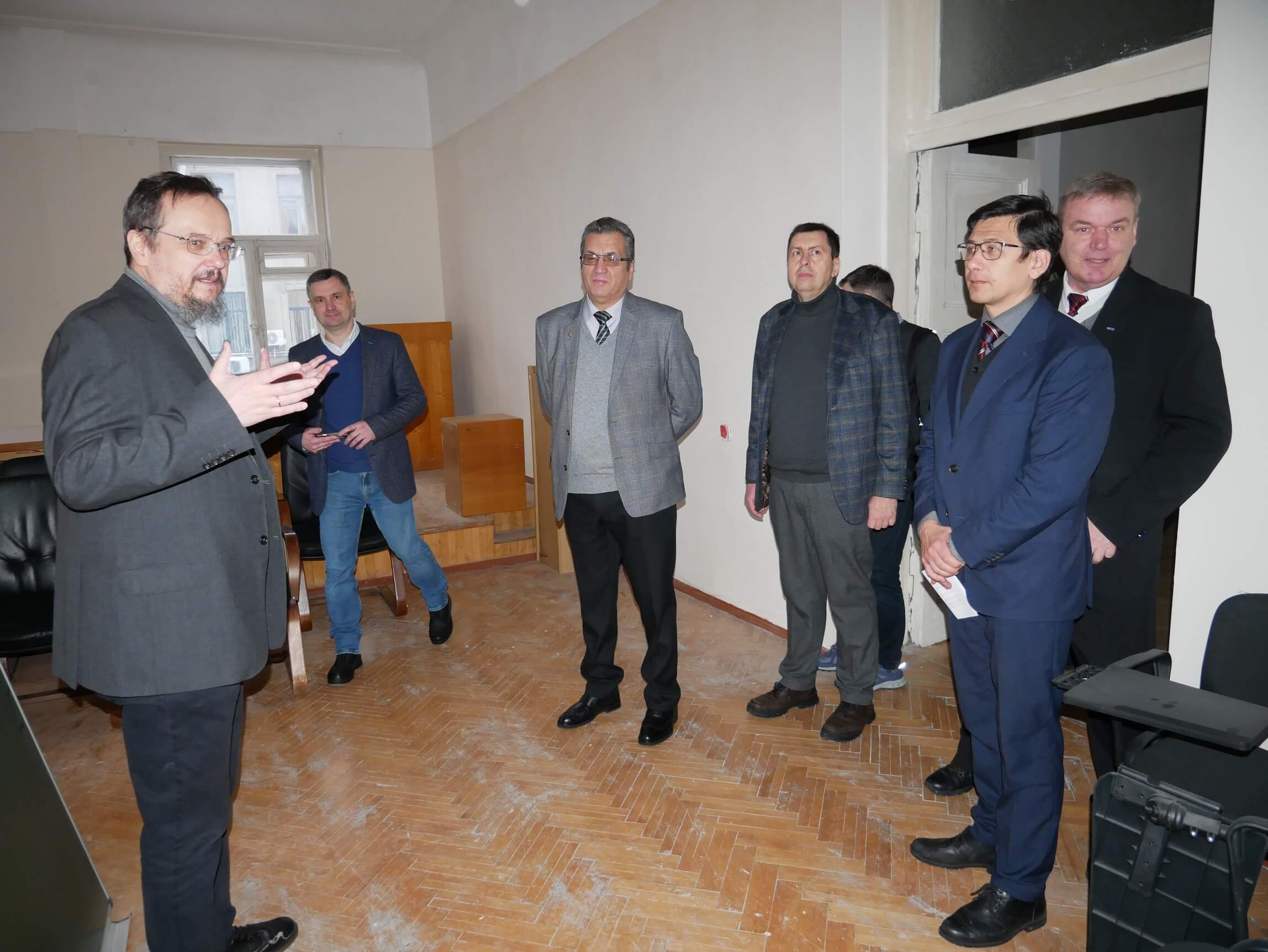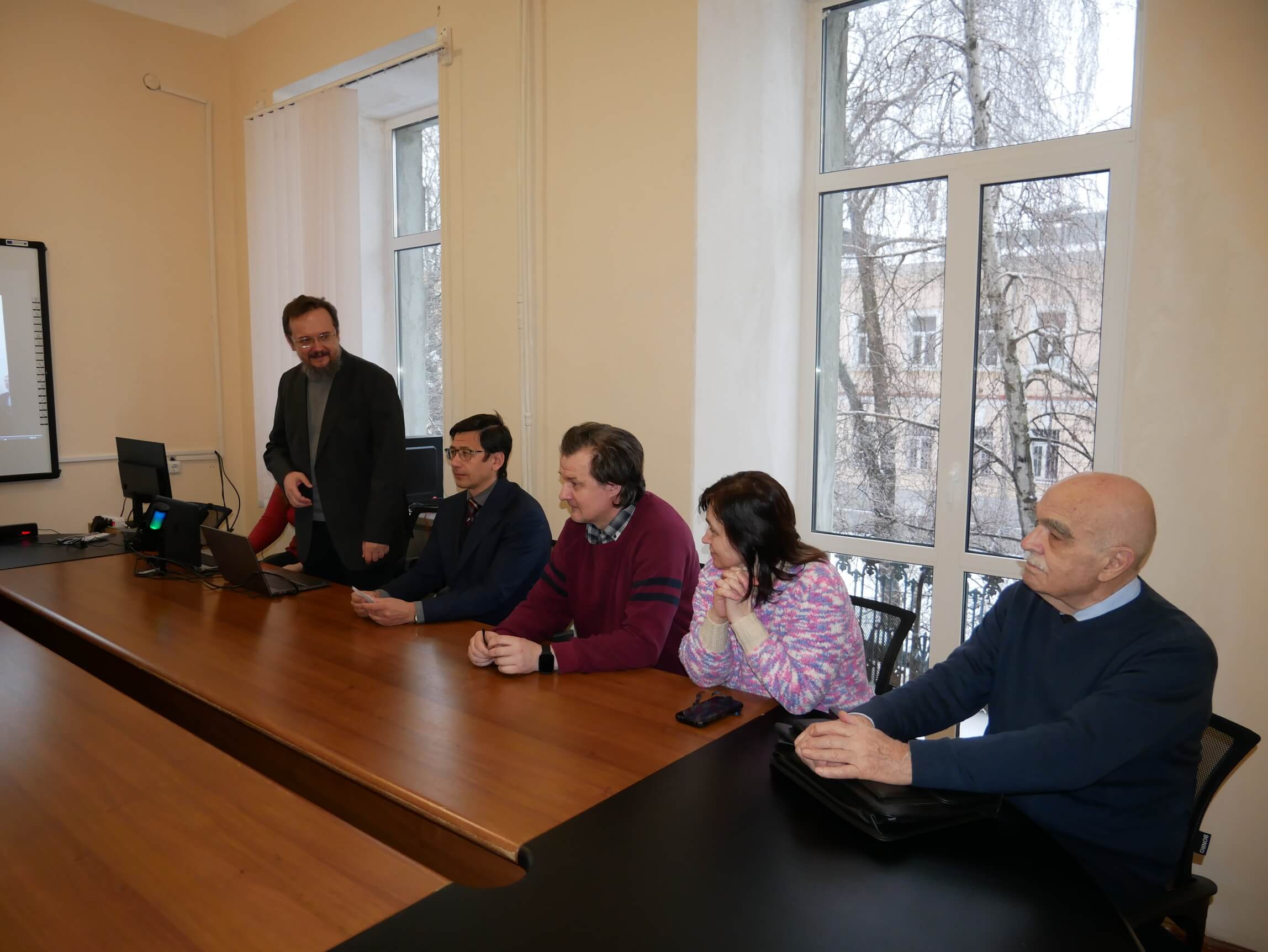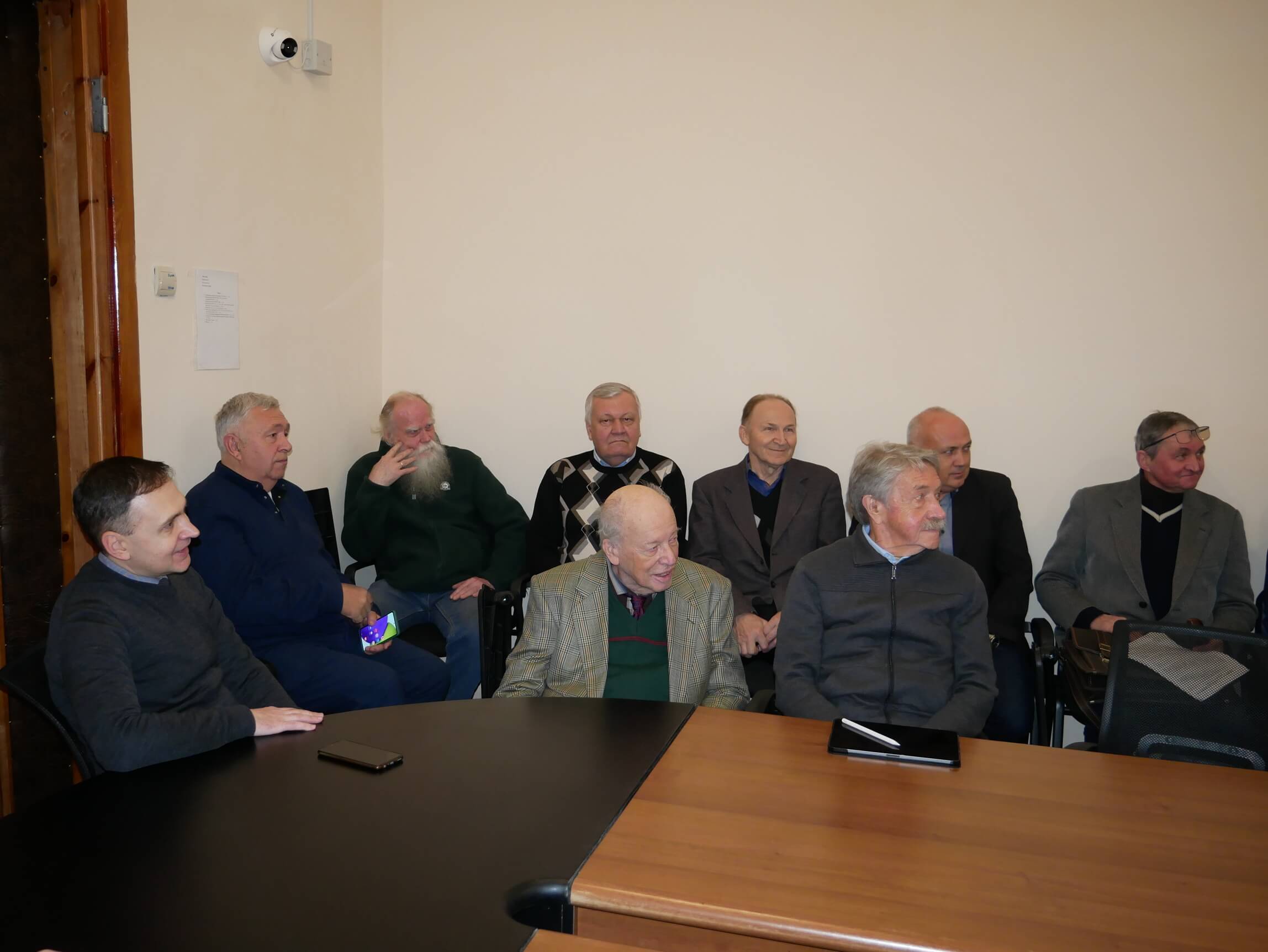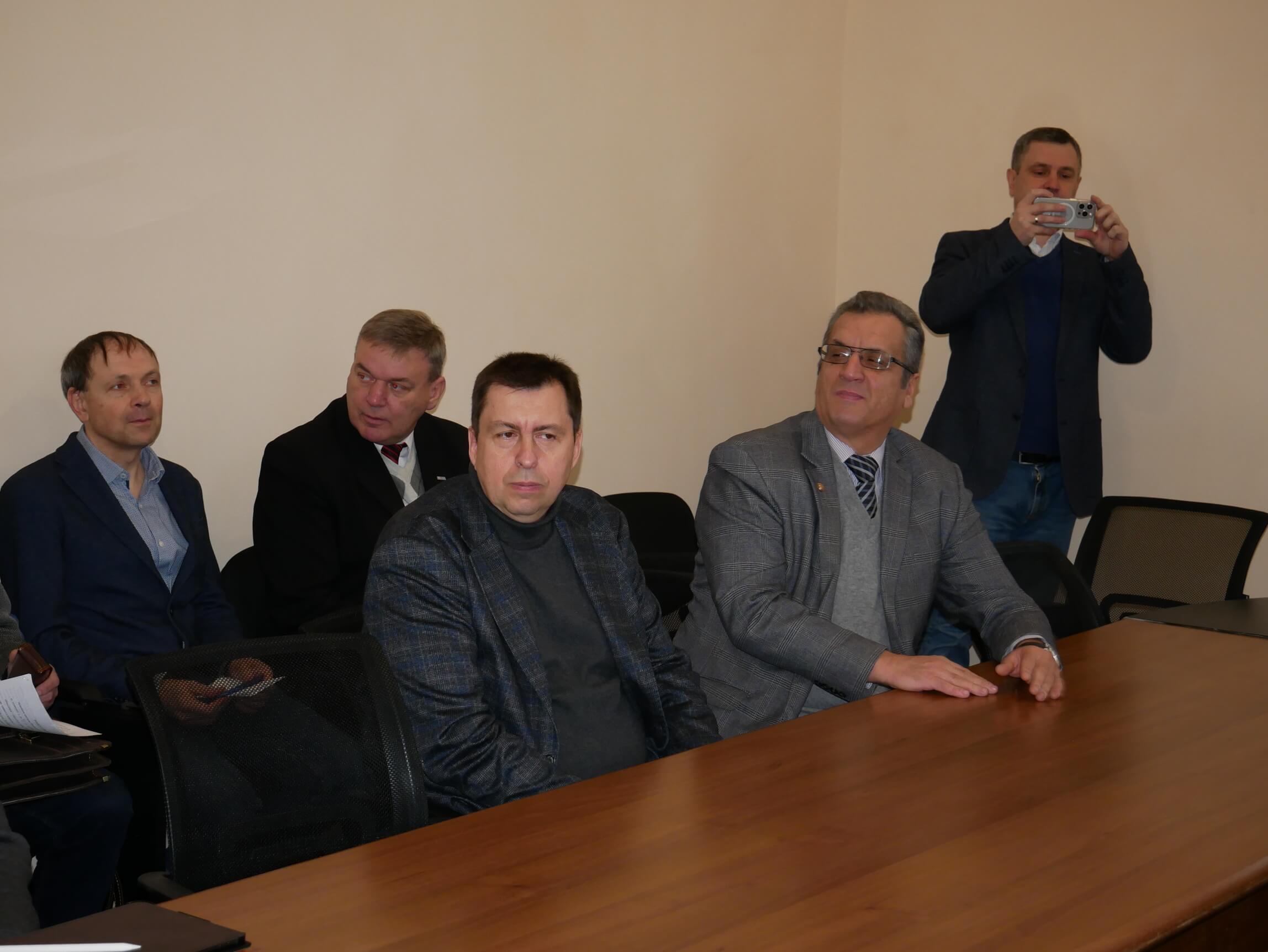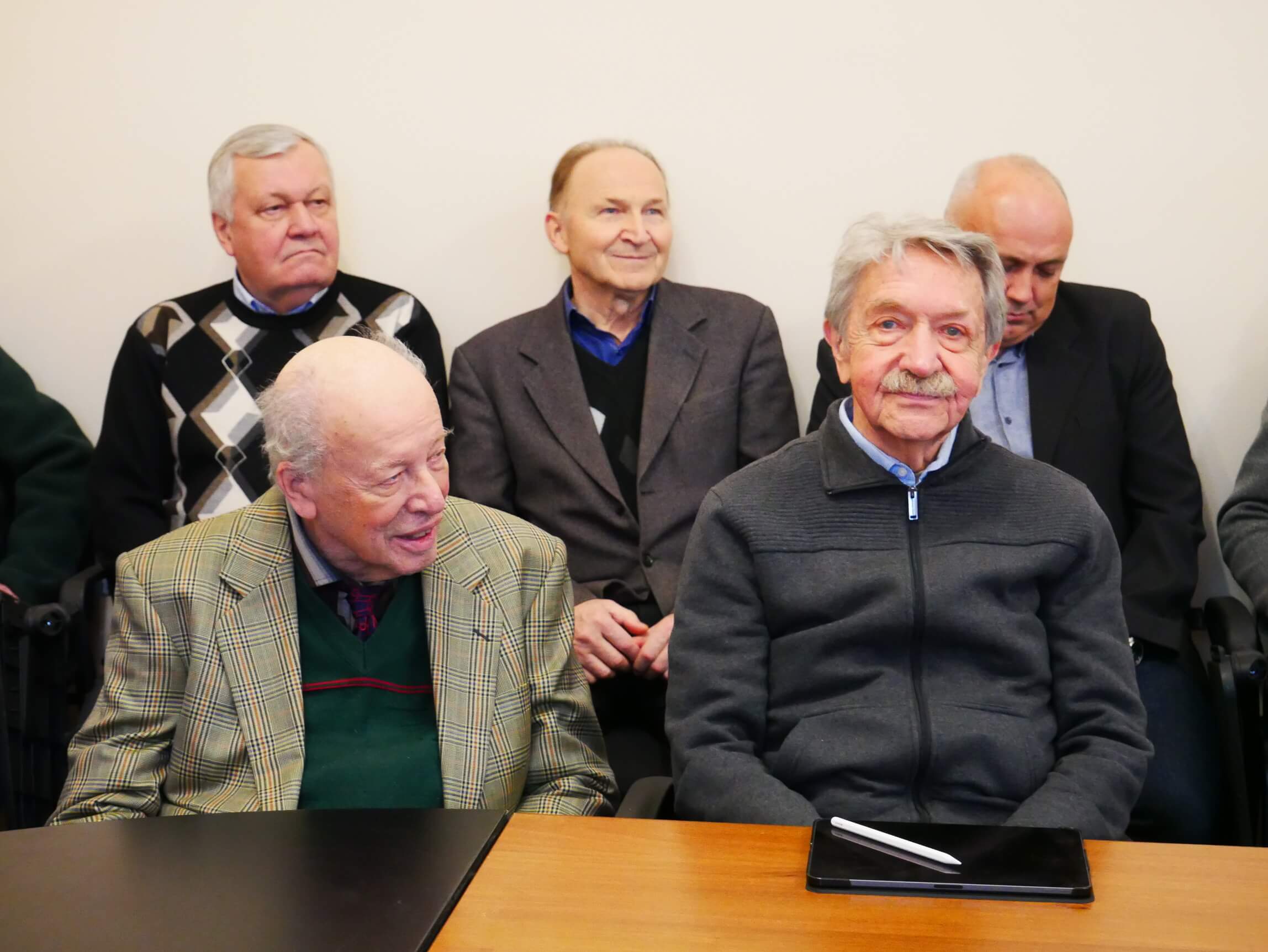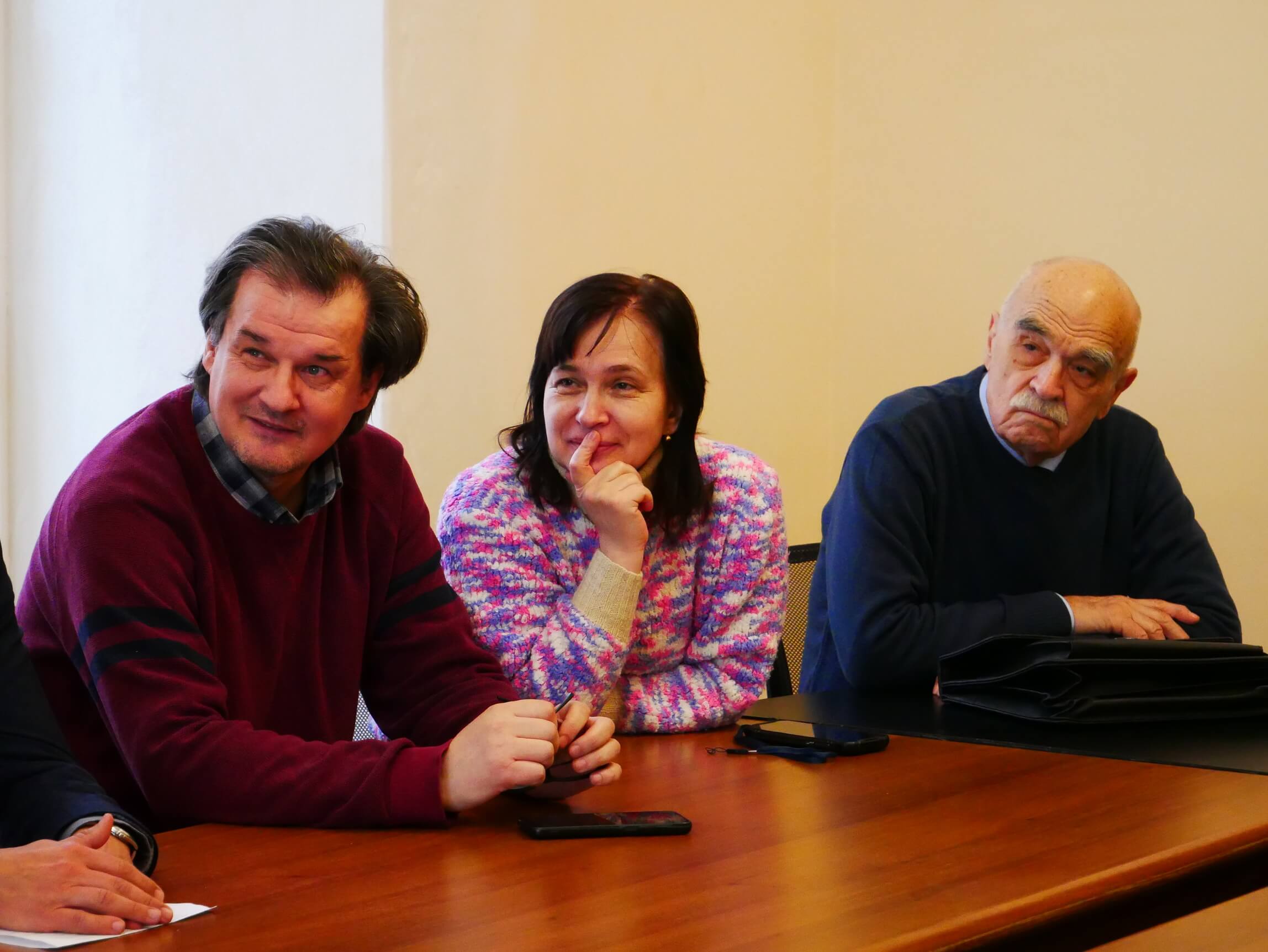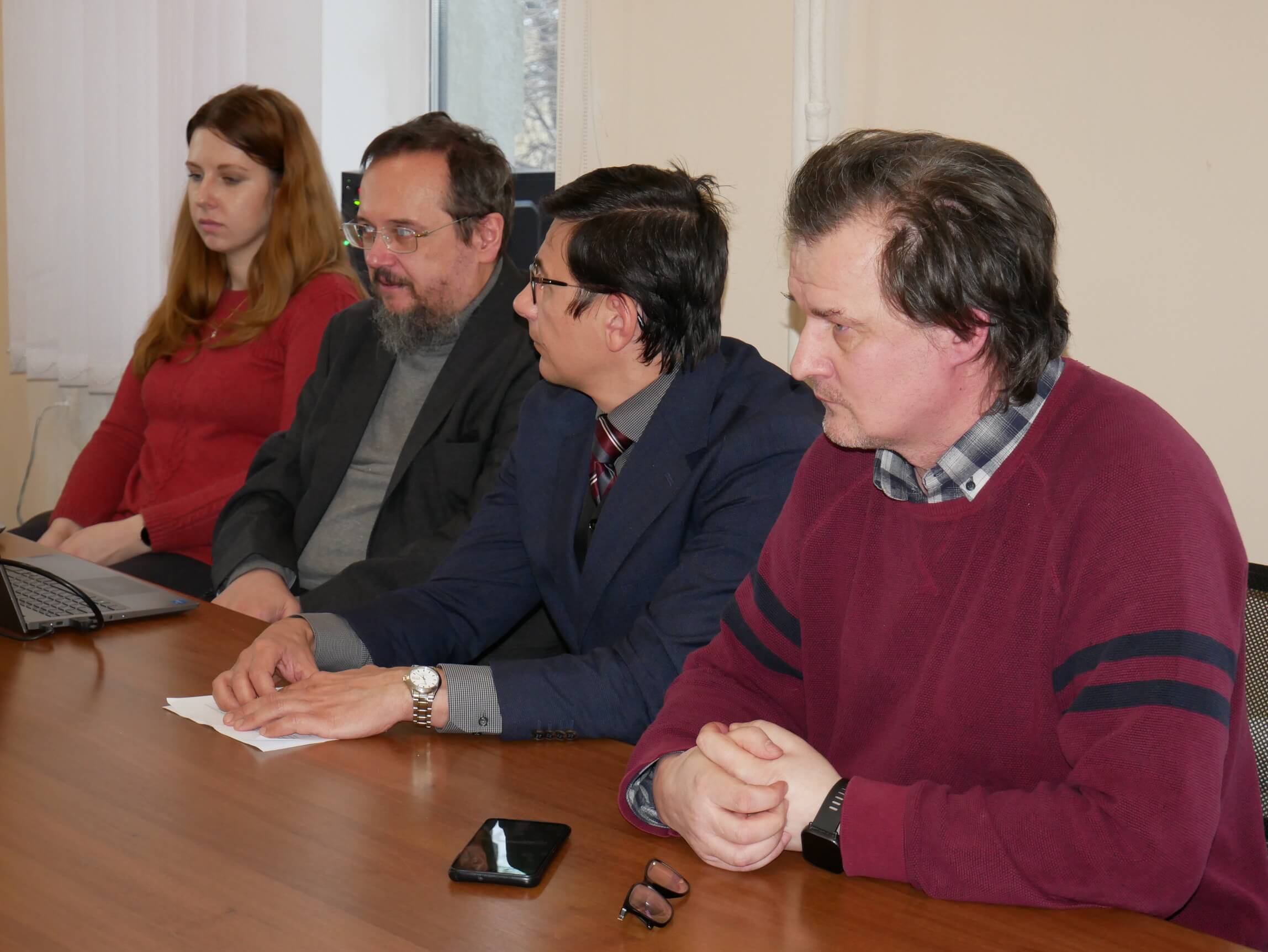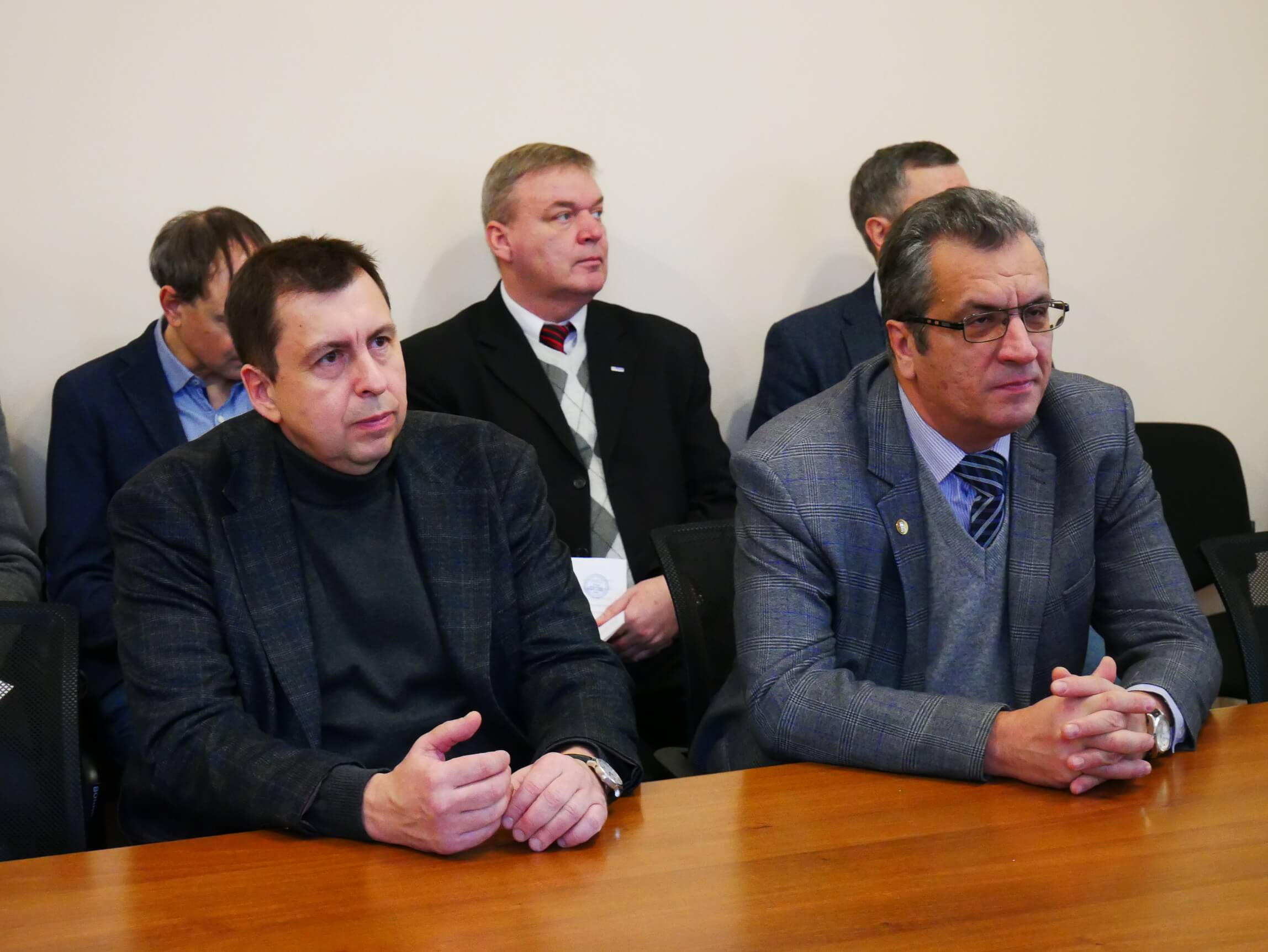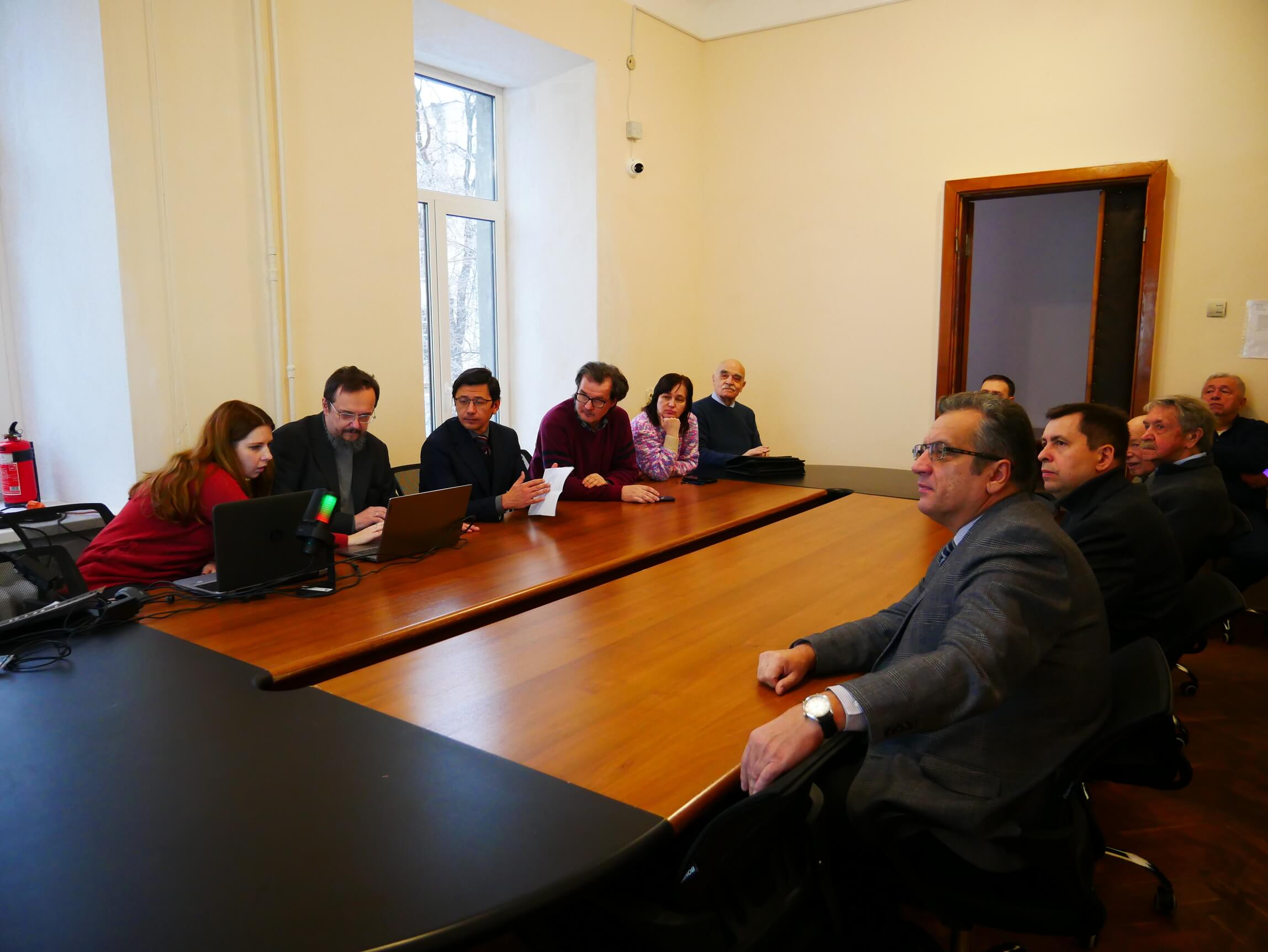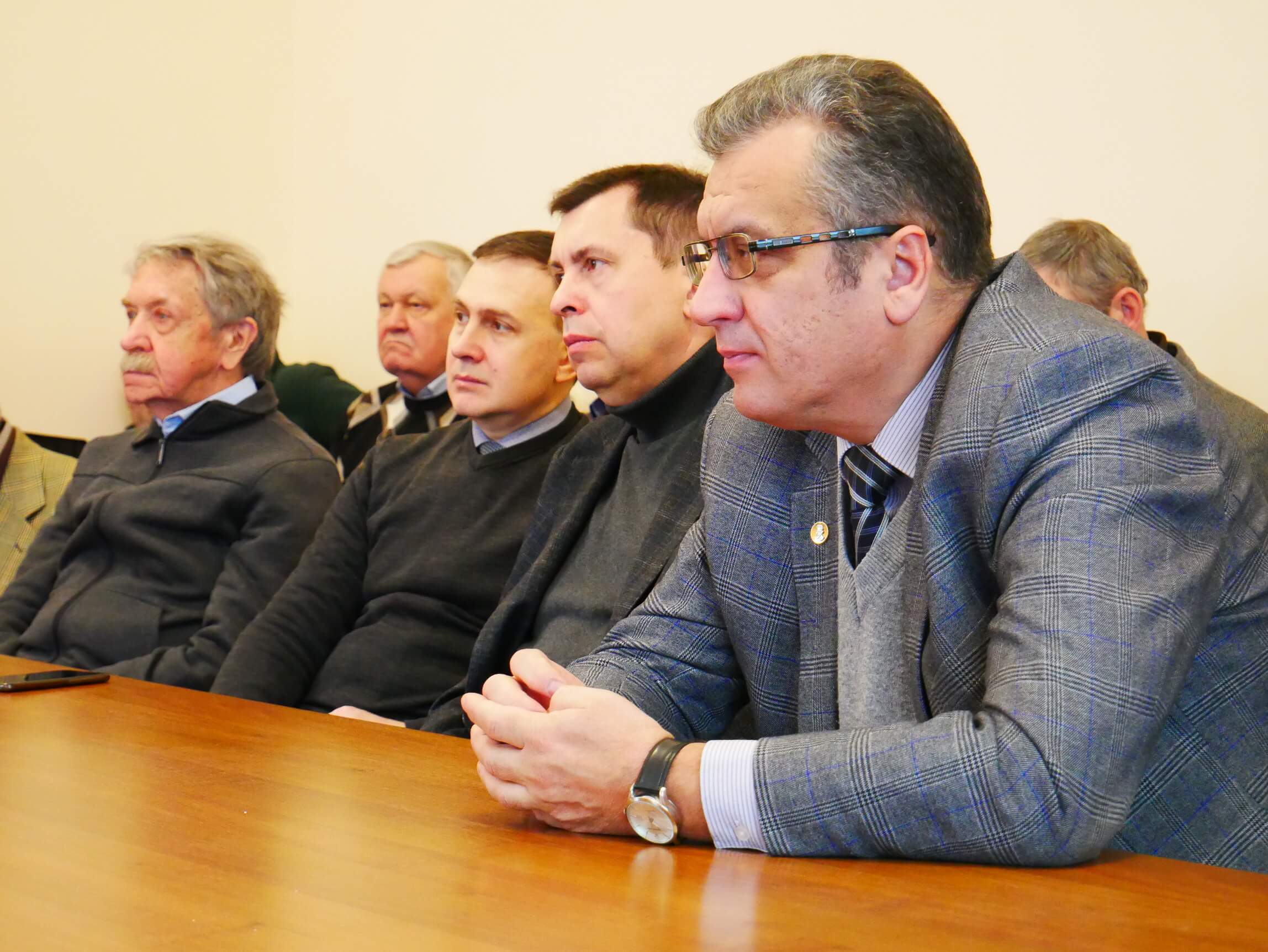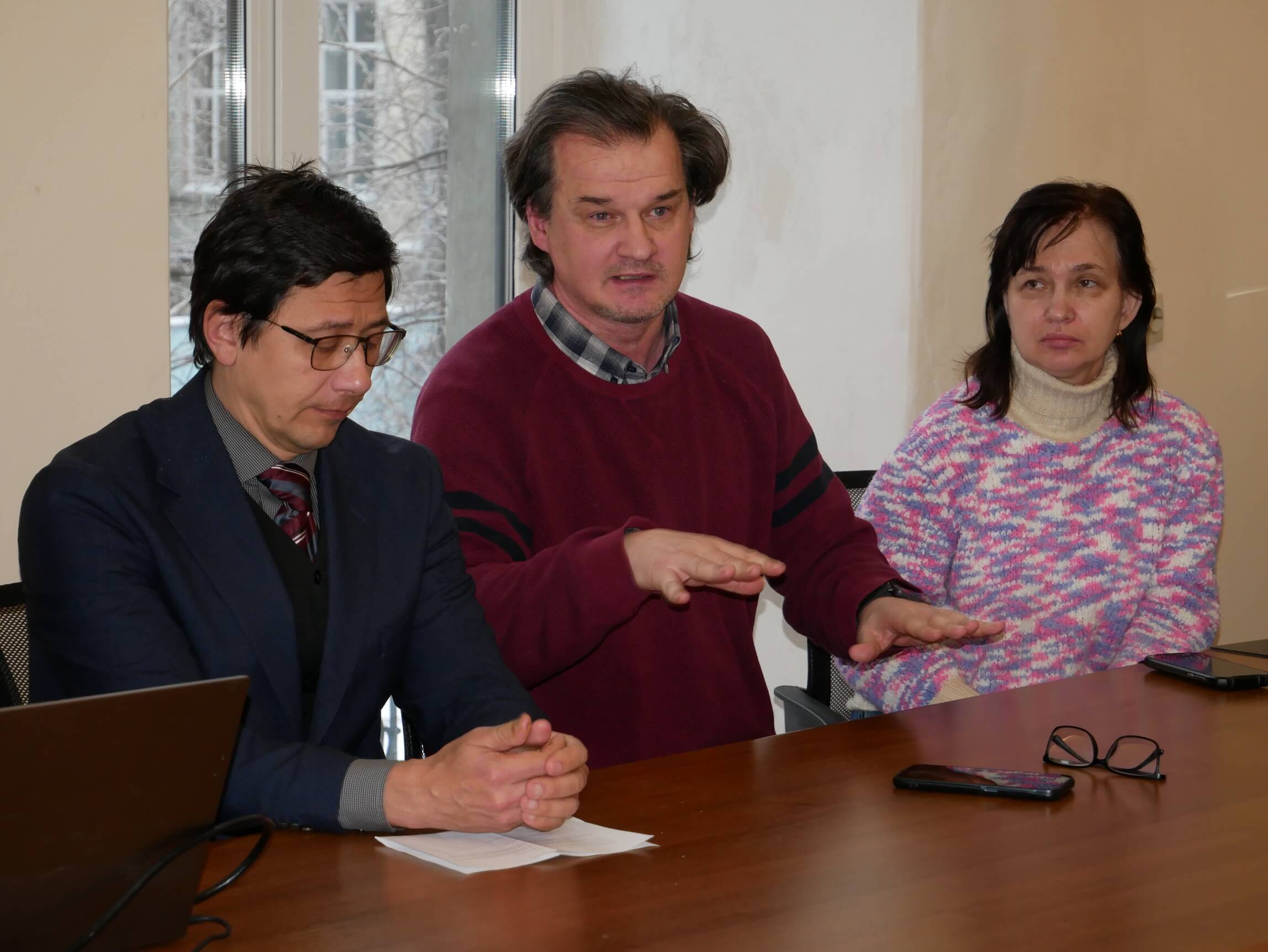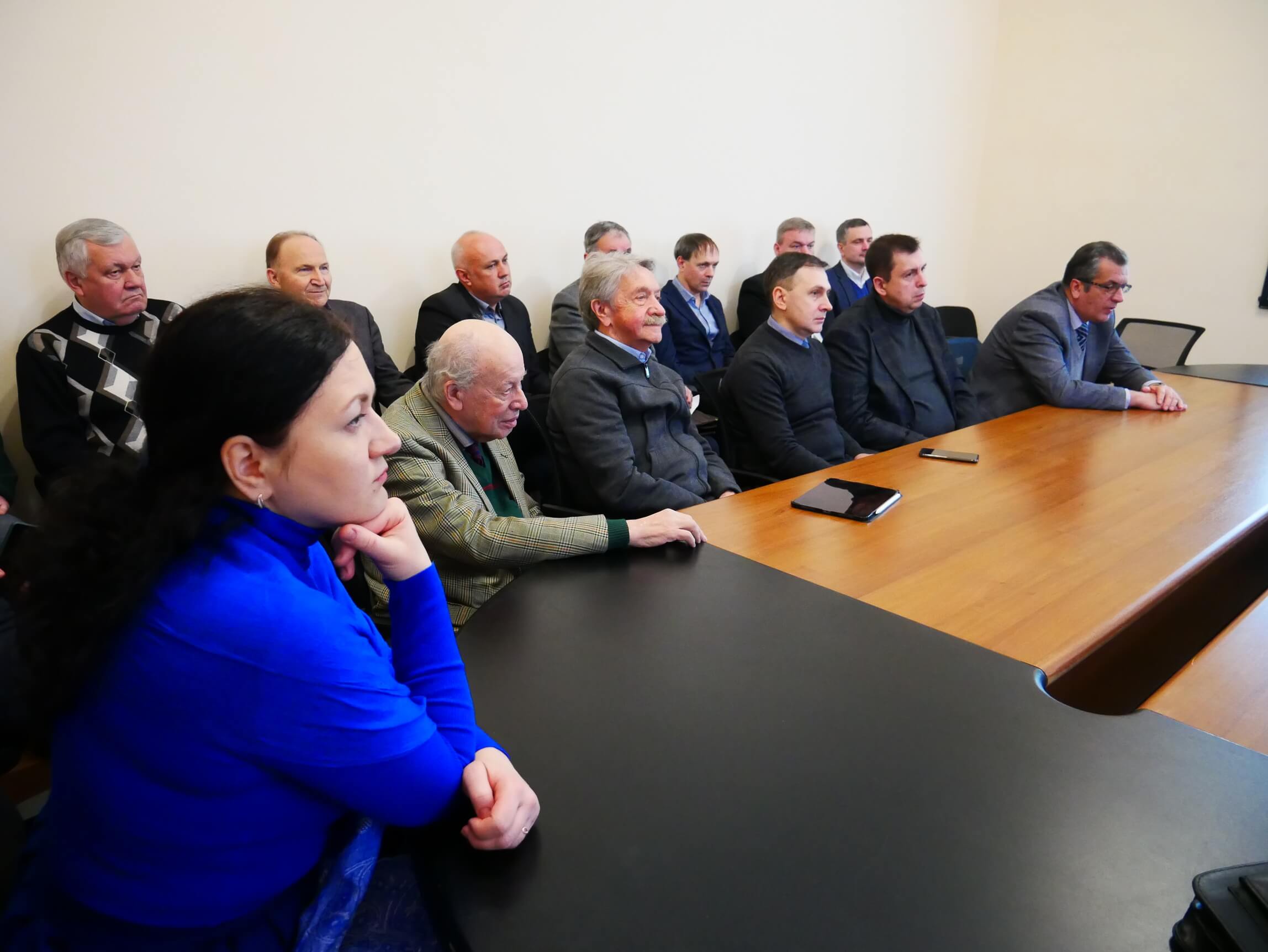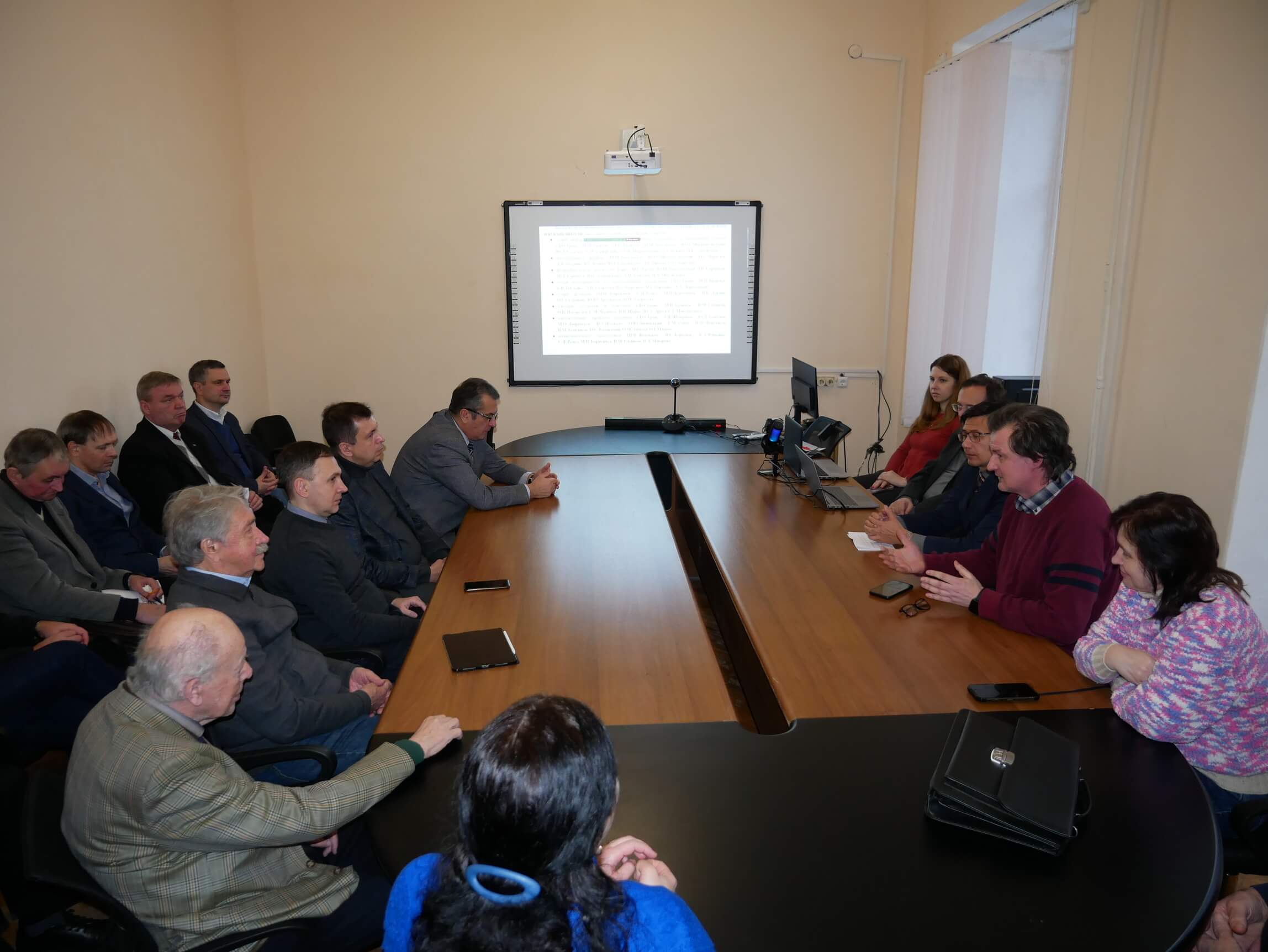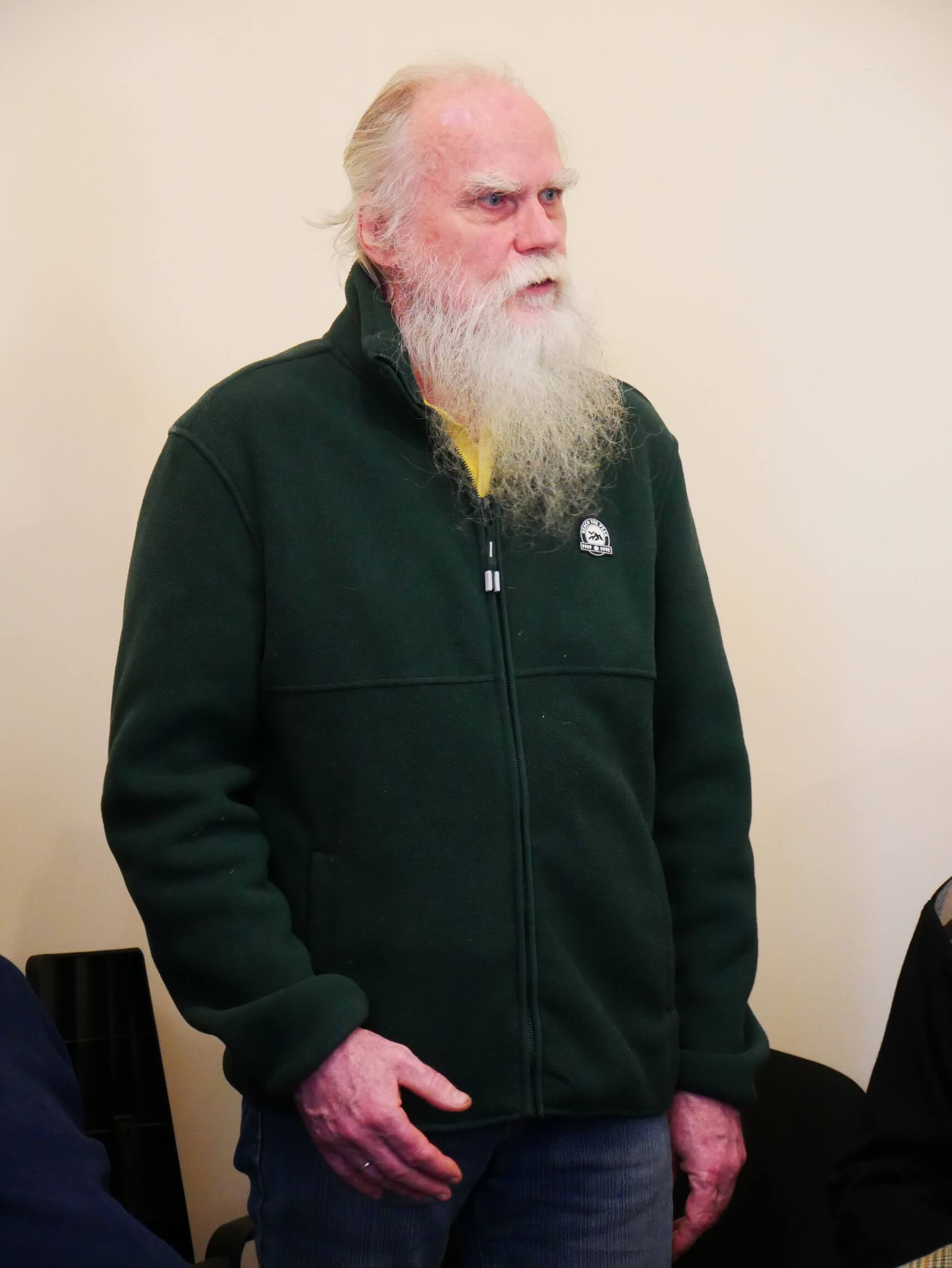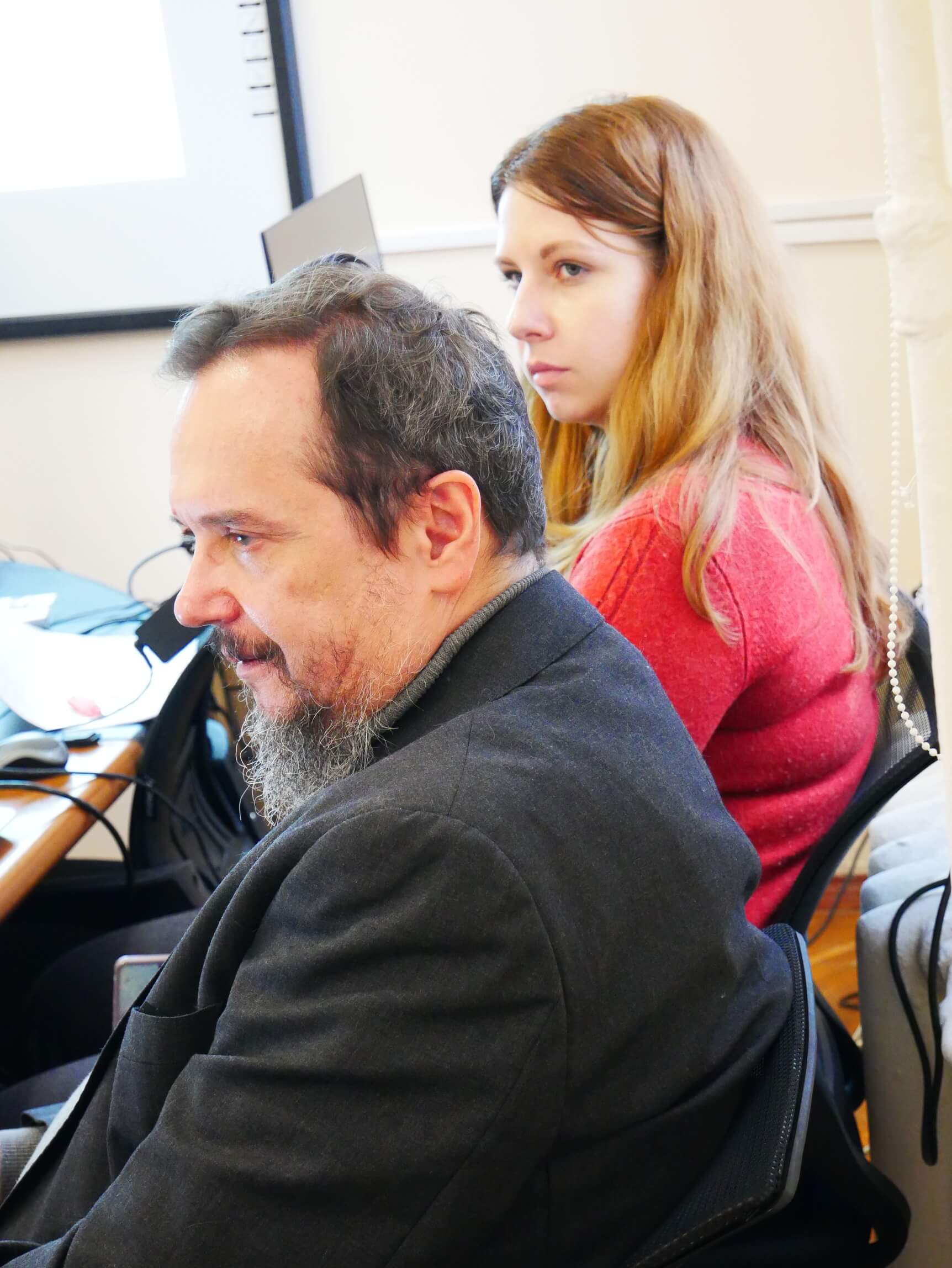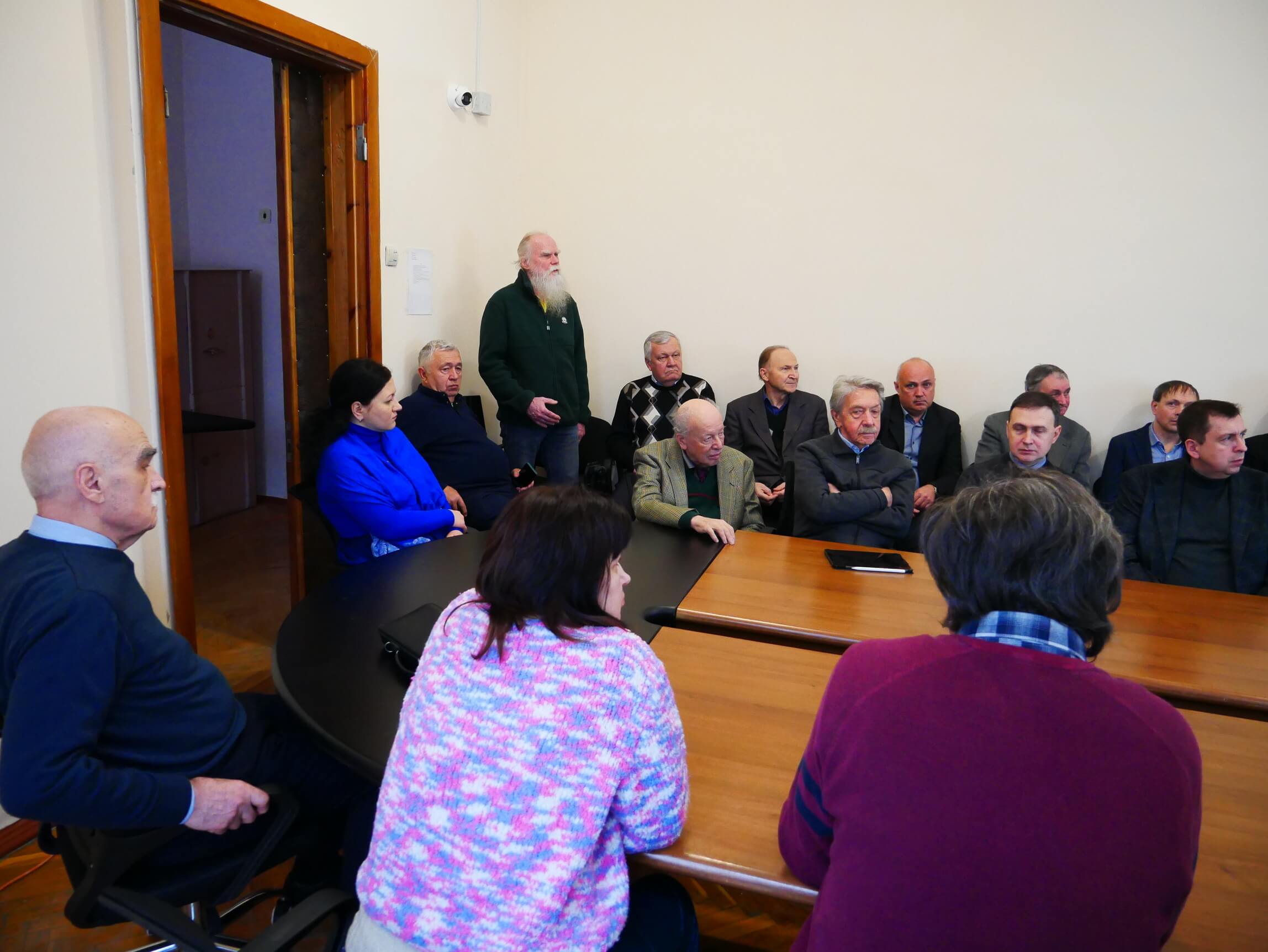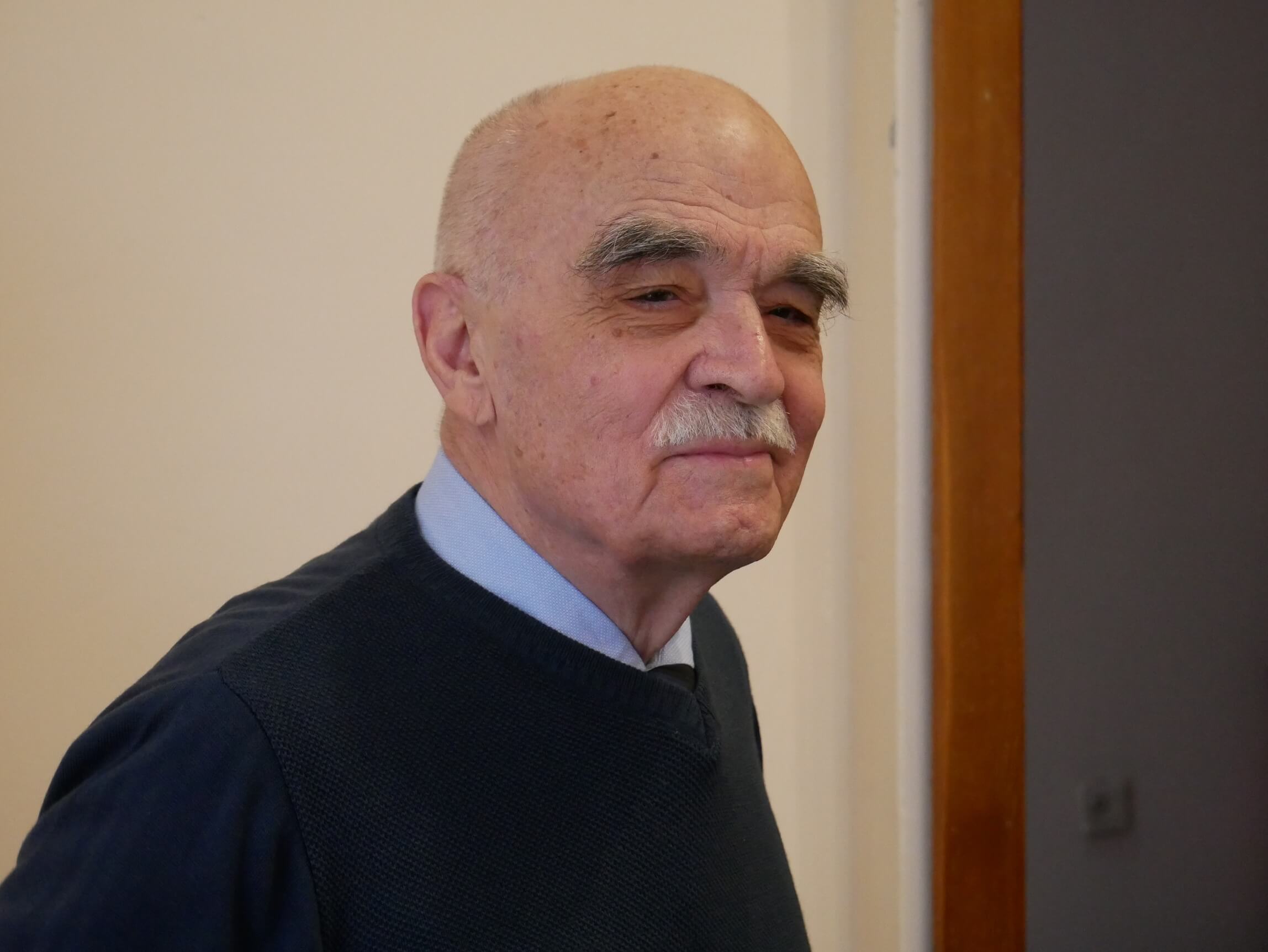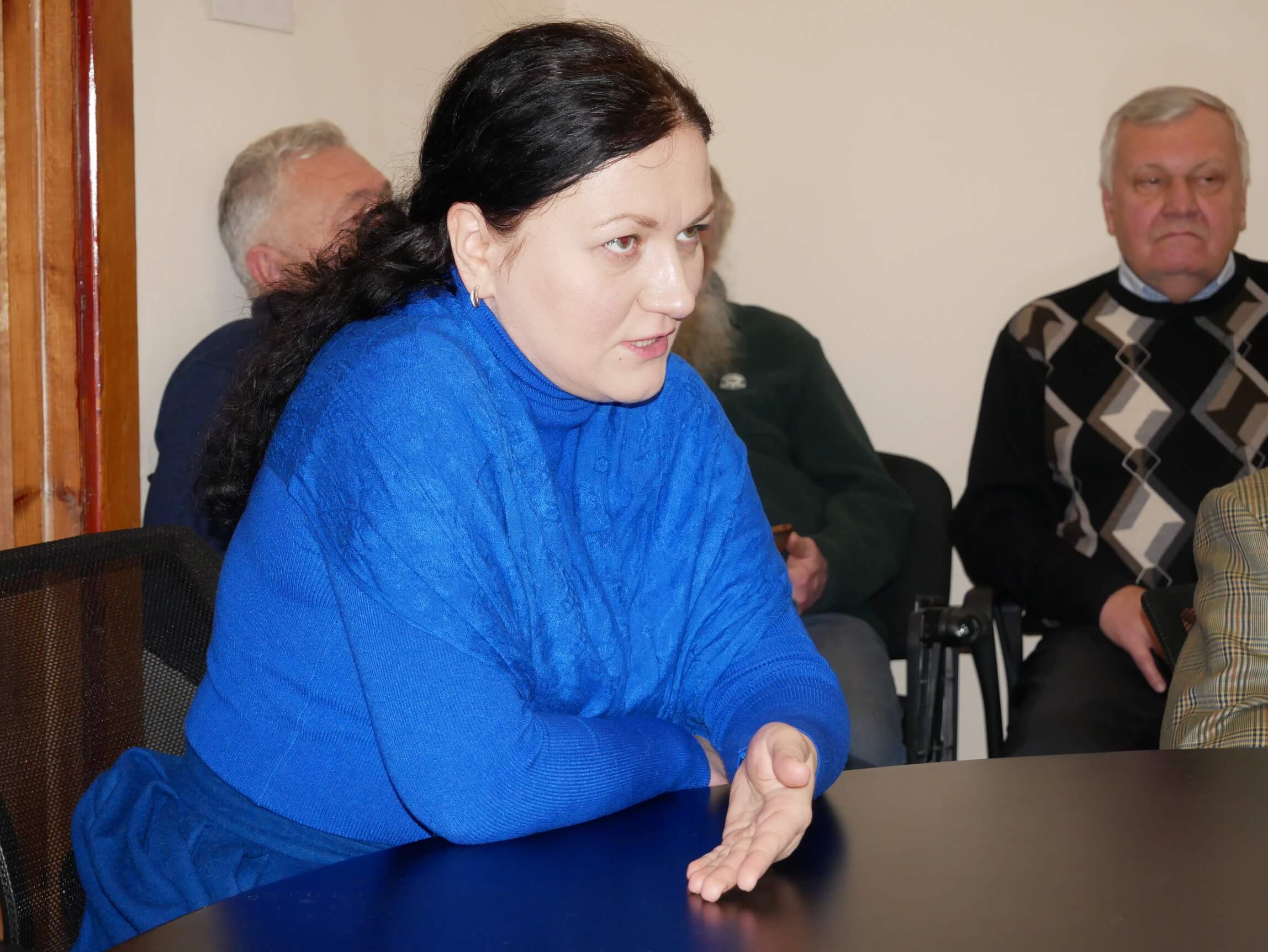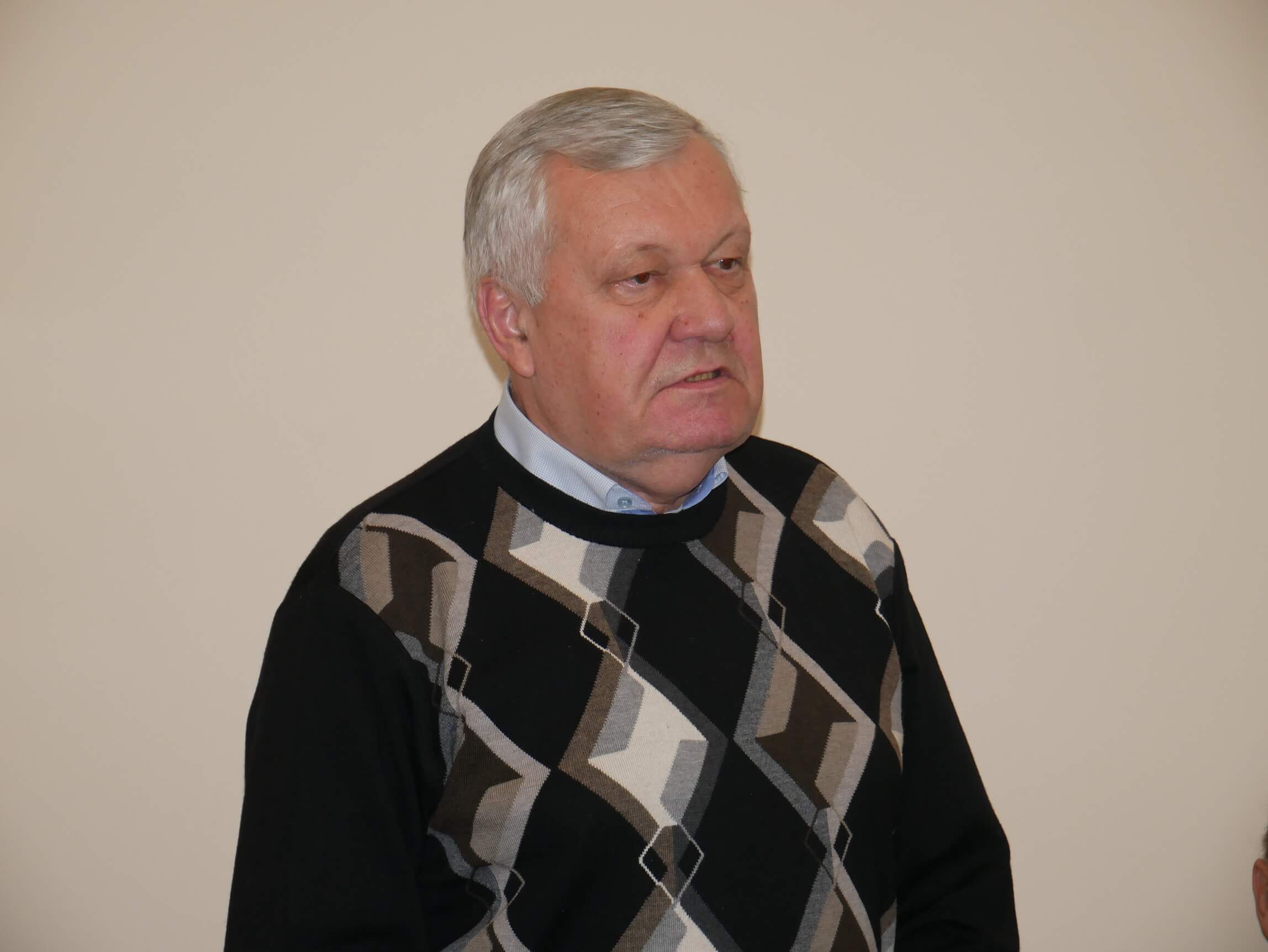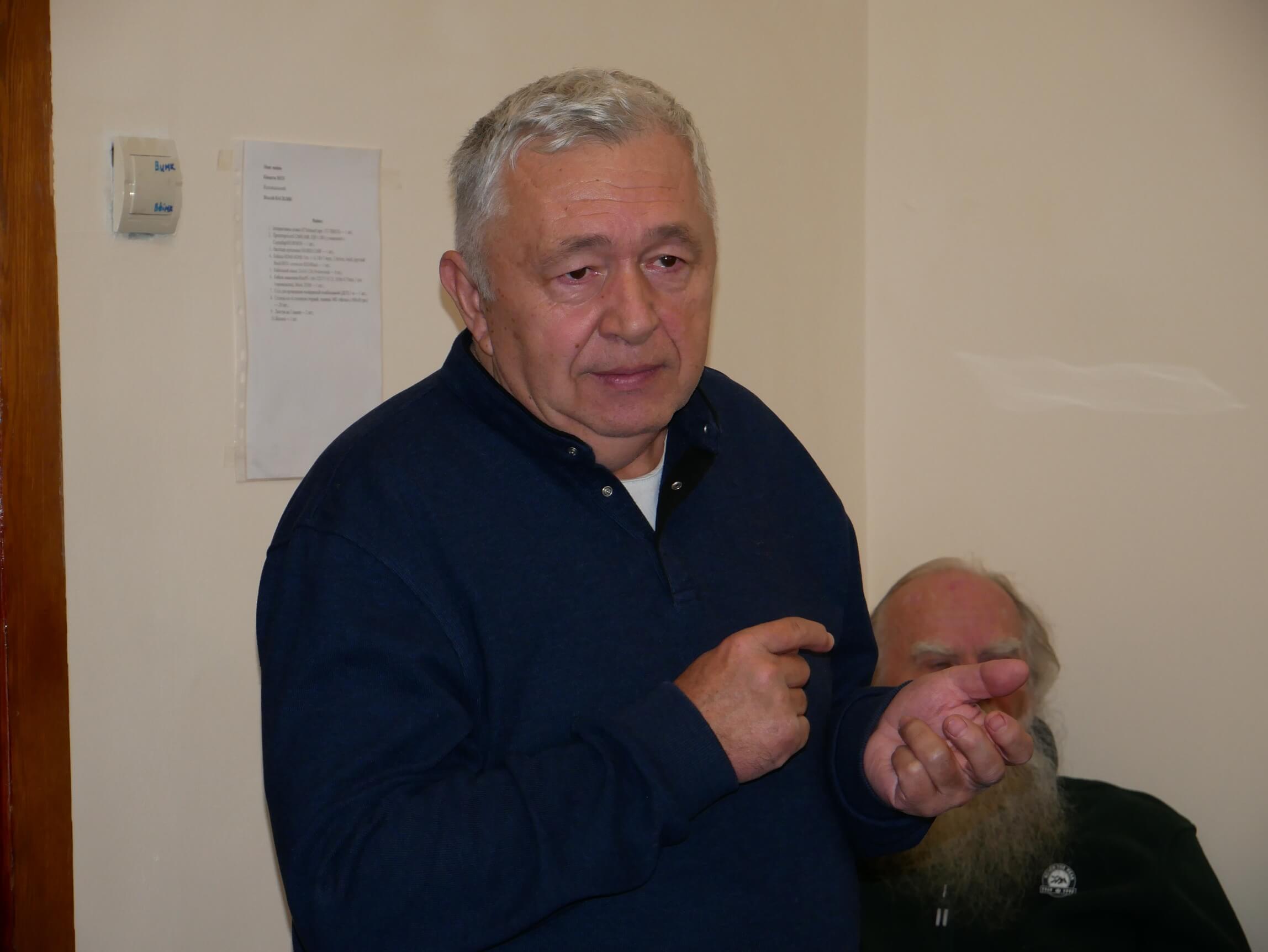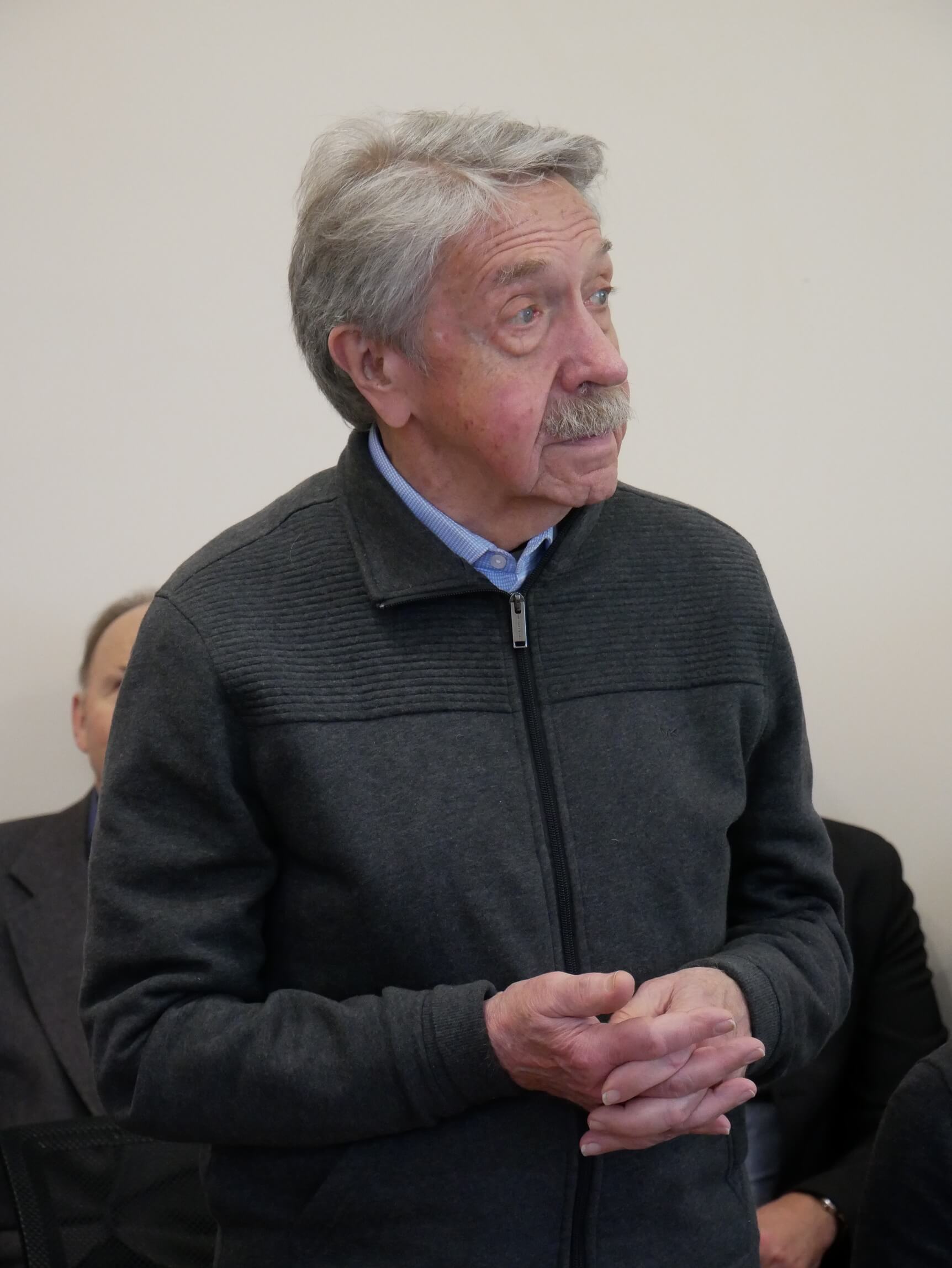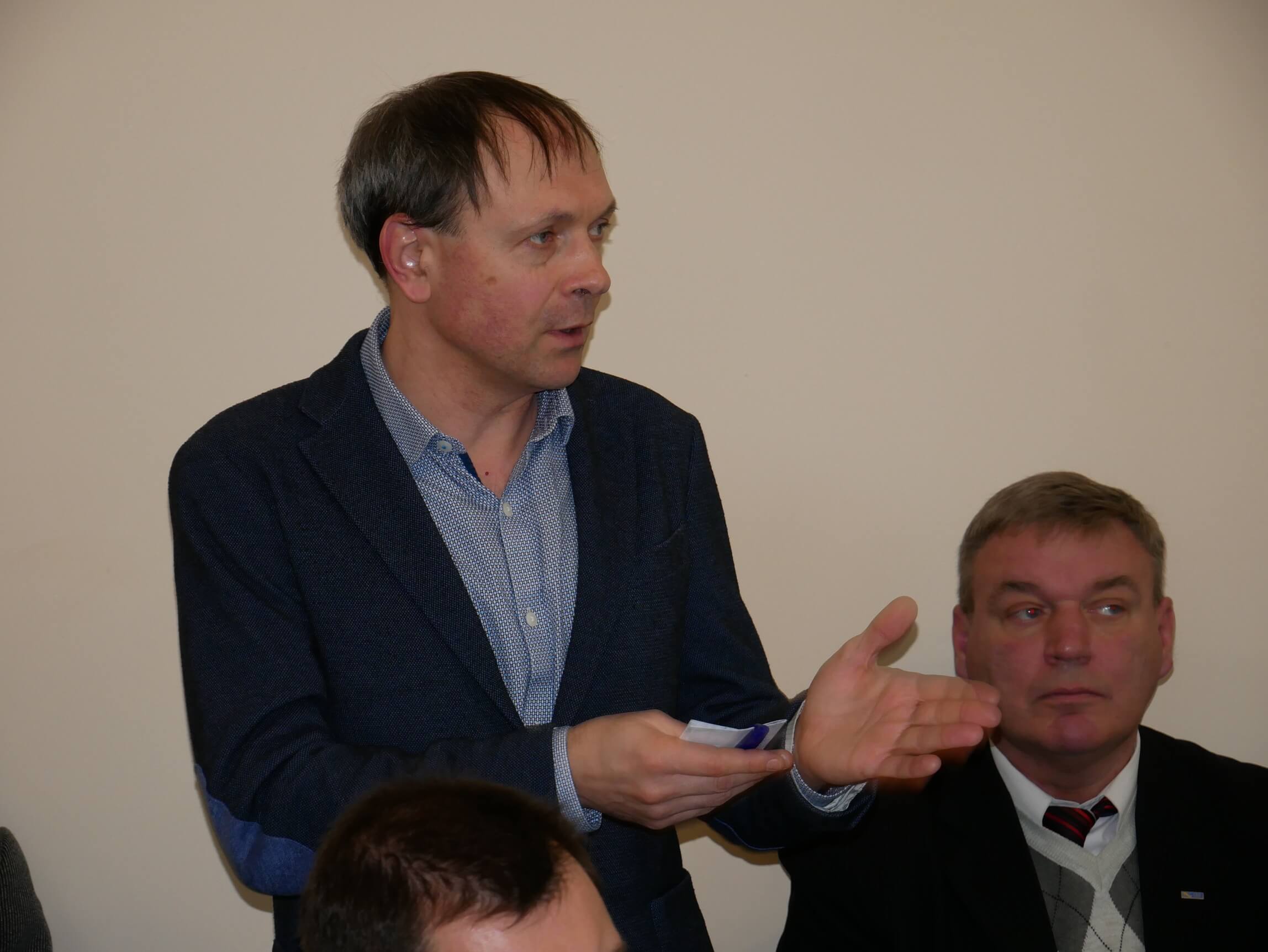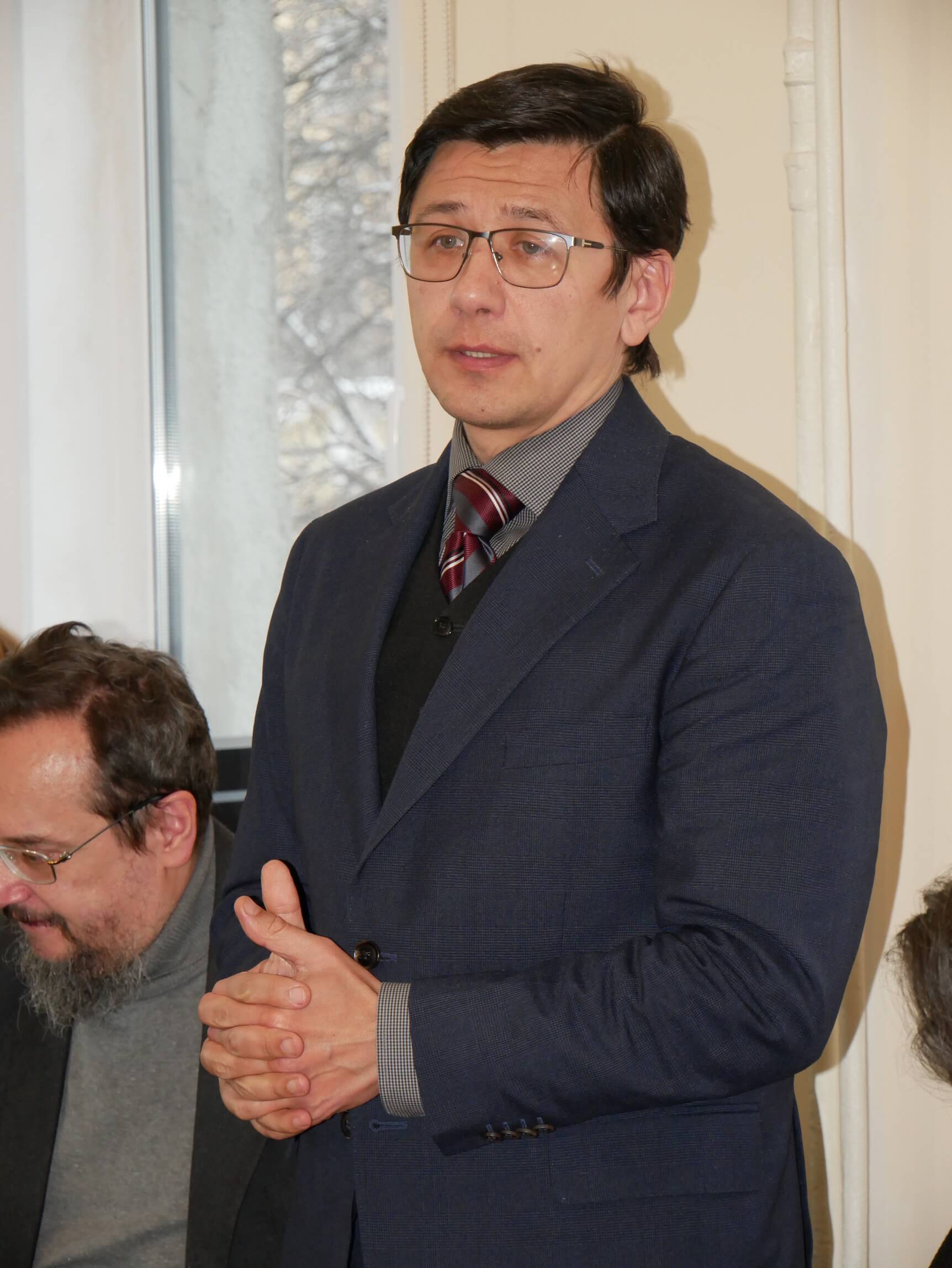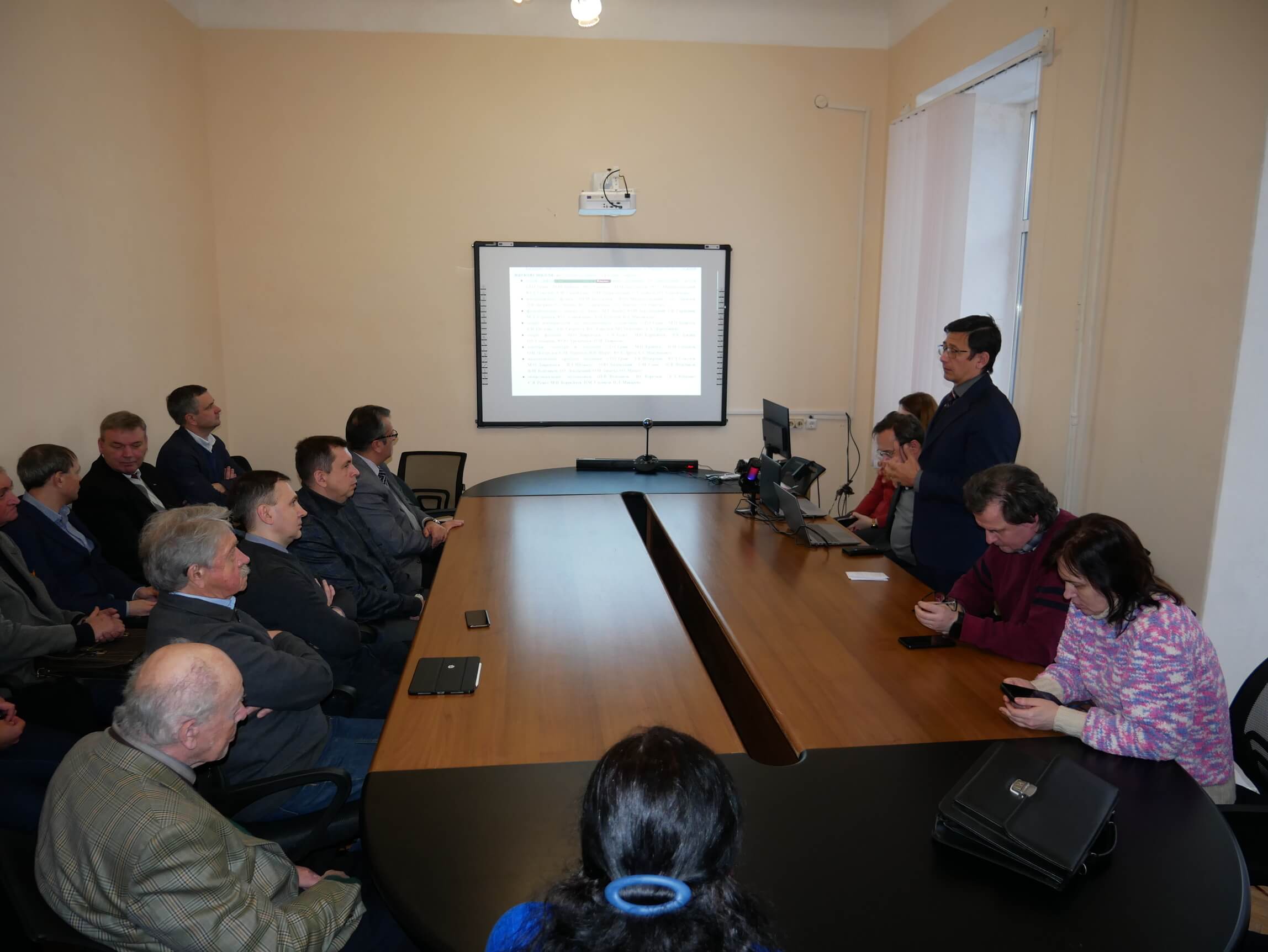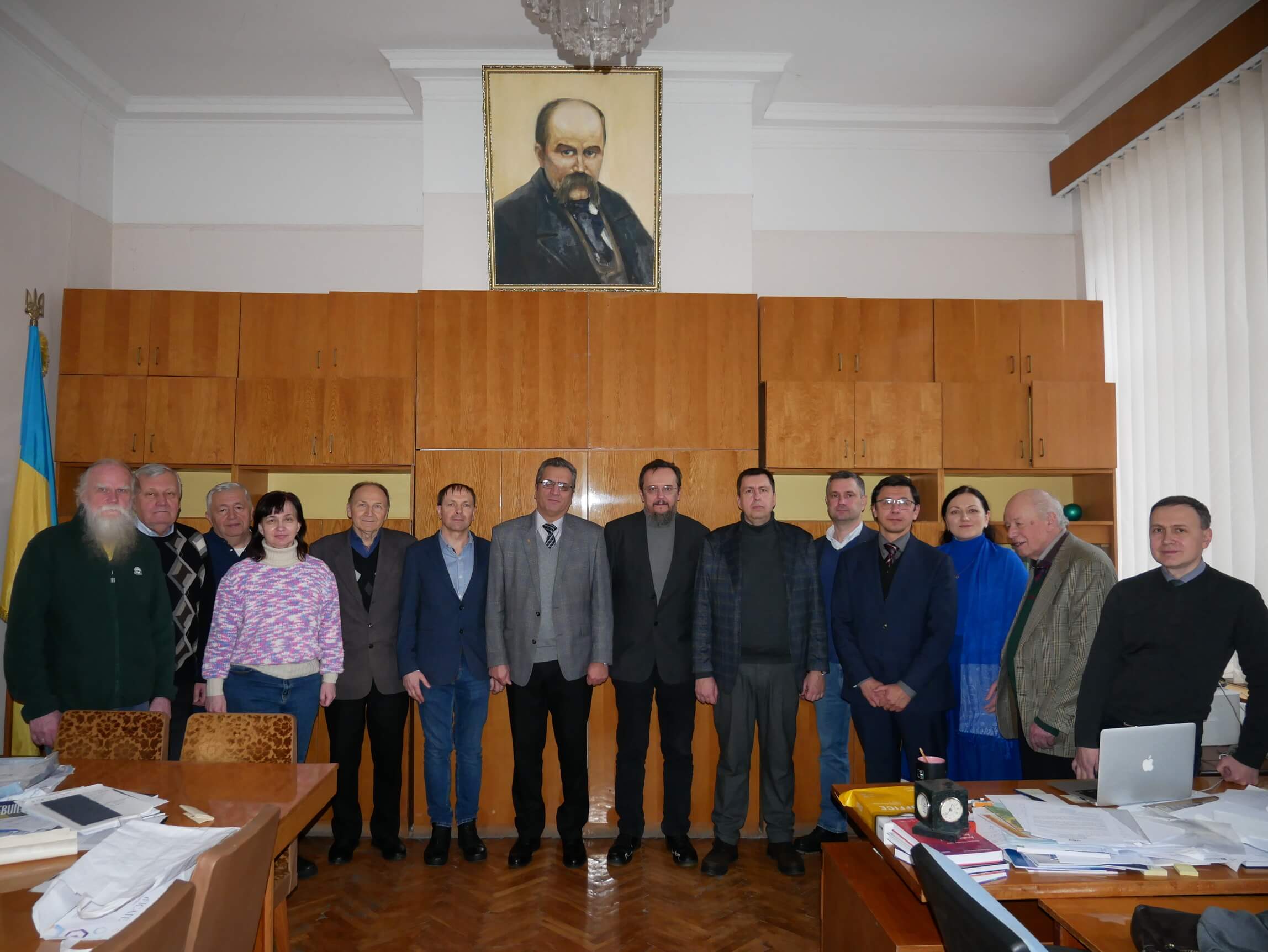
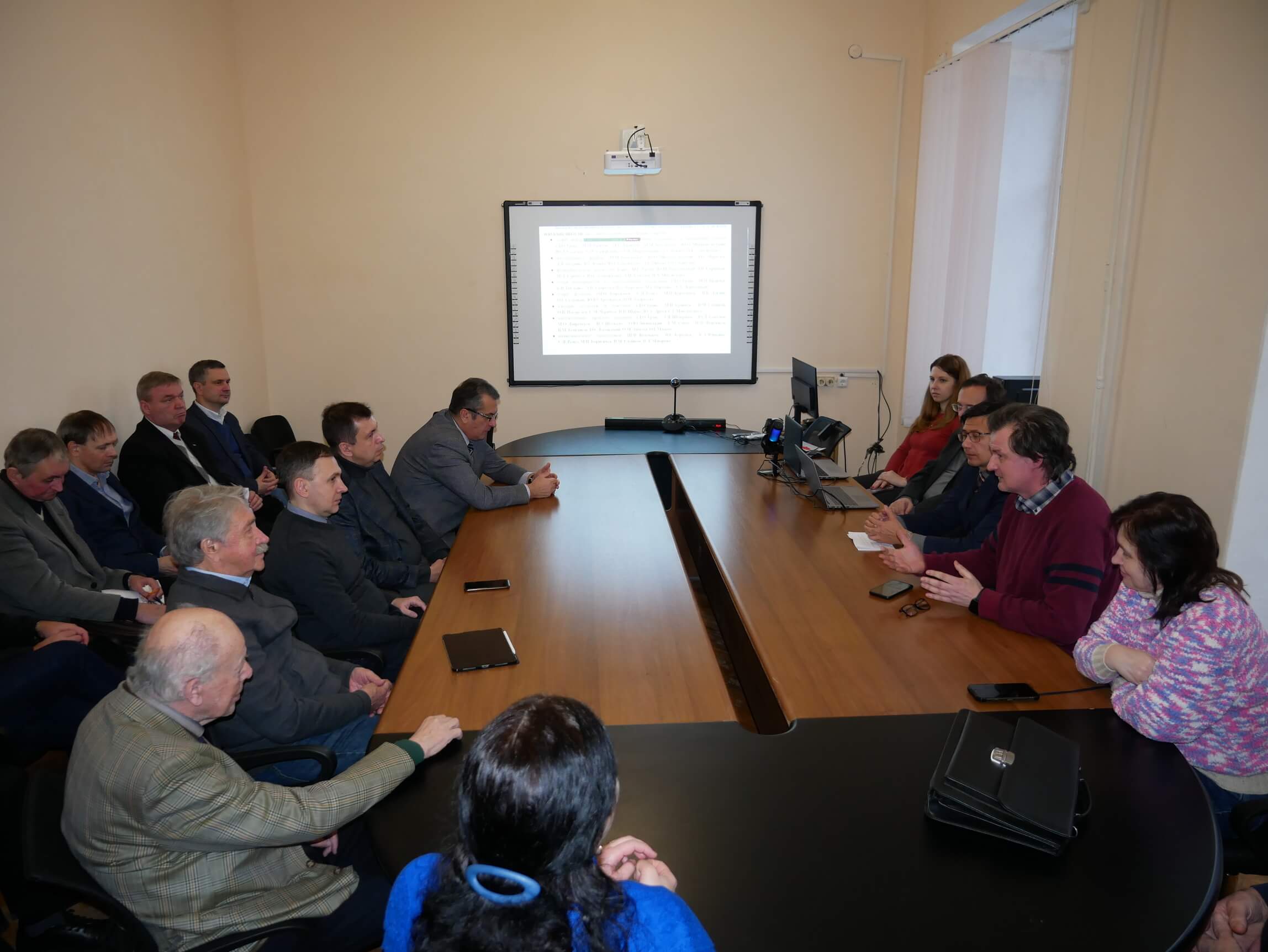
On January 8, 2026, the Institute of Mathematics of the NAS of Ukraine received a working visit from the first vice-president of the NAS of Ukraine, head of the Section of Physical-Technical and Mathematical Sciences, academician of the NAS of Ukraine Vyacheslav Bogdanov, academician-secretary of the Department of Mathematics of the NAS of Ukraine, academician of the NAS of Ukraine Oleksandr Tymoha (who is also the director of the mentioned Institute), and the scientific secretary of the Section, Doctor of Technical Sciences Serhii Bespalov. During the visit, the guests were accompanied by the deputy director for scientific work of the Institute of Mathematics of the NAS of Ukraine, Doctor of Physical and Mathematical Sciences Vitalii Vasilyk, and the scientific secretary of the Institute, Candidate of Physical and Mathematical Sciences Ihor Sokolenko.
In his introductory remarks, the director of the Institute of Mathematics of the NAS of Ukraine, academician of the NAS of Ukraine Oleksandr Tymoha, noted that the institution has a rich history that nominally begins in 1934, but in fact, the Institute was founded in 1920. Therefore, officially it is 91 years old, but essentially 106. Today, the institution continues to fulfill its mission as a leading national center for fundamental mathematical research.
During the meeting, attention was paid to the historic building of the Institute, which became a true "cradle" for many Academy institutions. The first mentions of the building date back to 1848; it belonged to various well-known families, including for a long time the family of philanthropists Tereshchenko. Over the years, initially as laboratories, institutes of physics, semiconductors, metal physics, nuclear research, theoretical physics, entomology and phytopathology, mining, and many others originated here. At different times, prominent scientists whose names have become legends worked in this building: academicians of the NAS of Ukraine Oleksandr Davidov, Vadym Lashkaryov, Oleksandr Leipunsky, Oleksandr Goldman; future institute directors, including academicians of the NAS of Ukraine Oleh Nimets, Mytrofan Pasichnyk, Marat Shpak. This vividly demonstrates how closely intertwined different fields of science are and positions the Institute not only as a center of mathematics but as a historic cradle from which a significant part of modern Ukrainian science grew. The legacy of these great scientists still lives within the walls of the Institute, creating a special atmosphere. There is an idea to immortalize their memory by transforming their offices into memorial spaces that would inspire new generations. An initiative was voiced to mark with special plaques the offices where world-renowned luminaries worked: academicians of the NAS of Ukraine Mykhailo Lavrentiev, Mykola Bogolyubov, Yurii Mitropolskyi, Oleksandr Sharkovskyi, and others. In this way, the Institute aims to preserve the historical memory of outstanding scientists whose results became the foundation of modern mathematics.
Over the years, the Institute was headed by academicians of the NAS of Ukraine Dmytro Grave (1934–1939), Mykhailo Lavrentiev (1939–1941, 1944–1948), Heorhii Pfeiffer (1941–1944), Oleksandr Ishlinsky (1948–1955), Borys Gnedenko (1955–1958), Yurii Mitropolskyi (1958–1988), and Anatolii Samoilenko (1988–2020). The duties of director were performed by Doctor of Physical and Mathematical Sciences Oleksandra Antoniuk (2020–2021) and academician of the NAS of Ukraine Oleksandr Boichuk (2021). Since December 2021, the institution has been headed by academician of the NAS of Ukraine Oleksandr Tymoha.
Since 2012, the main directions of the Institute’s scientific activity have been defined as:
- theory of differential equations, dynamical systems, and nonlinear oscillations;
- mathematical physics, methods of functional and nonlinear analysis;
- probability theory and mathematical statistics;
- theory of functions of real and complex variables;
- algebraic and topological structures;
- computational mathematics, analytical mechanics, and dynamics of mechanical systems.
Academician of the NAS of Ukraine Oleksandr Tymoha also spoke about the current personnel potential, the structure of scientific achievements, the publication activity of the Institute’s scientists, its educational mission, and current challenges. Over the past three years, the Institute’s staff has remained relatively stable, which indicates the institution’s ability to maintain scientific potential even under current difficult conditions.
A key positive trend is the steady growth in the number of articles published in first quartile (Q1) journals, stimulated by an internal policy of awarding bonuses for articles in high-ranking journals.
Today, the Institute’s international recognition is confirmed by the following key markers.
1. Leadership in national rankings. For the third consecutive year, the Institute ranks first in Ukraine according to the "Center for World University Ranking," which testifies to the high reputation and significant scientific contribution of its postgraduate and doctoral graduates and staff to global mathematics. For decades, the Institute of Mathematics of the NAS of Ukraine has been the place where the most outstanding Ukrainian and foreign mathematicians defended their dissertations, developed scientifically, and built their careers. The ranking takes into account their achievements and reputation on the international stage as the legacy of the institution that nurtured them. The long-term impact of the Institute far exceeds any formal indicators. Its true strength is measured not only by the works of its permanent staff but also by generations of leading scientists who started their global scientific careers here, for whom it became a fundamental career springboard.
2. Publishing activity. The Institute publishes five scientific journals. Its flagship publication, the "Ukrainian Mathematical Journal," enjoys high international authority: three-quarters of the articles come from foreign authors.
3. Expert role. Forty-seven scientists from the Institute are members of editorial boards of leading international mathematical publications, highlighting their high qualifications and integration into the global scientific community.
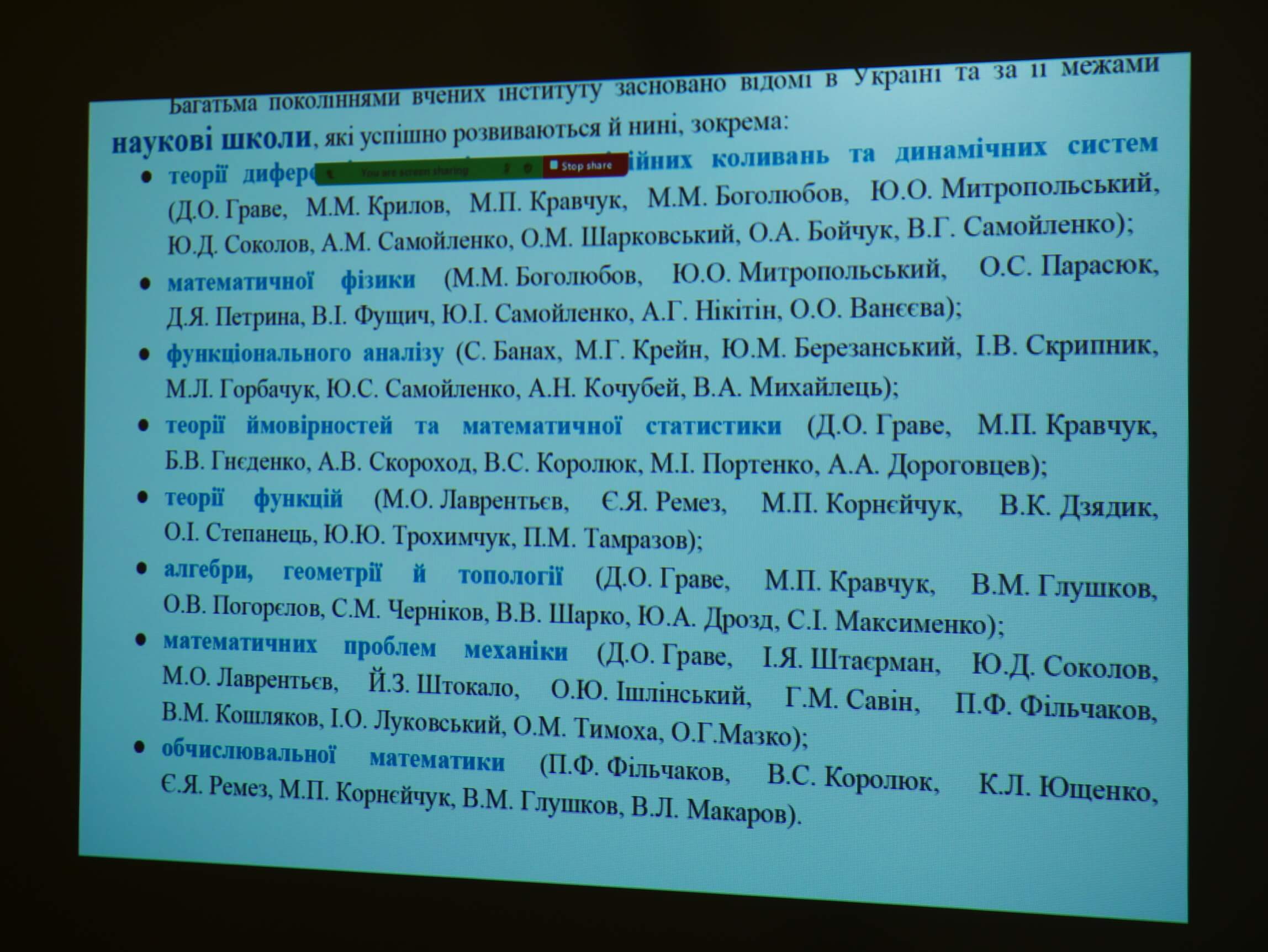
Academician of the NAS of Ukraine Oleksandr Tymoha paid special attention to the description of leading scientific schools, which are the intellectual core and foundation of the Institute’s intellectual capital. They ensure the continuity of unique research traditions established by outstanding scientists and serve as a platform for generating new knowledge and training future generations of researchers.
The head of the Department of Mathematical Physics, Doctor of Physical and Mathematical Sciences Vyacheslav Boiko, informed about the activities of two scientific schools:
- theory of differential equations, nonlinear oscillations, and dynamical systems (its founders and key figures include Dmytro Grave, Mykola Krylov, Mykhailo Kravchuk, Mykola Bogolyubov, Yurii Mitropolskyi, Yurii Sokolov, Anatolii Samoilenko, Oleksandr Sharkovskyi, Oleksandr Boichuk, and Valerii Samoilenko);
- mathematical physics (founders and key figures include Mykola Bogolyubov, Yurii Mitropolskyi, Ostap Parasiuk, Dmytro Petryna, Wilhelm Fushchych, Yurii Samoilenko, Anatolii Nikitin, and Olena Vanieieva).
By the way, representatives of these scientific schools recently received grants from the National Research Foundation of Ukraine, and earlier prestigious international grants from the Max Planck Society Mathematical Institute and L'Oréal-UNESCO for Women in Science, which testifies to the high level and relevance of their research.
The head of the Department of Functional Analysis, Doctor of Physical and Mathematical Sciences, Professor Vasyl Ostrovskii presented the school of functional analysis (its founders and key figures include Stefan Banach, Marko Krein, Yurii Berezansky, Ihor Skrypnyk, Myroslav Horbachuk, Yurii Samoilenko, Anatolii Kochubei, and Volodymyr Mykhailiets). The main research directions of the school are spectral theory of operators, infinite-dimensional analysis, and algebraic methods. Recently, new directions have been actively developing, including mathematical methods in quantum information and quantum biology. The Institute of Mathematics of the NAS of Ukraine represents this school through two departments. Scientists of the school (including senior researcher of the Department of Functional Analysis, Candidate of Physical and Mathematical Sciences Danylo Yakymenko) won a prestigious grant in the field of quantum biology. The school’s shift toward quantum information and biology demonstrates its successful adaptation to new high-priority research areas, positioning it as a key player in interdisciplinary science.
The chief researcher of the Department of Probability Theory, Corresponding Member of the NAS of Ukraine Mykola Portenko, presented the school of probability theory and mathematical statistics. Its founders and key figures include Dmytro Grave, Mykhailo Kravchuk, Borys Gnedenko, Anatolii Skorokhod, Volodymyr Koroliuk, Mykola Portenko, and Andrii Dorohovtsev. The main research directions are theory of random processes, stochastic differential equations, and Malliavin calculus. Representatives of the school have received three international awards, including recently the Kiyosi Itô Prize. The school conducts an international online seminar "Malliavin Calculus and Its Applications," which unites scientists from Ukraine, Germany, the United Kingdom, and other countries.
The head of the Department of Function Theory, Doctor of Physical and Mathematical Sciences, Professor Anatolii Romaniuk, and the head of the Department of Complex Analysis and Potential Theory, Doctor of Physical and Mathematical Sciences, Professor Serhii Plaksa, presented the school of function theory. Its founders and key figures include Mykhailo Lavrentiev, Yevhen Remez, Mykola Korneichuk, Vladyslav Dziadyk, Oleksandr Stepanets, Yurii Trokhymchuk, and Promarz Tamrazov. The main research directions are approximation theory, quasiconformal mappings, and extremal problems in functional classes. The school, represented in the Institute by two departments, has undergone a difficult generational transition, preparing a number of young doctors of sciences. Effective succession of scientific personnel in this school is a valuable institutional model for ensuring the long-term sustainability of other key research directions.
The head of the Department of Algebra and Topology, academician of the NAS of Ukraine Serhii Maksymenko, and the chief researcher of this department, corresponding member of the NAS of Ukraine Yurii Drozd, presented the school of algebra, geometry, and topology. Its founders and key figures include Dmytro Grave, Mykhailo Kravchuk, Viktor Glushkov, Oleksii Pohorelov, Serhii Chernikov, Volodymyr Sharko, Yurii Drozd, and Serhii Maksymenko. The main research directions are representation theory, group theory, algebraic and differential topology, and computation of critical points of smooth functions on manifolds. In the 1970s, the school became one of the world leaders. Today, its graduates are professors at the best universities in Germany, the United Kingdom, and Brazil, maintaining the school’s high reputation.
The head of the Department of Computational Mathematics, Doctor of Physical and Mathematical Sciences Vitalii Vasilyk, presented the school of computational mathematics. Its founders and key figures include Pavlo Filchakov, Volodymyr Koroliuk, Kateryna Yushchenko, Yevhen Remez, Mykola Korneichuk, Viktor Glushkov, and Volodymyr Makarov. The main research directions are difference scheme theory, numerical methods for spectral and inverse problems, solving ill-posed problems, and mathematical foundations of machine learning. The school actively develops international cooperation, participating in joint projects with universities in Germany and Canada, emphasizing its integration into global research and the relevance of work in machine learning.
Academician of the NAS of Ukraine Oleksandr Tymoha presented the school of mathematical problems of mechanics. Its founders and key figures include Dmytro Grave, Illia Shtaierman, Yurii Sokolov, Mykhailo Lavrentiev, Yosyp Shtokalo, Oleksandr Ishlinsky, Hurii Savin, Pavlo Filchakov, Volodymyr Koshliakov, Ivan Lukovskyi, Oleksandr Tymoha, and Oleksii Mazko. The main research directions are mathematical modeling of dynamic processes, theory of nonlinear oscillations, dynamics of rigid bodies and systems of bodies, interaction of rigid bodies with fluid (hydromechanics), mathematical problems of elasticity theory, approximate and analytical methods. The school actively develops international cooperation and develops mathematical models of nonlinear dynamics of complex systems and interaction of bodies with fluid, focusing on promising tasks in space technology, energy, and creating high-precision analytical methods for the engineering of the future.
As the director of the Institute further informed, the institution’s funding is diversified but limited. All budget funds are directed to salary payments. However, even under these conditions, these funds cover only 0.89 of the payroll fund. Actual full employment, payment of utilities, and operational expenses are covered by grants and competitive scientific projects, including foreign ones. This model creates financial pressure on scientists and slows the strategic development of the Institute. It contradicts global practice, where basic funding must cover the payroll fund of main permanent scientific staff and utilities and operational expenses, while grants are directed toward development—personnel, infrastructure, etc.
The key sources of income to the special fund at the Institute level in recent years are:
- grants from the National Research Foundation of Ukraine (in the latest competition "Advanced Science in Ukraine 2026-2028," the Institute’s scientists won grants for two new projects);
- targeted programs of the NAS of Ukraine (the Institute actively participates in projects under the budget program "Support for the Development of Priority Scientific Research Directions" (KPKVK 6541230), funds are a significant donor to achieving 100% payroll coverage);
- international projects (the Institute is a winner of European programs, including the "Horizon 2020" program);
- grants from the "Simons Foundation."
In 2022–2023, charitable and sponsorship assistance played a significant role, thanks to which over 100 windows and frames damaged by missile strikes in central Kyiv were restored. IT companies also help the Institute. They have donated dozens of used but functional laptops, office furniture, and more free of charge.
The key task of the Institute for preserving and developing unique scientific schools is the systematic training of a new generation of scientists capable of continuing traditions and responding to modern scientific challenges. Training highly qualified scientists is a strategic priority of the Institute, implemented through deep integration of scientific research and the educational process.
An effective "head-hunting" model has been developed: a joint master's program with the Kyiv Academic University is unique and functions as an effective model for attracting the best students from leading universities in Ukraine. Statistics confirm the success of the model: over 5 years, 31 masters have graduated, 19 of whom entered postgraduate studies, including 12 directly at the Institute of Mathematics of the NAS of Ukraine. This approach significantly helps ensure the continuity of scientific schools. It allows early integration of the younger generation into the research environment, nurturing not just specialists but future leaders. Moreover, this strategy has nationwide significance, as Ukraine experiences a sharp shortage of personnel in mathematics teaching. By training a new generation, the Institute supports not only itself but the entire ecosystem of Ukrainian science and engineering.
The number of postgraduate students at the institution is growing—currently, there are 30. Four specialized scientific councils operate for defending doctoral dissertations, covering almost all mathematical specialties. This makes the Institute a unique center for certification of highly qualified scientific personnel in the country.
Nationwide online courses of the Institute actively popularize fundamental science. By opening online access to its master's and postgraduate courses for students across Ukraine, the Institute expands access to knowledge. This initiative enables youth from regions to attend lectures by leading specialists in narrowly specialized fields (for example, complex analysis or differential geometry), which are often absent in regional higher education programs.
In addition to achievements, academician of the NAS of Ukraine Oleksandr Tymoha spoke about systemic challenges and difficulties currently restraining the institution’s potential, about its activities during wartime, and about problems that need to be solved to ensure the long-term strategic goals of the institution as a European center for mathematical research and education.
Despite significant scientific achievements, the Institute’s activities are complicated by chronic infrastructural, financial, and regulatory problems that require urgent resolution at the level of state authorities.
Over the past 20 years, the Institute has not received state funding for updating scientific equipment. Such prolonged underfunding of physical and digital infrastructure is a critical operational risk that directly restrains research productivity and threatens the safety and integrity of the historic national asset.
As already mentioned, 100% of the Institute’s budget funds today are directed to salary payments, while all operational expenses (such as utilities, repairs, materials, and other development costs) are covered exclusively by the special fund, which is mostly a product of international scientific activity. In fact, what the Institute "earns" for development "burns out" in the furnace of operational losses.
The Institute’s activities face a number of obstacles—impossibility to open accounts in commercial banks, legislative prohibition on foreign travel for male scientists (including one of the EU "ERASMUS+" program projects, which involves exchange of postgraduate students with Friedrich Schiller University in Jena, Germany, has not started since 2023), prohibition on currency transfer for paying membership fees to international unions. These barriers undermine the Institute’s integration into the European Research Area, hinder participation in international projects, damage international reputation, and partially isolate the scientific community.
Overcoming existing challenges and fully realizing the Institute’s scientific potential requires not only internal efforts but also systemic solutions and strategic initiatives. The Institute’s leadership has identified the following priority development directions.
1. Preparation has begun to establish a Center for Advanced Mathematical Research and Education based at the Institute. This initiative aims to concentrate intellectual resources, develop interdisciplinary projects, and strengthen the educational component.
2. The main financial goal is to transfer all utility expenses to budget financing, which will free special fund resources for targeted investment in scientific development, infrastructure modernization, and support for young scientists.
3. A strategic priority is strengthening and expanding unique educational programs. The Institute plans to create sustainable financial support mechanisms for master’s and postgraduate students to enable them to fully focus on scientific work.
4. After the end of martial law, the Institute intends to resume the practice of holding large international conferences and mathematical congresses in Ukraine. This will not only integrate Ukrainian scientists into the global context but also strengthen the scientific prestige of our country on the international stage.
5. Together with the Presidium of the NAS of Ukraine, the Institute is ready to fight for resolving regulatory issues, including permission for currency operations, foreign travel for scientists, etc. Removing these barriers is a necessary condition for the full integration of Ukrainian mathematical science into the European Research Area.
In conclusion, academician of the NAS of Ukraine Oleksandr Tymoha emphasized that today the Institute of Mathematics of the NAS of Ukraine is much more than just a collection of offices and scientific departments. It is a living organism with a rich history, resilient people, and a creative approach to problem-solving. Its walls remember the birth of Ukrainian physics, its rankings reflect the success of dozens of generations of scientists, and its financial strategies demonstrate an amazing capacity for adaptation. Today, the Institute’s strength lies not only in the elegance of proven theorems but also in the ability to nurture talents, overcome bureaucratic traps, and keep moving forward despite everything. Fundamental science in mathematics is, above all, about people, and the Institute has a place for every talented researcher—whether from Ukraine or abroad.
The discussion of problems and prospects of the Institute of Mathematics of the NAS of Ukraine also involved the head of the Scientific Committee of the National Council of Ukraine on Science and Technology Development, leading researcher of the Department of Nonlinear Analysis, Doctor of Physical and Mathematical Sciences Oleksandra Antoniuk, and leading researcher of the Department of Mathematical Physics, corresponding member of the NAS of Ukraine Olena Vanieieva.
At the end of the visit, the first vice-president of the NAS of Ukraine, academician of the NAS of Ukraine Vyacheslav Bogdanov, emphasized that the Institute of Mathematics of the NAS of Ukraine is a strategic asset of the state, highly appreciated the current activities of the Institute’s scientific schools, particularly the high quality of their research despite the difficult conditions of wartime. He separately noted that many talented young people work at the Institute, whose preservation and development of potential is a significant achievement of the Institute’s management.
It was agreed to support the initiative to create the Center for Advanced Mathematical Research and Education, as well as to assist in resolving the raised problematic issues.
According to information from the Department of the NAS of Ukraine and the Institute of Mathematics of the NAS of Ukraine
Photo: press service of the NAS of Ukraine