


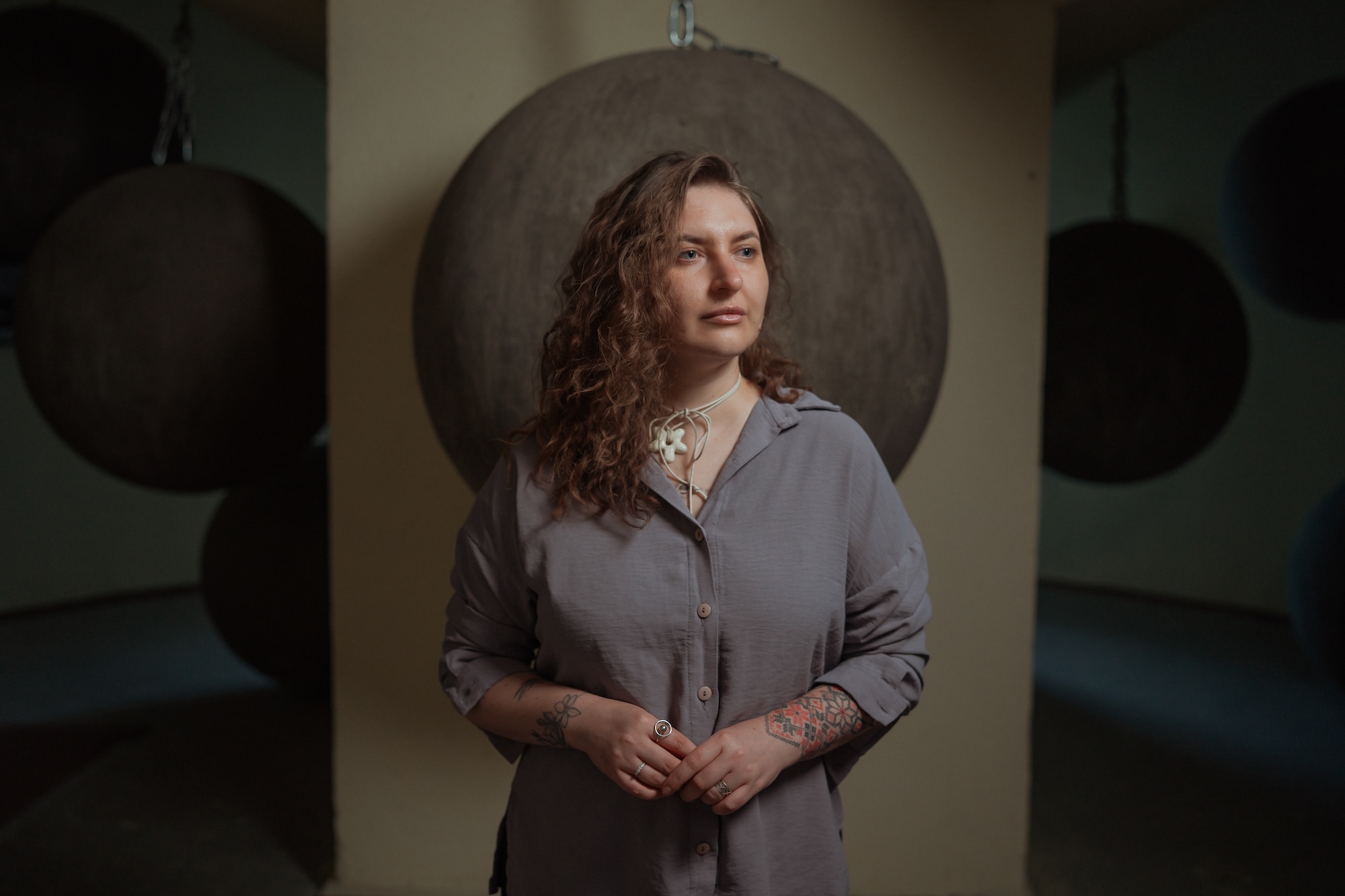
How many stars are in the sky? Why does spring come after winter? What is the Moon made of? Questions about the Universe fascinated Olena Kompaniiets from a young age. The future scientist grew up in Osokorivka in the Kherson region, where light pollution hardly interfered with starwatching. Her interest in science was instilled by her father, who explained to the girl how the world around her works and introduced her to telescopes. Olena was so passionate about astronomy that she even earned the nickname Cosmos at school. After school, she actively studied sunspots day after day. Eventually, she was able to fulfill her cherished dream, although it did not happen immediately: first, she prepared a project for the Junior Academy of Sciences, then, on her second attempt, she entered the Physics and Mathematics Lyceum in Kryvyi Rih, and now she works at the Main Astronomical Observatory of the NAS of Ukraine as a junior research fellow. She studies isolated galaxies, which she calls introverted galaxies. At the same time, she tells children about her beloved stellar sky, as Olena is a well-known science popularizer in the country. For example, her book "Secrets of the Polar Aurora" was recently published.
Russian aggression changed the life of our colleague and significantly affected her research: the occupation of Crimea deprived her of access to the telescopes there, which she worked with at the beginning of her scientific career; the Kakhovka disaster did not bypass Olena’s native village; her father and boyfriend serve in the military. But no enemy missile and no drone, fortunately, can extinguish the light of distant galaxies.
Olena Kompaniiets shared her successes, hardships, and plans with the journalists of the online magazine “The Ukrainians.” Read the photo report here.