


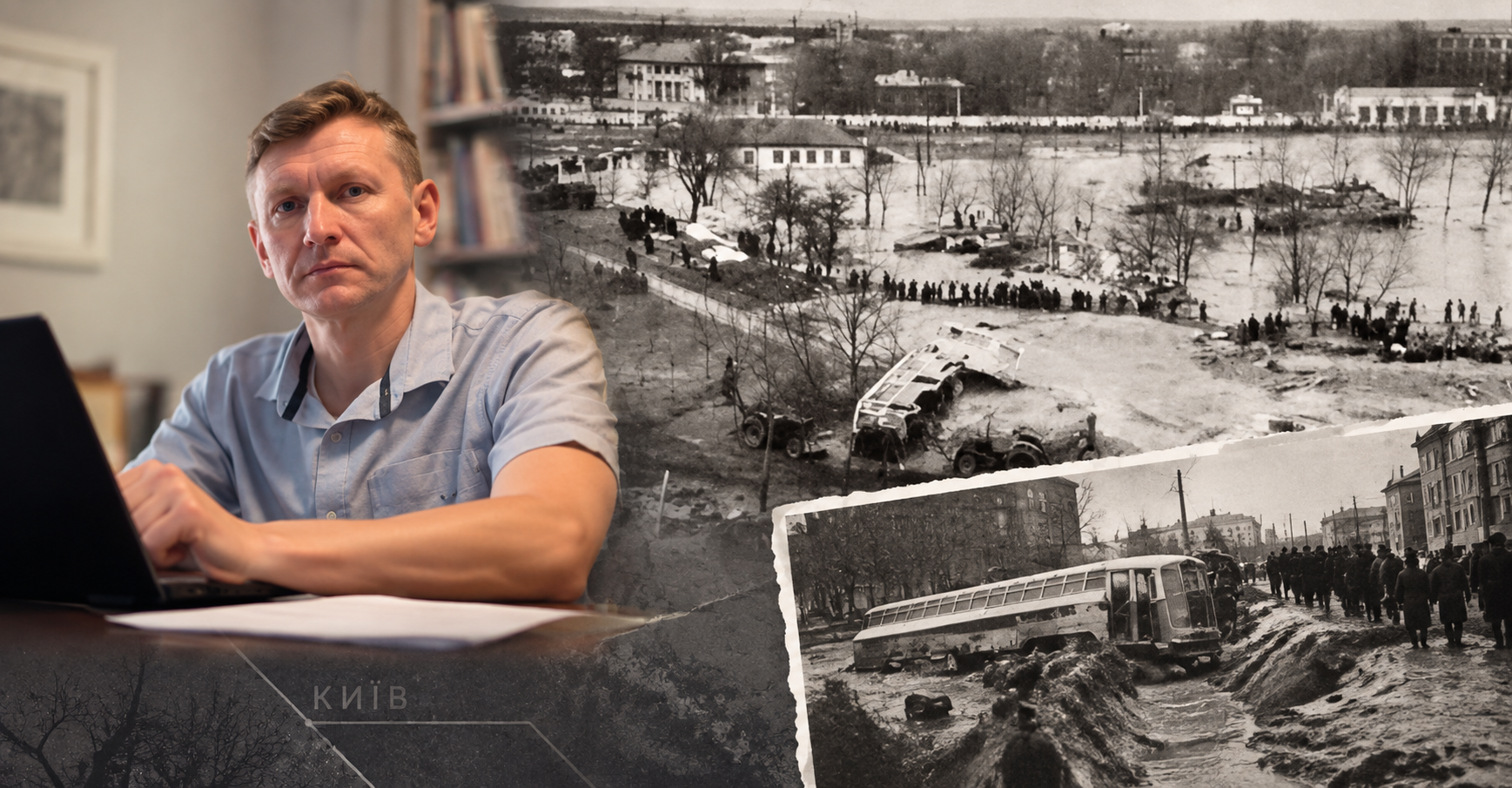
 On March 13, 1961, Kyiv experienced one of the largest man-made disasters of the Soviet era. After the dam broke in Babyn Yar, a flow of water and slurry covered Kurenivka, destroying houses, transportation, and infrastructure, and taking human lives. Why this tragedy was not accidental, what decisions led to the disaster, how many people actually died, and how the Soviet authorities tried to conceal its scale were explained by senior researcher at the Institute of History of Ukraine of the NAS of Ukraine, Candidate of Historical Sciences Viktor Krupina during the "Historical Webinar."
The topic of his presentation was "The Kurenivka Tragedy of 1961: A Local Accident of State Scale."
The prerequisites for the disaster were formed over almost a decade. In the early 1950s, liquid waste from the Petrovsky Brick Factories – clay slurry – began to be dumped into the third spur of Babyn Yar. According to various estimates, a total of 3.2 to 4 million cubic meters of this mass accumulated there.
This decision aimed to solve several tasks simultaneously: to rid the brick factories of waste, to level the complex terrain of Babyn Yar for further development and park arrangement. At the same time, as Viktor Krupina emphasized, this policy fit into the Soviet authorities' desire to erase the memory of Babyn Yar as a place of mass shootings of Jews and other victims of Nazi terror during World War II.
The situation was worsened by numerous technical violations. Instead of a concrete dam, an earthen dam was built, the pipes for water drainage had insufficient capacity, and the slurry was supplied much longer than planned: instead of eight hours a day, it was 16 hours or even around the clock. The water neither had time to be pumped out nor to evaporate.
The first signs of the accident appeared on the morning of March 13. Around 6:45 – 7:00 a.m., a duty worker noticed water breaking through the upper dam. However, no evacuation of the population was announced. Around 8:30 a.m., fire trucks arrived to pump out the water, but it was already impossible to stop the development of the accident.
The water eroded the lower dam, movement along Frunze Street (now Kyrylivska) became difficult, traffic jams formed from trams, buses, and other transport. Soon the dam could not hold.
A wave of water-saturated slurry about 8-10 meters high rushed into Kurenivka. It moved at a speed of 3-5 meters per second – up to 18 km/h. In total, over 600,000 cubic meters of mud mass broke out from Babyn Yar.
Within just a few tens of minutes, it covered about 30-34 hectares. Residential buildings and private estates, a hospital, a school, the Podil tram depot named after Krasin were completely or partially destroyed. Workers of the morning shift died in the depot. One of the passenger buses caught fire due to a short circuit in the disaster zone.
The historian separately focused on the number of victims – one of the most debated issues in the history of the Kurenivka tragedy. The official government commission reported 145 dead and about 143 injured. At the same time, later testimonies of Soviet officials mentioned the figure of 198 dead.
For decades, estimates of 1,500 to 3,000 victims were also circulated. However, according to Viktor Krupina, the processing of archival materials, including documents from the SBU and civil registration authorities, provides grounds to estimate the actual number of dead within 145 to 200 people. The historian also noted that the total number of residents in the area flooded was about 1,300 people.
The Soviet authorities tried to severely limit the spread of information about the tragedy. In Kyiv, long-distance telephone communication was cut off for several days, the disaster area was surrounded by the military, and witnesses had their cameras and films confiscated. The dead were buried in different cemeteries and on different days, which prevented seeing the real scale of human losses.
The causes of the disaster were investigated by a special government commission. It was headed by Petro Bakuma, president of the Academy of Construction and Architecture of the Ukrainian SSR. The commission concluded that the tragedy was caused by the imperfection of the project, deepened by negligence during the work.
Six people were held criminally responsible – two designers from Moscow and four heads of Kyiv construction and installation departments. They received sentences ranging from three to five years in prison. Material damages to the state were estimated at over 3 million Soviet rubles. Compensation was paid to the victims, and more than 390 new apartments were provided to families.
As the history of the Kurenivka tragedy shows, the disaster of March 13, 1961, was not a sudden natural calamity. It was preceded by years of dangerous technical decisions, violations, and neglect of risks, and after the accident – censorship and attempts to conceal its true scale.
More details are available in the webinar video recording.