


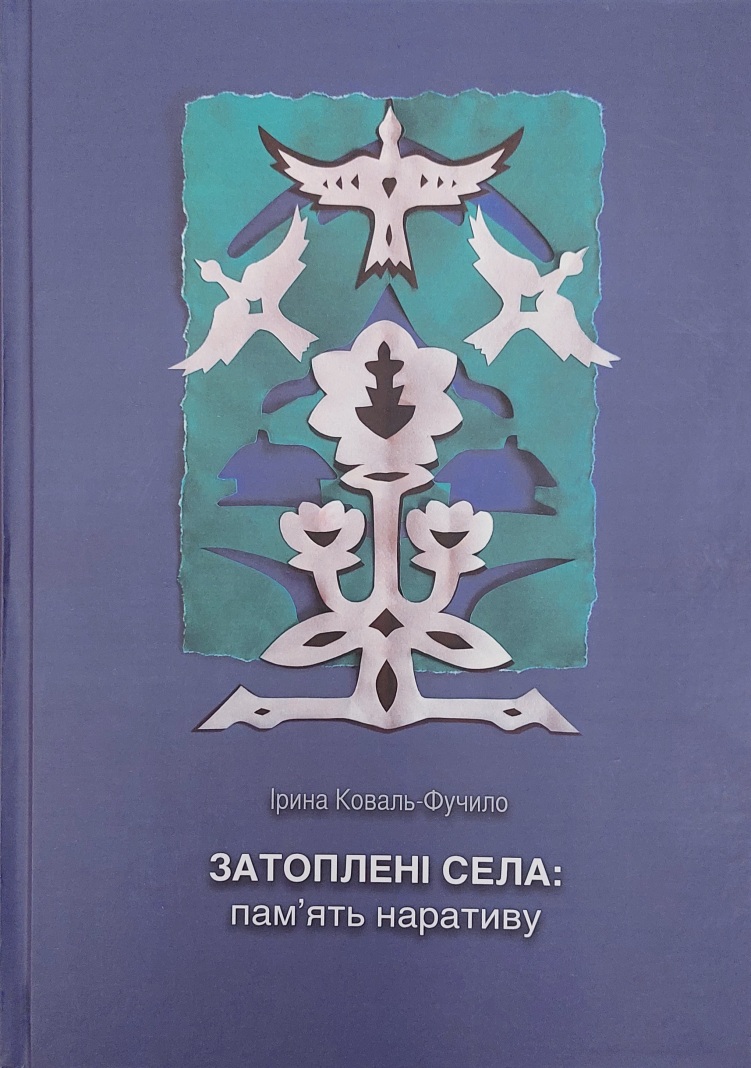
At the end of 2025, a monograph by the Ukrainian scholar-folklorist, senior research fellow of the Department of Ukrainian and Foreign Folklore at the M. T. Rylsky Institute of Art Studies, Folklore and Ethnology of the NAS of Ukraine, Candidate of Philological Sciences Iryna Koval-Fuchylo, titled "Flooded Villages: Memory of the Narrative," was published.
In this work, for the first time in Ukrainian folklore studies, memories of resettlement from the zones of hydroelectric power plants and artificial reservoirs construction from the mid-1950s to the early 1980s were comprehensively researched, as well as forms of popular memory about flooded villages (books, meetings, memorial crosses and signs, museum corners, photo exhibitions, etc.) were presented. The analyzed texts constitute a resettlement narrative. Its themes, nomination of main phenomena, and ways of presenting experience were studied.
The main source material consists of the author's own recordings made from 2012 to 2024 during seven expeditions to villages in the Kremenchuk district of Poltava region, Kamianets-Podilskyi district of Khmelnytskyi region, Zolotonosha and Cherkasy districts of Cherkasy region, as well as the former Svitlovodsk district of Kirovohrad region and the former Pereiaslav-Khmelnytskyi district of Kyiv region. A number of recordings were made in Pereiaslav and Kyiv: these include, in particular, interviews with two Kherson residents who survived the flooding caused by the destruction of the Kakhovka HPP dam by Russian occupiers on June 6, 2023. These materials are presented in the appendices to the monograph.
The strategy of the resettlement narrative was formed under the influence of contradictions between the official position of the state and the experience of the loss of land, home, and native village. The textual array consists of stories about the traumatic experience of the inability to resist the state machine. The motifs of loss are especially pronounced in our time.
The book is intended for scholars and everyone interested in the history of Ukraine in the 20th–21st centuries and the folk narrative tradition.
FULL ELECTRONIC VERSION OF THE BOOK
According to the information from the M. T. Rylsky Institute of Art Studies, Folklore and Ethnology of the NAS of Ukraine