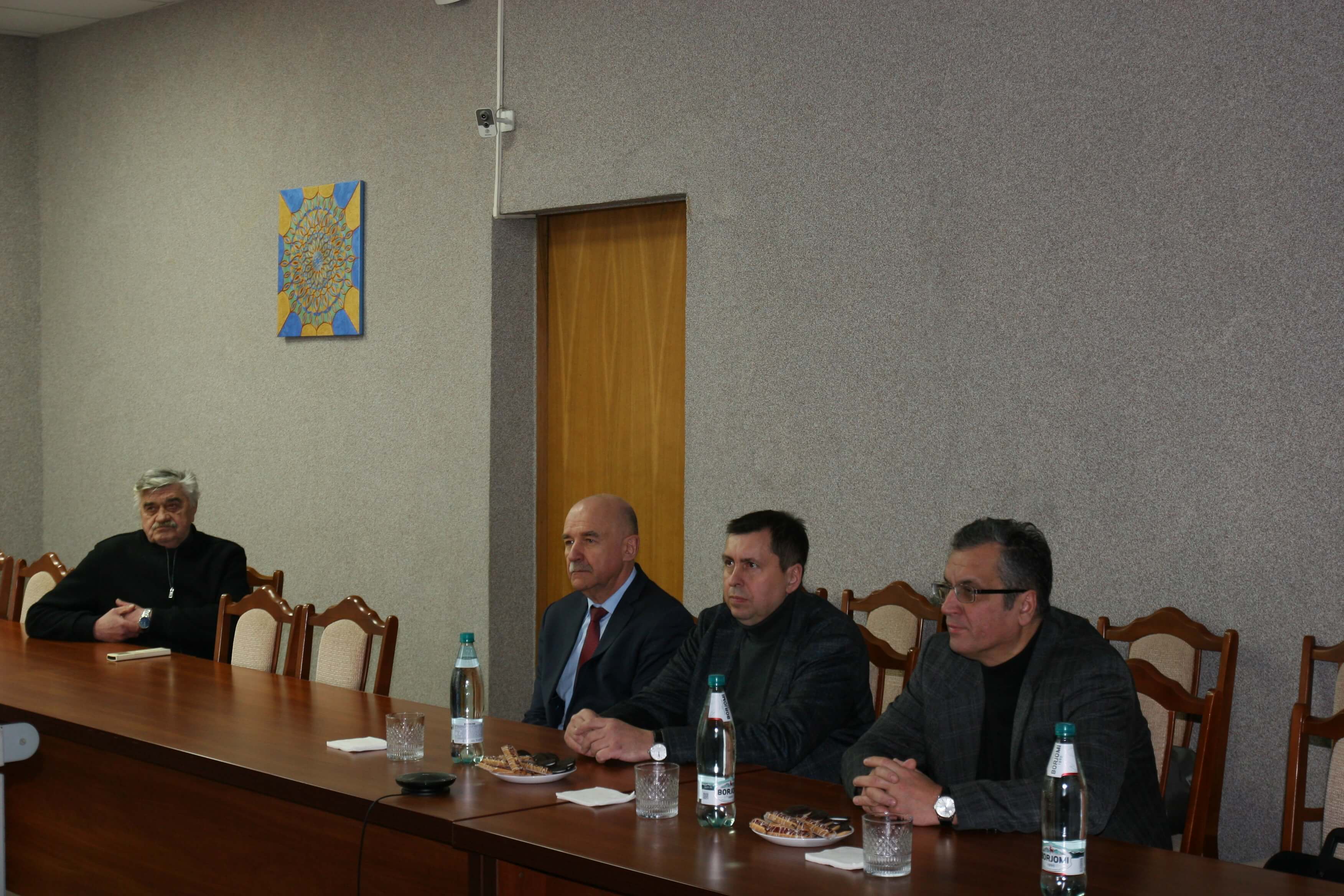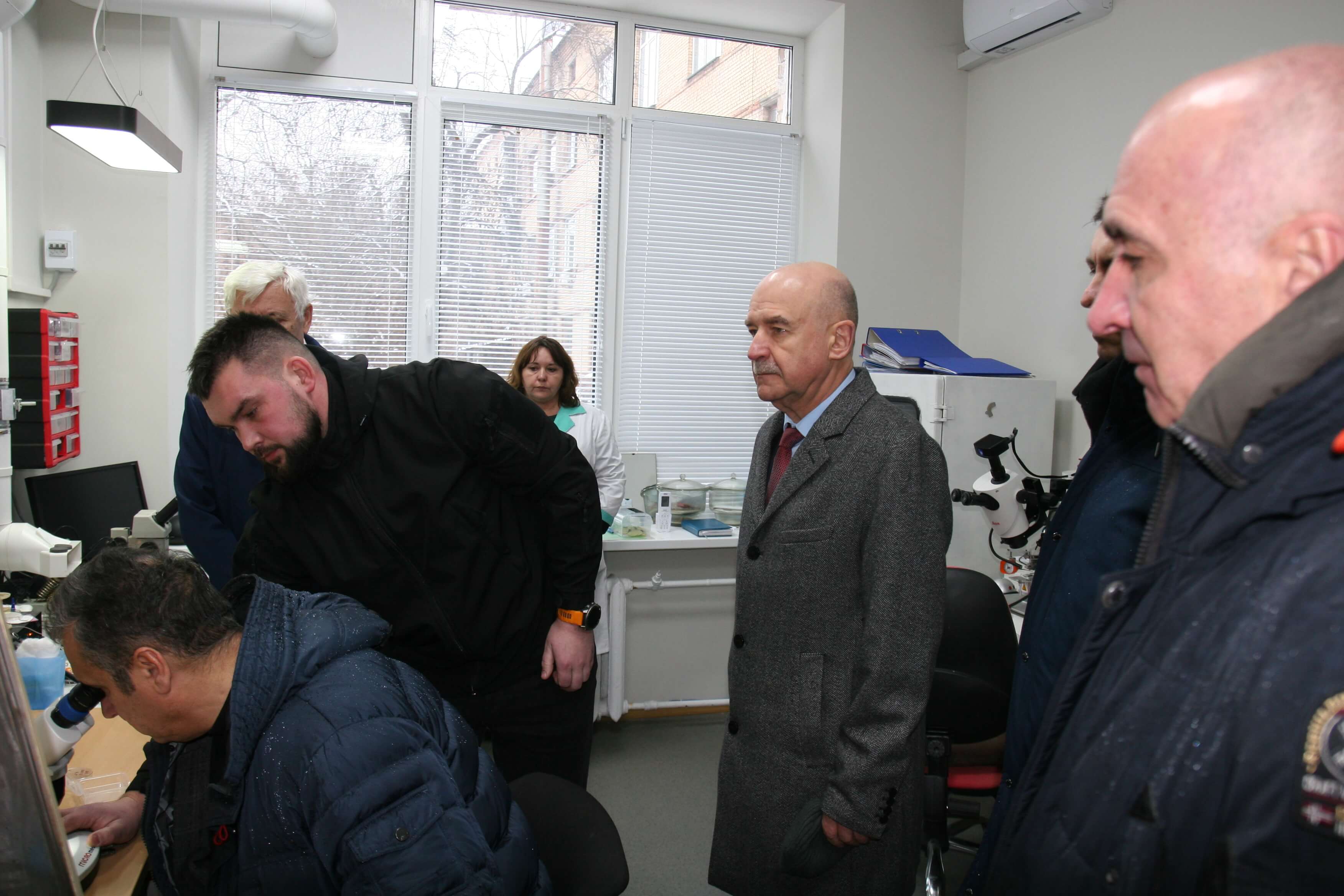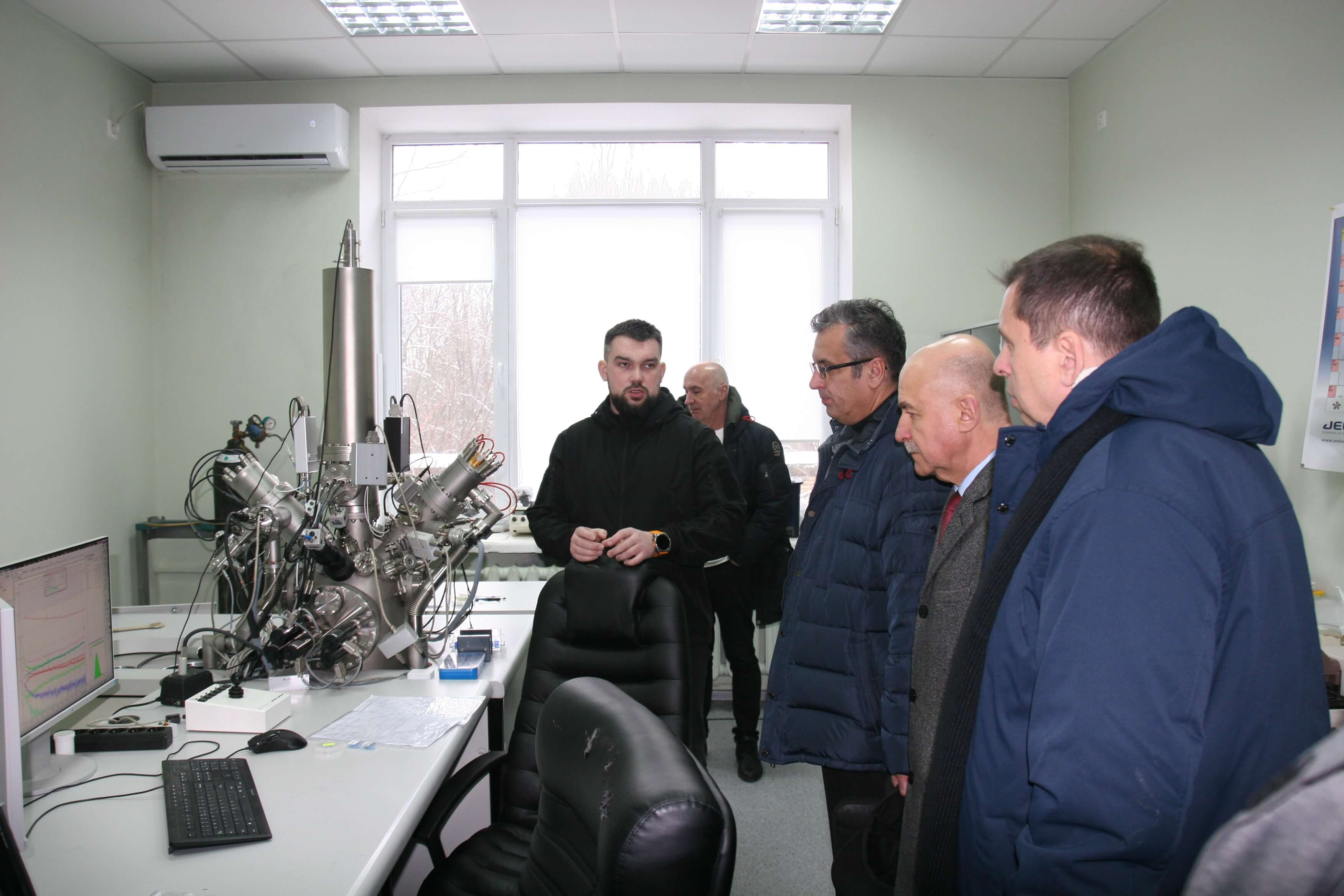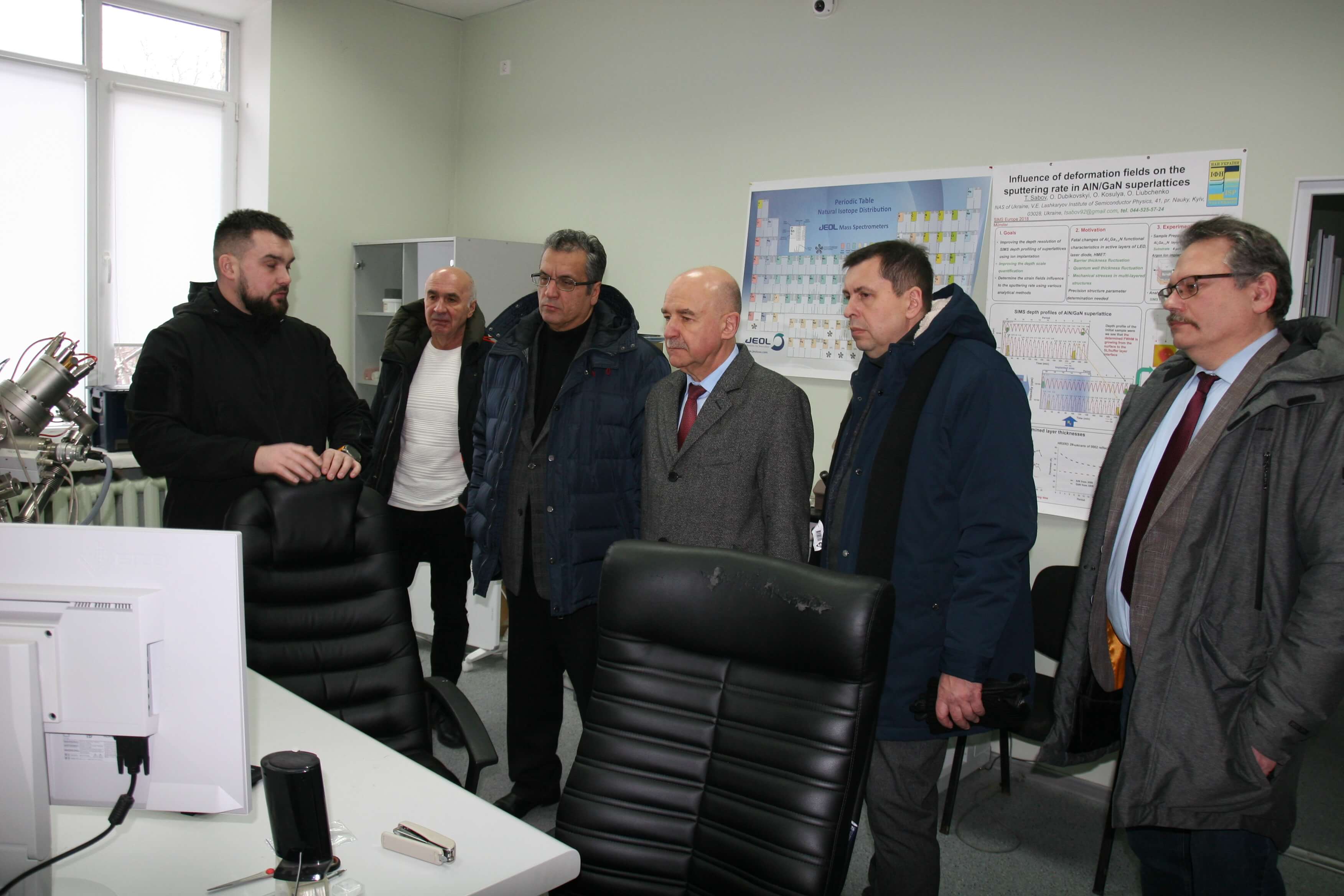
On January 6, 2026, the leadership of the National Academy of Sciences of Ukraine, represented by the first vice-president of the NAS of Ukraine, head of the Section of Physical-Technical and Mathematical Sciences of the NAS of Ukraine, academician Vyacheslav Bogdanov, and the academician-secretary of the Department of Physics and Astronomy of the NAS of Ukraine, academician Mykhailo Bondar, visited the V.E. Lashkaryov Institute of Semiconductor Physics of the NAS of Ukraine. The delegation also included the scientific secretary of the Section of Physical-Technical and Mathematical Sciences of the NAS of Ukraine, Doctor of Technical Sciences Serhiy Bespalov. The purpose of the visit was to directly familiarize themselves with the scientific activities of the Institute, its personnel and infrastructure potential, as well as to discuss current tasks and strategic prospects for the development of semiconductor microelectronics within the academic science system amid modern challenges.
The guests were welcomed by the acting director of the Institute, Doctor of Physical and Mathematical Sciences Viktor Melnyk, the acting deputy director for scientific work of the Institute, Candidate of Physical and Mathematical Sciences Serhiy Mamikin, and the advisor to the Institute’s director, academician of the NAS of Ukraine Oleksandr Belyaev.
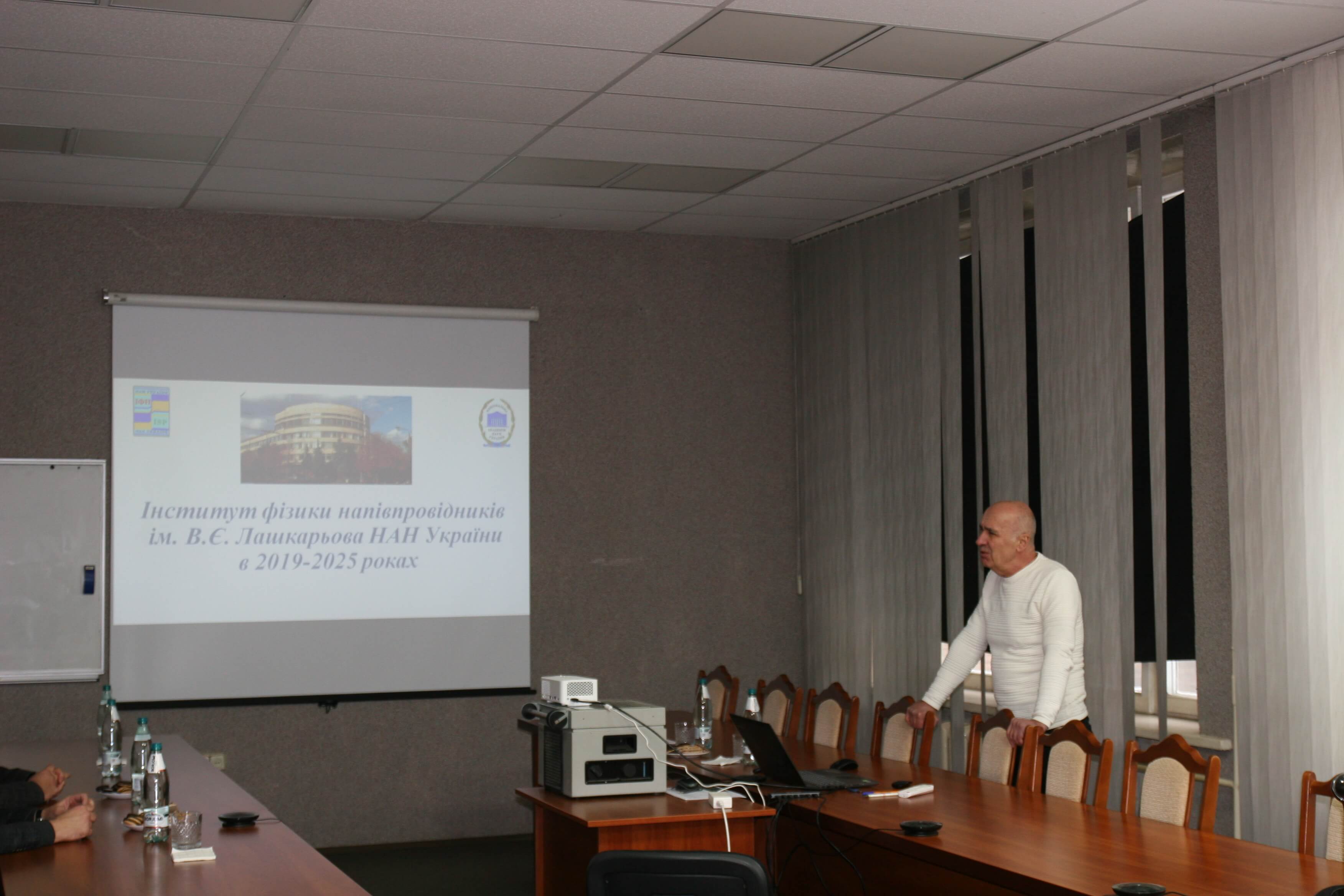
The introduction to the institution began with a brief overview of the Institute, outlining its role and place within the structure of the National Academy of Sciences of Ukraine as one of the leading centers of applied and fundamental research.
The acting director of the Institute, Doctor of Physical and Mathematical Sciences Viktor Melnyk, delivered a comprehensive report on the current state of the institution, its structure, personnel potential, and priority areas of scientific activity, emphasizing that over the past five years the Institute has undergone significant restructuring and optimization of its staff, participates in the implementation of relevant state applied and fundamental programs (including priority topics of the National Academy of Sciences of Ukraine and an infrastructure project funded by a grant from the National Research Foundation of Ukraine), and maintains its status as one of the leading centers of applied physical science (based on the results of the state attestation of scientific institutions, the Institute was awarded category "A").
The report outlined key thematic research areas, including:
- physics of processes of interaction between electromagnetic radiation and matter;
- physics of low-dimensional systems, micro- and nanoelectronics;
- optoelectronics and solar energy;
- semiconductor materials science and sensor systems.
The speaker emphasized that these areas are developed in accordance with modern scientific trends and in close cooperation with leading international research centers, with the share of funding from special funds increasing to 50%.
Special attention was paid to the structure of the Institute. The guests from the Academy Presidium were informed about the work of twelve scientific departments of the institution. It is within these units that scientific schools founded by NAS of Ukraine academicians Vadym Lashkaryov, Solomon Pekar, Serhiy Svechnikov, Mykhailo Lysytsa, and Oleksiy Snitko have been preserved and actively developed, which laid the foundation of Ukrainian semiconductor physics and gained international recognition.
Speaking about the personnel potential, Viktor Melnyk noted that today the Institute employs over 300 scientists — both experienced researchers and young scientists. The Institute’s postgraduate students are directly involved in applied and fundamental research and participation in international scientific projects. Continuous professional training of the new generation of scientists is a key condition for the sustainable development of the institution. Following a recent competition for vacant positions, some heads of scientific units have changed, and the average age of department heads has decreased from 66 to 50 years.
Next, the director briefly touched upon the most significant scientific results achieved in recent years, which have already gained international recognition.
In particular, in collaboration with Polish colleagues, excitations of terahertz oscillations in nanostructures (plasmons) are being studied for the detection, amplification, and generation of electromagnetic waves in the terahertz range. A new class of hybrid semiconductor structures — plasmonic crystals — has been proposed. The research results have been published in prestigious journals such as “PhysRev” and “Nature Communications.”
The Institute has developed methodological foundations for ultra-sensitive nanoscale control of mechanical parameters of nanometer-thick GeSn layers. Great interest in this semiconductor material worldwide is due to its compatibility with established silicon technology, as well as its ability to absorb infrared light, which can be shifted toward longer wavelengths almost without limitation by increasing the tin content in the alloy. Obtaining solid solutions of GeSn with arbitrary tin content will become the basis for a technological breakthrough in the field of high-speed fiber-optic networks and the creation of more accurate thermal imagers for medical and military use and environmental monitoring.
Research continues on the creation of key elements of optoelectronic devices for the infrared spectrum. In particular, methods for designing photosensitive modules based on narrow-bandgap semiconductors have been developed; a modern technological complex for manufacturing experimental samples of photomodules and optimizing technological processes and technologies has been created; basic designs of photosensitive modules and the technological route for their production have been developed.
Then the Academy leadership communicated with the Institute’s staff and heads of scientific units. The conversation took the form of an open dialogue, which allowed discussing not only the results of work but also everyday issues related to the functioning of the scientific institution.
The heads of the departments of theoretical physics, ion-beam engineering and structural analysis, kinetic phenomena and polaritonics, infrared and terahertz electronics, as well as the Center for Collective Use of Scientific Instruments briefly described the activities of their units, their personnel composition, participation in international projects, and scientific connections with Ukrainian and foreign institutions. Academician of the NAS of Ukraine Oleksandr Belyaev and corresponding members of the NAS of Ukraine Vyacheslav Kochelap and Serhiy Lysenko also joined the discussion.
Special attention was paid to the implementation of the Institute’s infrastructure project, strengthening the capabilities of the technological section, and finding ways to attract talented youth to increase the Institute’s capacity. Possible directions for the Academy’s development, in which the Institute could actively participate, were also discussed.
Summing up the visit, the leadership of the National Academy of Sciences of Ukraine noted that the V.E. Lashkaryov Institute of Semiconductor Physics of the NAS of Ukraine retains its role as one of the leading centers for semiconductor material diagnostics and centers for the development of the foundation of microelectronic production for the needs of the state. Despite complex modern challenges, the Institute demonstrates a high level of scientific results, strong personnel potential, a developed diagnostic component, and openness to Ukrainian society, remaining a space where ideas of key Ukrainian technologies and developments are implemented, capable of shaping the future landscape of applied and fundamental physical science in Ukrainian realities.
Information provided by the V.E. Lashkaryov Institute of Semiconductor Physics of the NAS of Ukraine
Photo: V.E. Lashkaryov Institute of Semiconductor Physics of the NAS of Ukraine