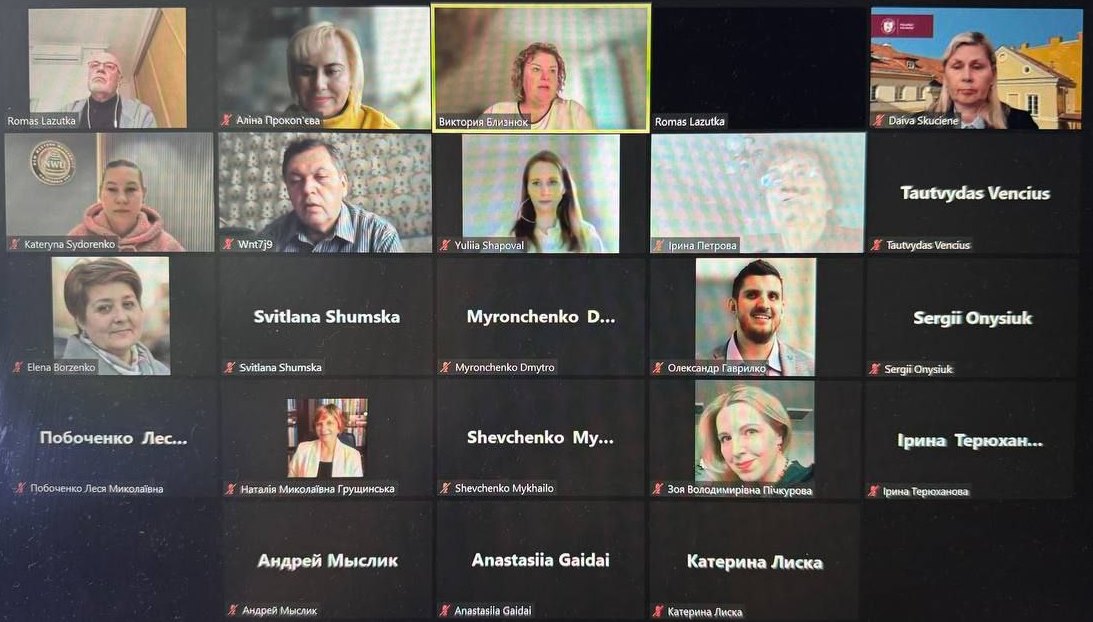

On December 10, 2025, an international scientific-practical conference "Opportunities and Risks of Building a Social State in Ukraine in Conditions of Global Uncertainty" was held online, which became the culmination of the Ukrainian-Lithuanian bilateral project of the Institute of Economics and Forecasting of the NAS of Ukraine and Vilnius University.
The opening speech was delivered by the Deputy Chairman of the Association of Employers' Organizations of Ukraine, Vasyl Kostrytsia, who outlined the key challenges of modern socio-economic development. He emphasized the low coverage of enterprises by collective agreements and the scale of the shadow sector, which directly generates the phenomenon of labor poverty. According to him, this problem is a systemic consequence of institutional weakness and insufficient coordination between the state, employers, and employees. As Vasyl Kostrytsia stressed, without expanding the scope of collective agreements and reducing the scale of the shadow economy, it is impossible to overcome the phenomenon of workers remaining poor despite official employment. At the same time, he drew attention to positive shifts: after the renewal of the Cabinet of Ministers of Ukraine, the restoration of the National Tripartite Social and Economic Council began, creating expectations for a new stage of social dialogue development and trust-building in society. Vasyl Kostrytsia built his argument on the logic of institutional modernization: in his opinion, only strong and coordinated social partnership mechanisms can transform declarative principles into real practices that affect the quality of life.

Continuing the discussion, the head of the Department of Social Policy at the Faculty of Philosophy of Vilnius University, Doctor of Sociology, Professor Daiva Skučienė, made a comparative analysis of pension reforms in Lithuania and Ukraine.
She enriched her report with statistical data and specific examples so that conference participants could assess the effectiveness of the second tier of the pension system. Daiva Skučienė reminded that the second (accumulative) tier of the pension system in Lithuania was introduced in 2004 as a response to demographic challenges and population aging. At the beginning of 2025, more than 1.4 million people participated in the system, i.e., more than half of the working-age population of the country.
Although the average amount of savings in the funds is growing, the real investment returns often cause dissatisfaction among participants because they do not always meet high expectations. This creates a sense of mismatch between contributions and results, undermining trust in the system. The key problem of the Lithuanian model, as noted by Daiva Skučienė, was the instability of rules: over two decades, contribution rates, co-financing mechanisms, and participation conditions changed repeatedly. This undermined citizens' trust. The sharpest example was 2009–2012 when, due to the economic crisis, the state temporarily reduced its share of co-financing. This caused a wave of mass withdrawals by participants in subsequent years, undermining the legitimacy of the accumulative model and its perception by society.
Particularly relevant conclusions for Ukraine from Daiva Skučienė are:
- mandatory implementation cannot be introduced without stable macroeconomic conditions and clear communication of risks;
- political "swings" must be minimized, as frequent changes in rates and rules destroy trust;
- the system must be built on the principle "from transparency to responsibility," where clear commissions, comparability of real returns, and strict supervision protect the investor.
Her argumentation was based on comparative logic: Lithuania's experience shows that even a well-designed system can lose effectiveness due to political instability, so the main task for Ukraine is to create long-term institutional trust.
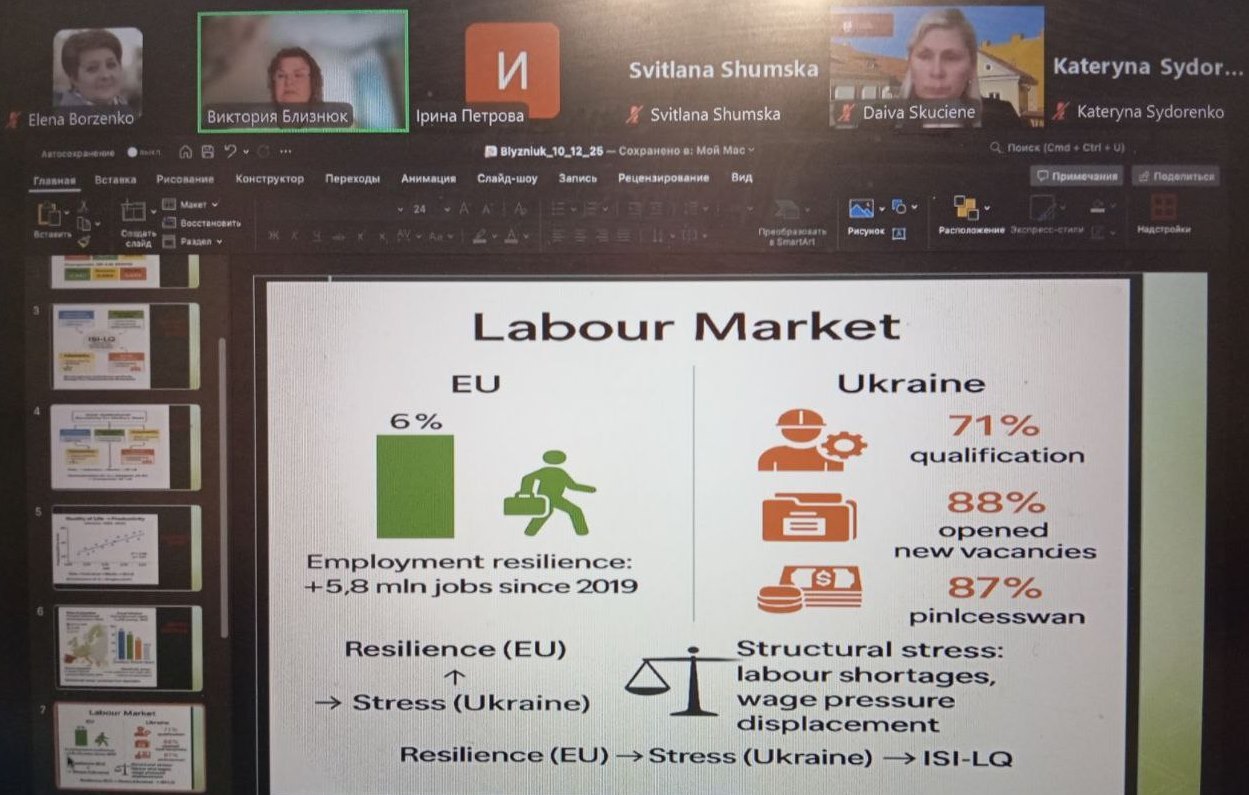
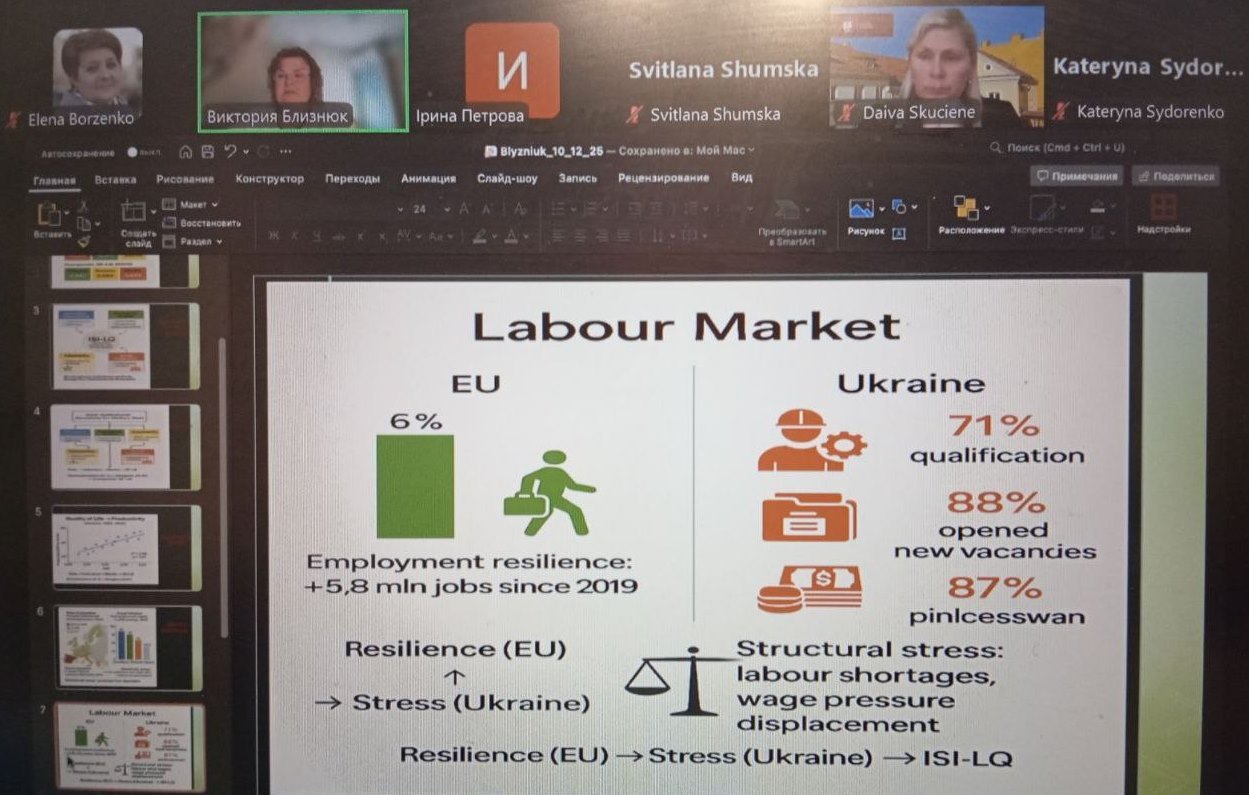
Next, the head of the Department of Socio-Economics of Labor at the Institute of Economics and Forecasting of the NAS of Ukraine, Corresponding Member of the NAS of Ukraine, Viktoriya Blyzniuk, spoke about the results of the joint Ukrainian-Lithuanian study, presenting an authorial scientific-methodological approach to calculating the Institutional Sensitivity Index of Quality of Life. This is a conceptually new composite indicator that offers an algorithm to assess the capacity of national institutions to guarantee the sustainability, inclusiveness, and adaptability of basic social services that form the basic living conditions of the population. Its goal is to measure how institutions (state bodies, social services, educational and medical systems) respond to societal needs, consider social risks, and can maintain an adequate standard of living even in crisis conditions.
The index allows for comparing different countries by the level of institutional capacity, identifying structural gaps, and determining the strengths of the management system. It shows that quality of life depends not only on economic resources but also on the ability of institutions to act transparently, adaptively, and inclusively, ensuring trust, social cohesion, and policy legitimacy.
In her report, Corresponding Member of the NAS of Ukraine Viktoriya Blyzniuk not only presented a new indicator but tried to create an analytical category that helps assess quality of life through the ability of institutions to act clearly, ethically, inclusively, and adaptively. The scientist emphasized that the classic welfare state model, which arose as compensation for market failures, is today transforming into the logic of social investments, where the main focus is not on the volume of expenditures but on institutional capacity to ensure resilience, inclusiveness, and social justice.
As the speaker explained, the Institutional Sensitivity Index of Quality of Life is a multidimensional composite indicator consisting of four blocks: normative expectations, procedural quality, adaptability, and social integration. Each segment is filled with indicators—from transparency of criteria that define the content of services and their perception by authorities to digital capacity and the level of social cohesion. The key is not just the list of these components but their systemic interconnection: the level of institutional sensitivity depends on their balance—the system's ability not just to function formally but to respond qualitatively to human requests.
During the discussion, Viktoriya Blyzniuk emphasized the pragmatic significance of the developed methodology, noting that the Institutional Sensitivity Index of Quality of Life is an effective tool for forecasting macroeconomic consequences. Her key thesis is based on the fact that the quality of life level determines labor productivity and the sustainability of human capital reproduction. Therefore, this indicator acts as a leading indicator signaling the emergence of systemic imbalances. This allows government authorities to carry out preventive and integrated interventions precisely at points where institutional inertia threatens economic stability.
Especially important in the scientist's speech was linking the concept of institutional sensitivity with the very idea of a social state. The speaker emphasized that the welfare state cannot be limited only to resource redistribution or compensation for market failures. Its viability depends on how capable institutions are of being sensitive to social expectations, explaining their decisions, acting transparently and inclusively. Institutional sensitivity, according to her, is the mechanism that makes the social state alive and effective. It transforms it from a formal construct that only compensates problems into a real development tool. It is a kind of "thermometer" for institutions: it shows how attentive they are to social signals, whether they act transparently, can quickly adapt to new challenges, and include different population groups in their decisions. When institutional sensitivity becomes the basis of the social state's functioning, it (the state) turns into a platform for sustainable development, capable not only of guaranteeing basic social payments but also ensuring the long-term adaptation of society to crisis waves, integration of new technologies, and support of social cohesion. In other words, institutional sensitivity determines whether the social state will be only a compensation mechanism or a real environment of stability and development for citizens. As Viktoriya Blyzniuk emphasized, in such a model, the welfare state ceases to be a reactive compensation mechanism and becomes a proactive system of investments in human capital, institutional quality, and social integration. The scientist stressed: if institutional sensitivity is the key to restoring trust between citizens and the state (institutions explain their decisions, act transparently and inclusively, and society is ready to support them even in periods of uncertainty), then this creates a foundation for sustainable development, where the social state becomes not only a guarantor of minimum standards but also a platform for unlocking each person's potential.
Concluding her speech, the speaker outlined a strategic conclusion: the future of the Ukrainian social state depends on the ability of institutions to combine normative expectations with procedural quality, adaptability, and social integration. Only in such a balance is it possible to move from fragmentation to resilience, from survival to development, and create a welfare model that works for people and withstands long waves of global uncertainty.