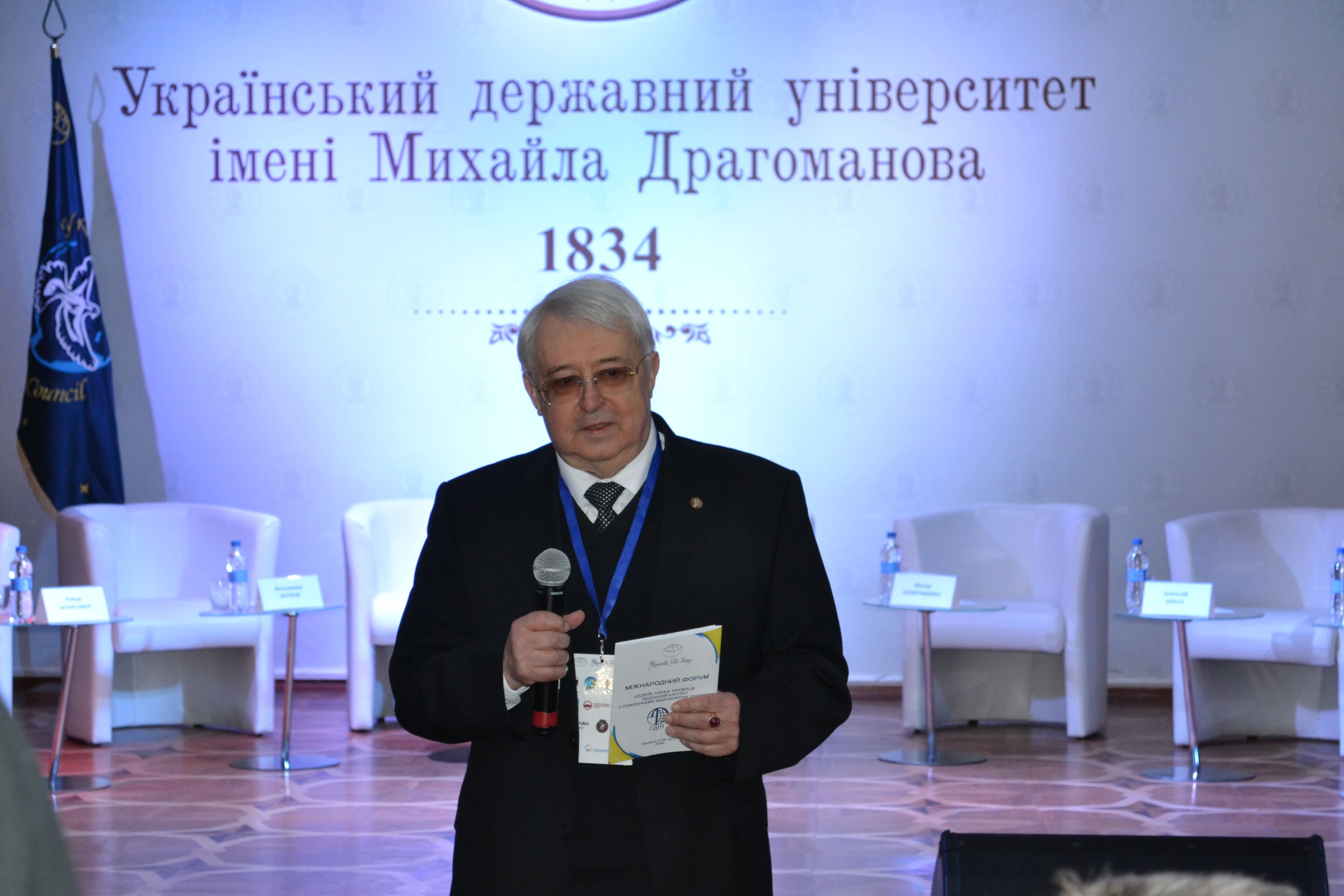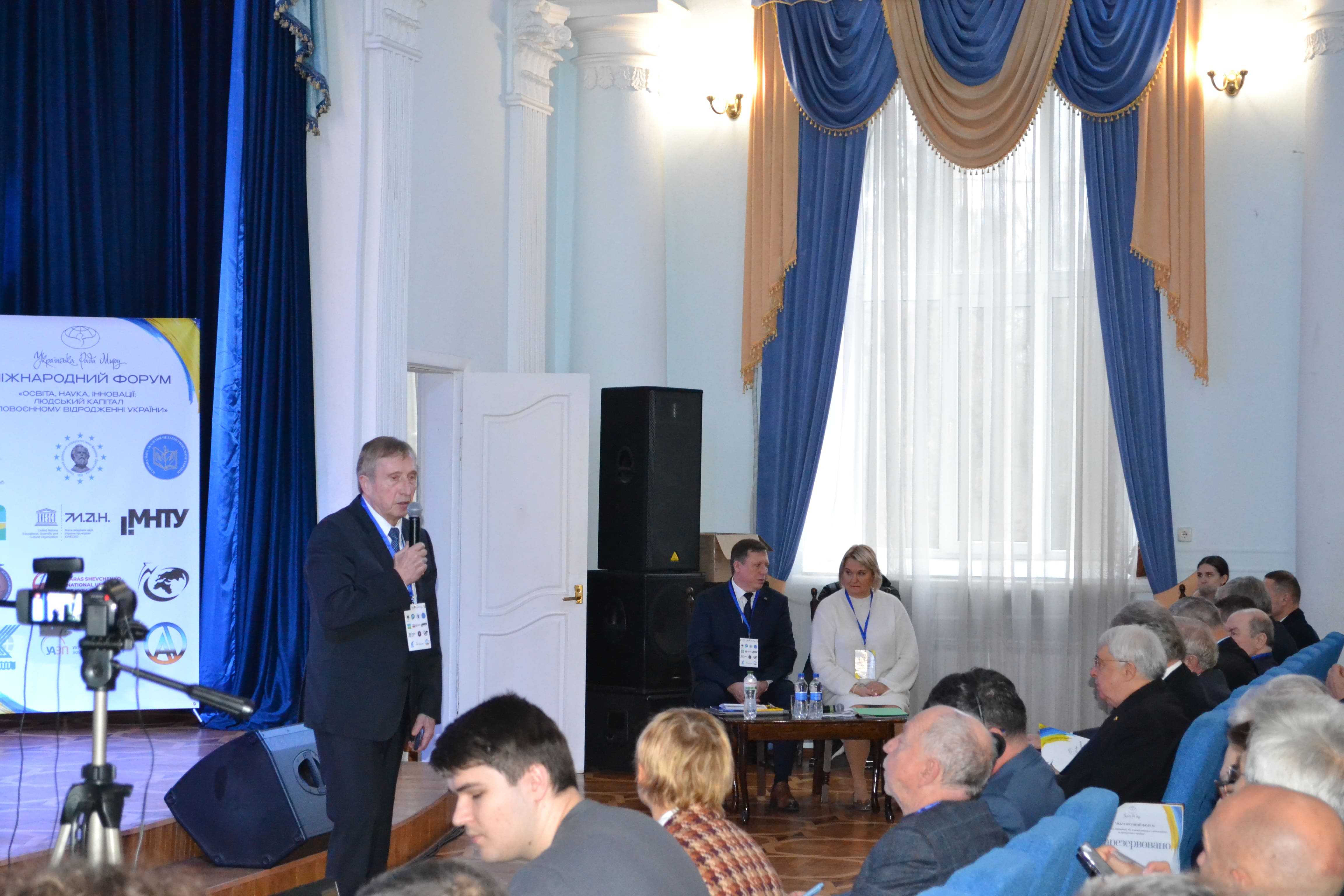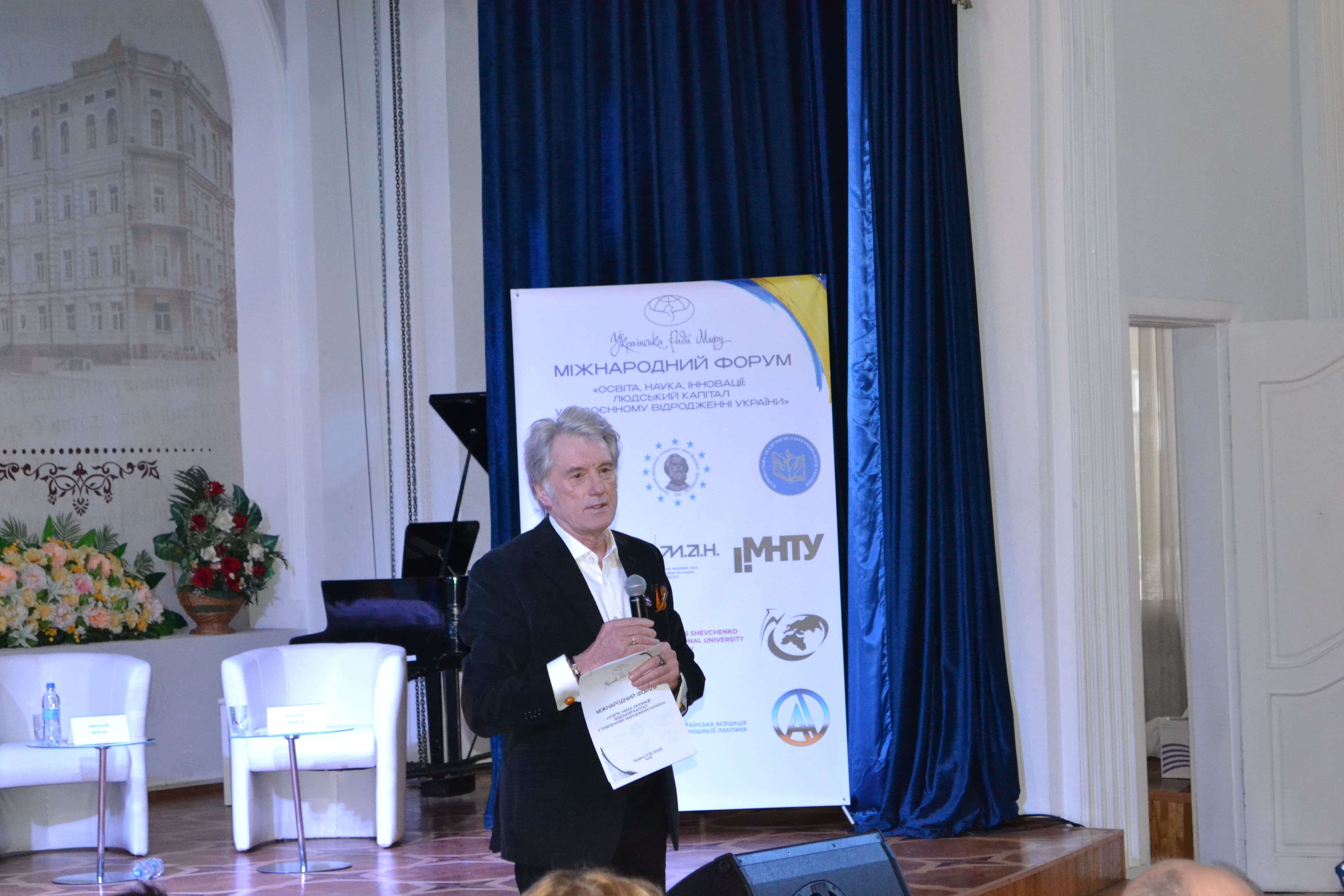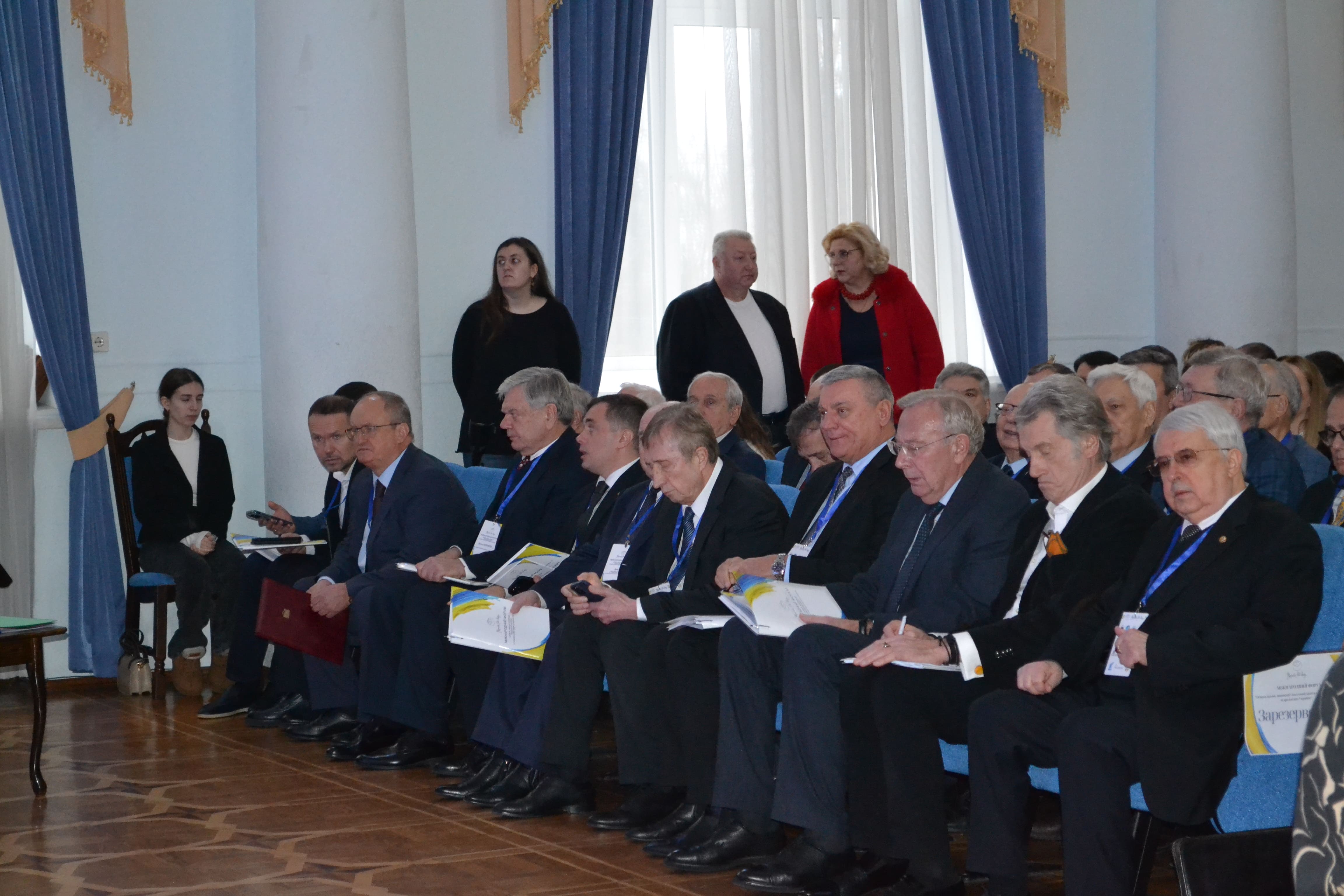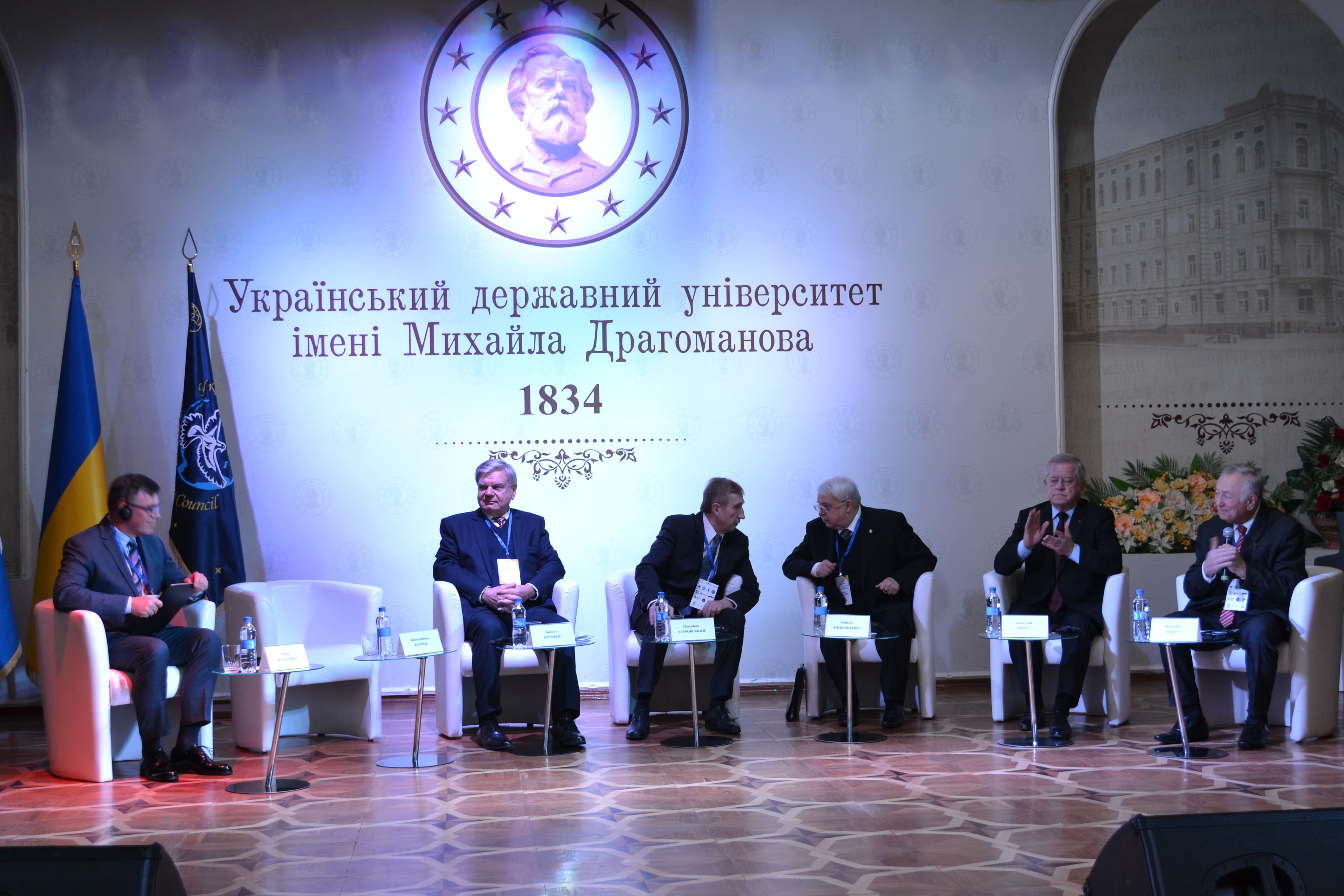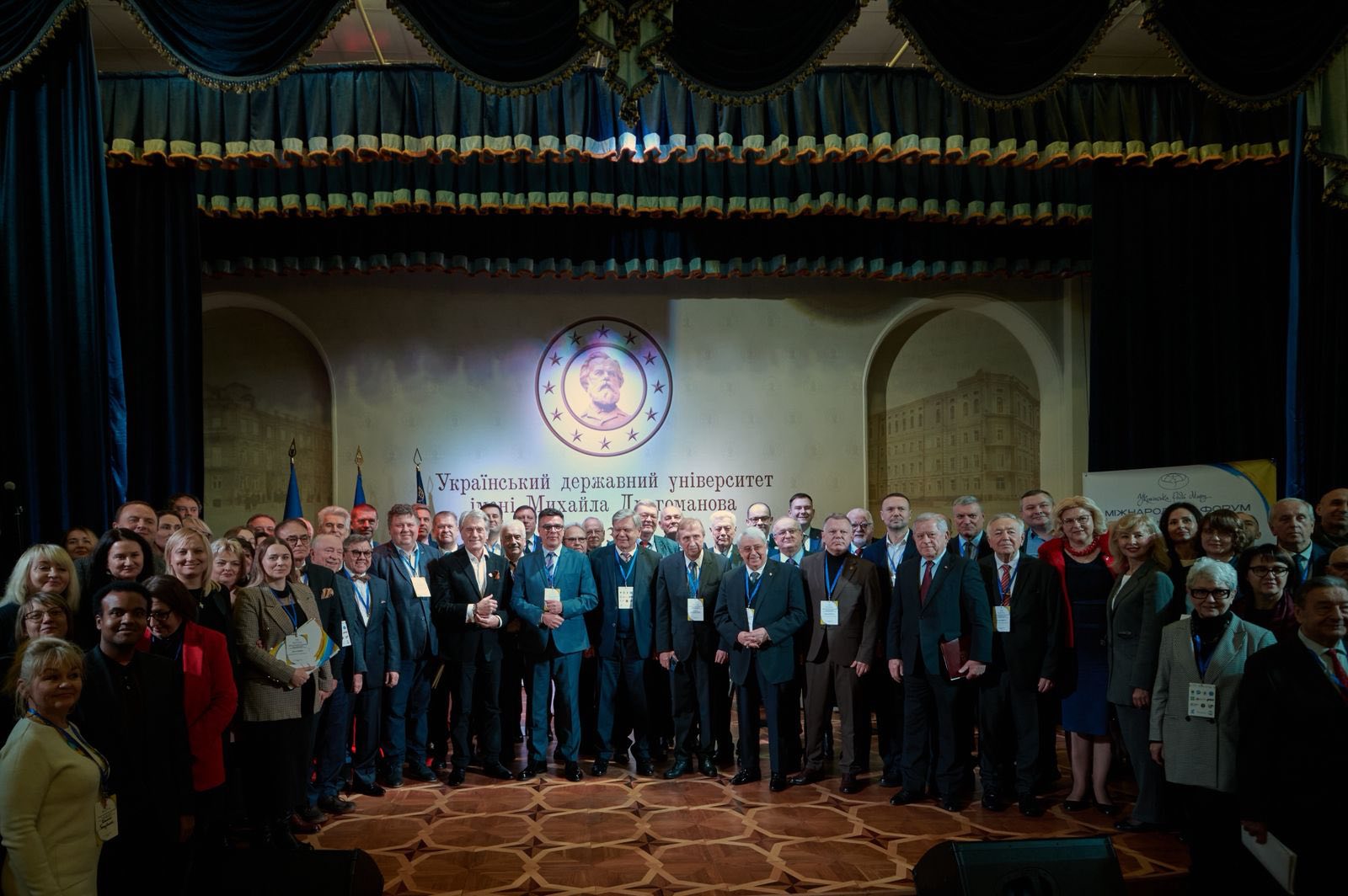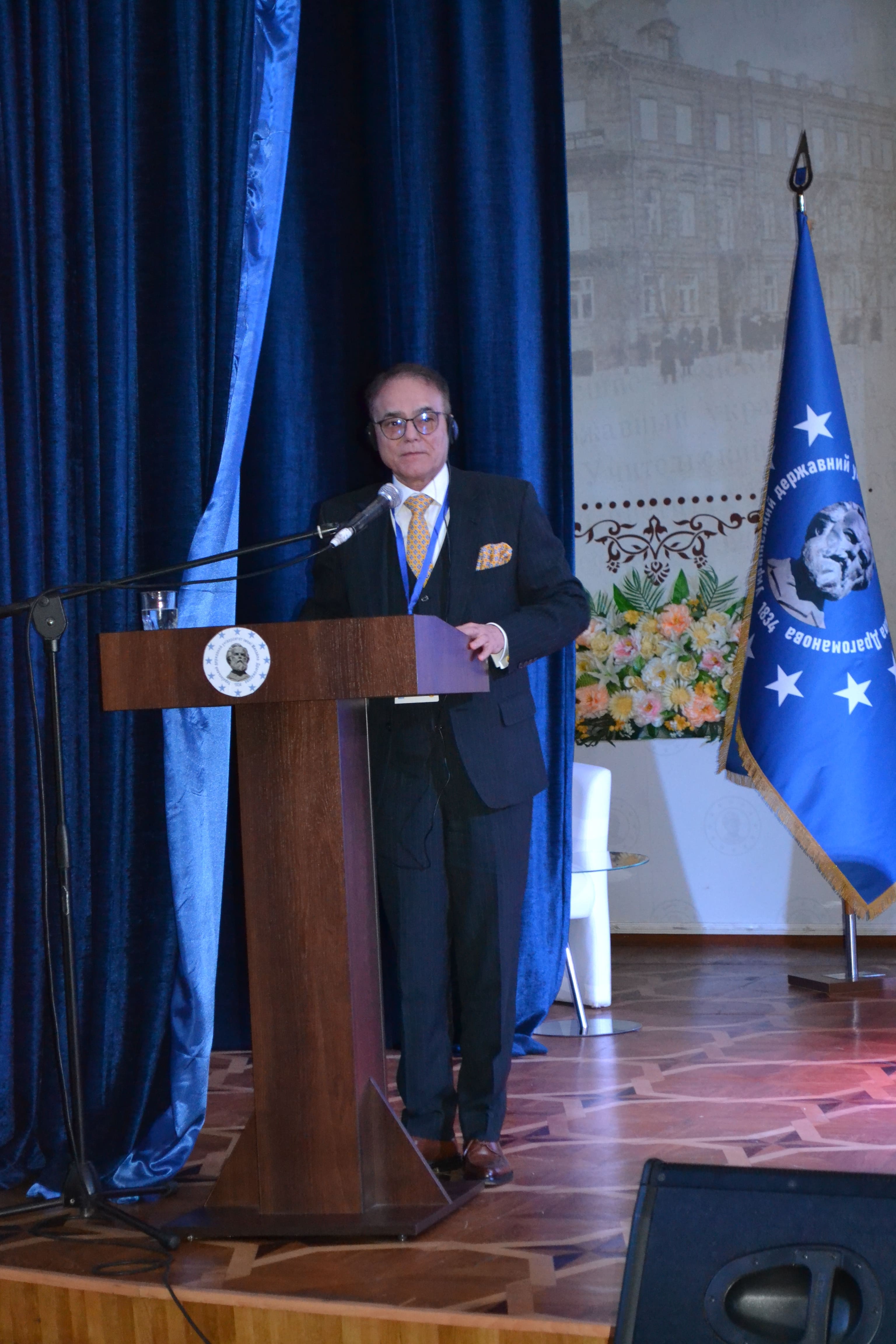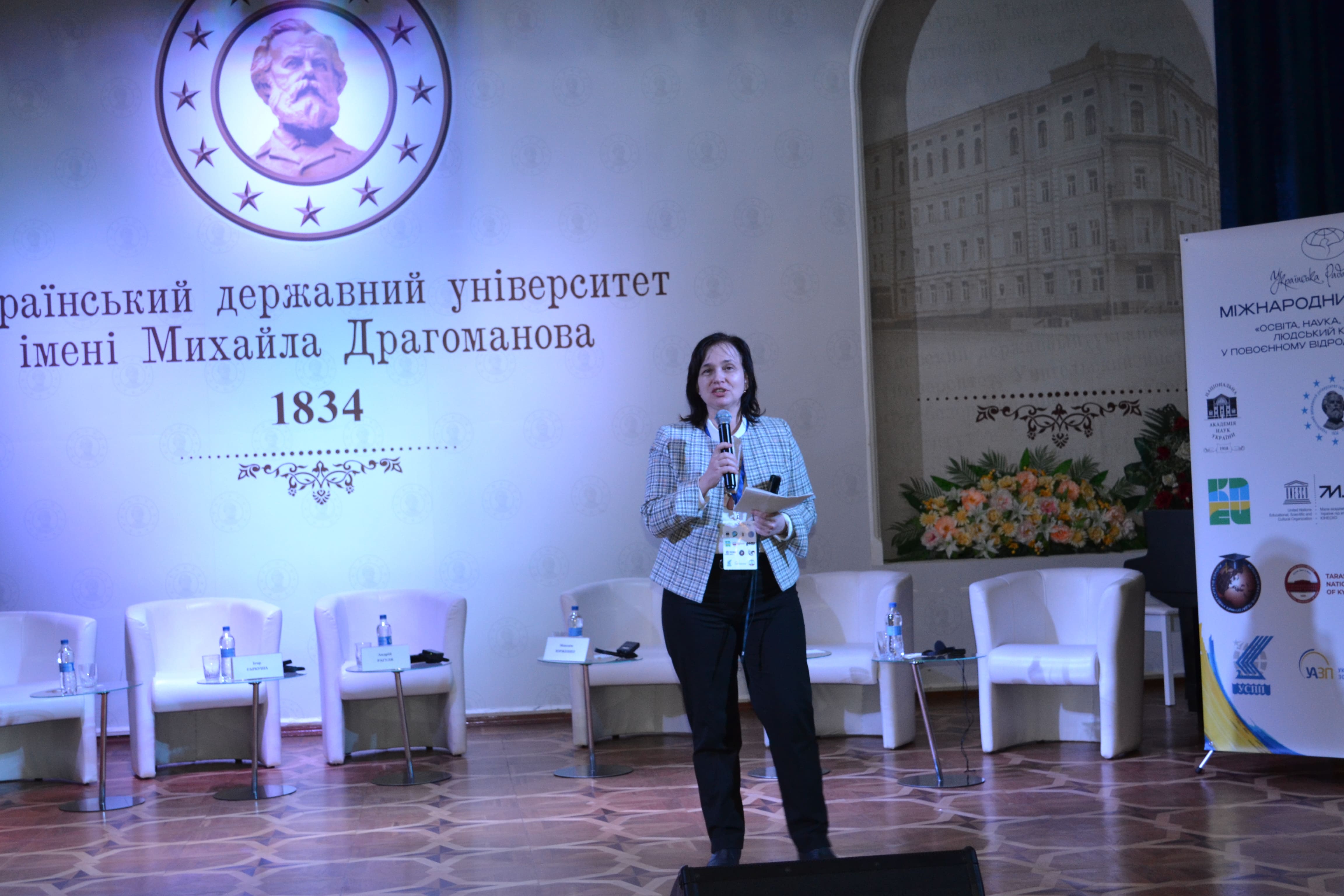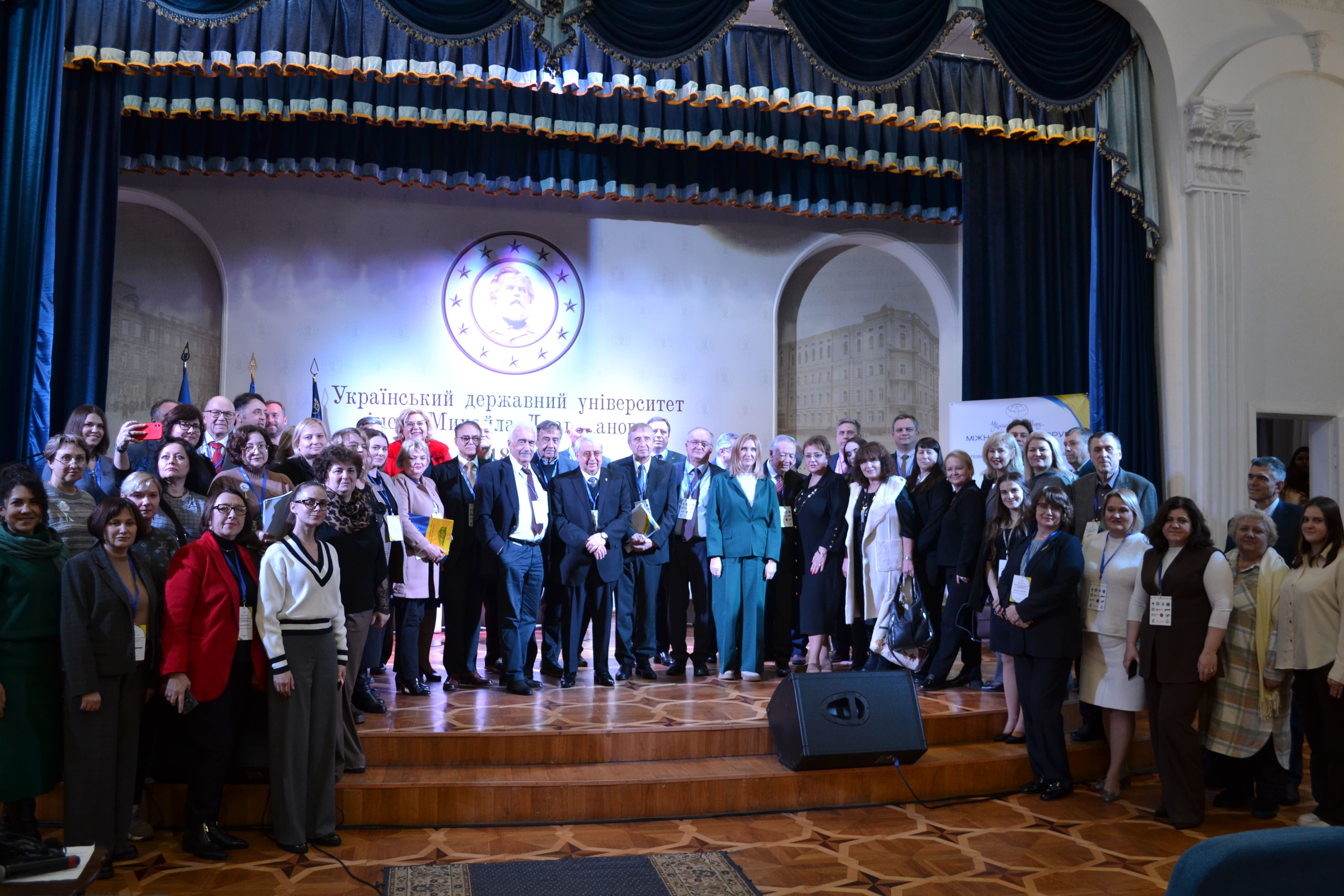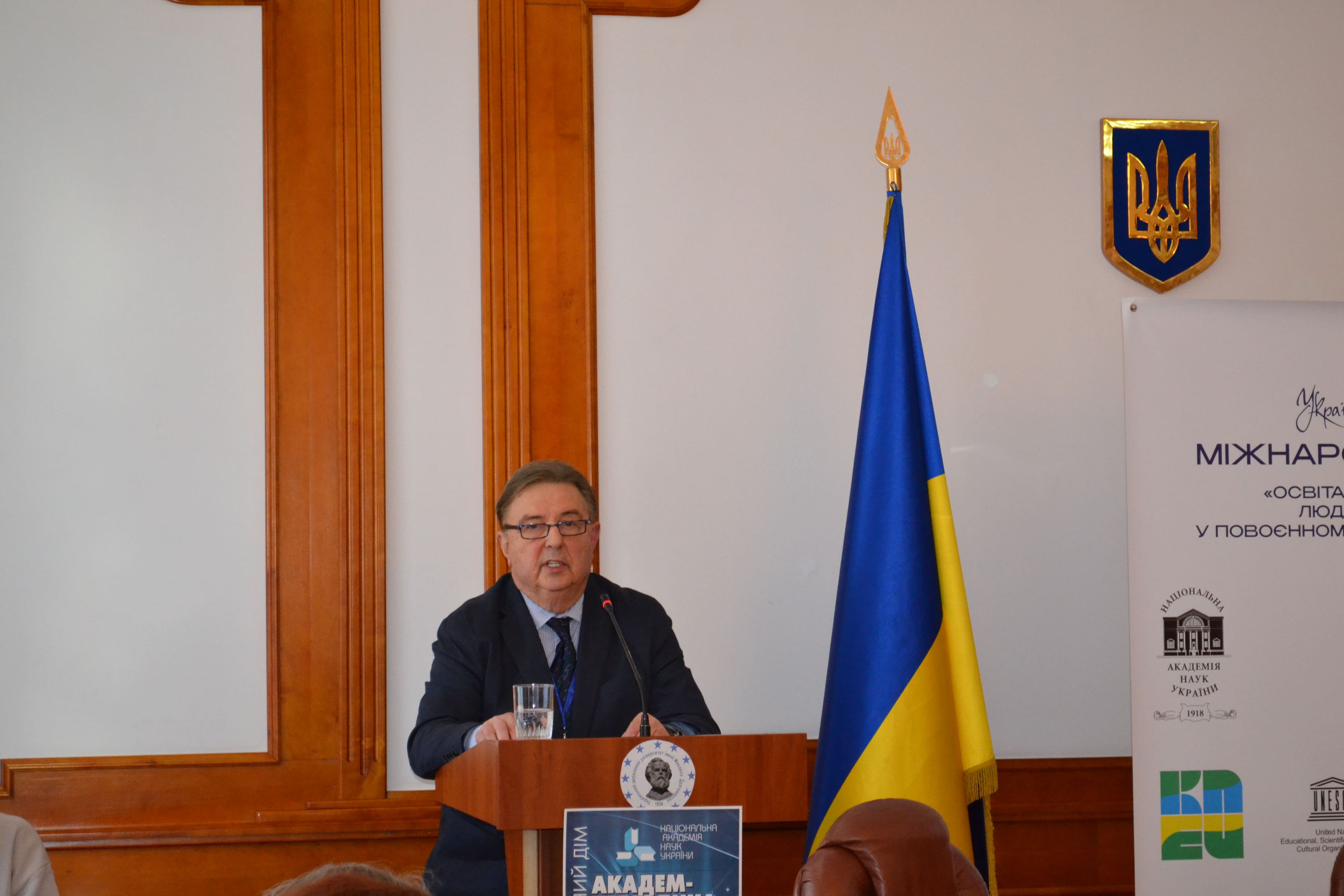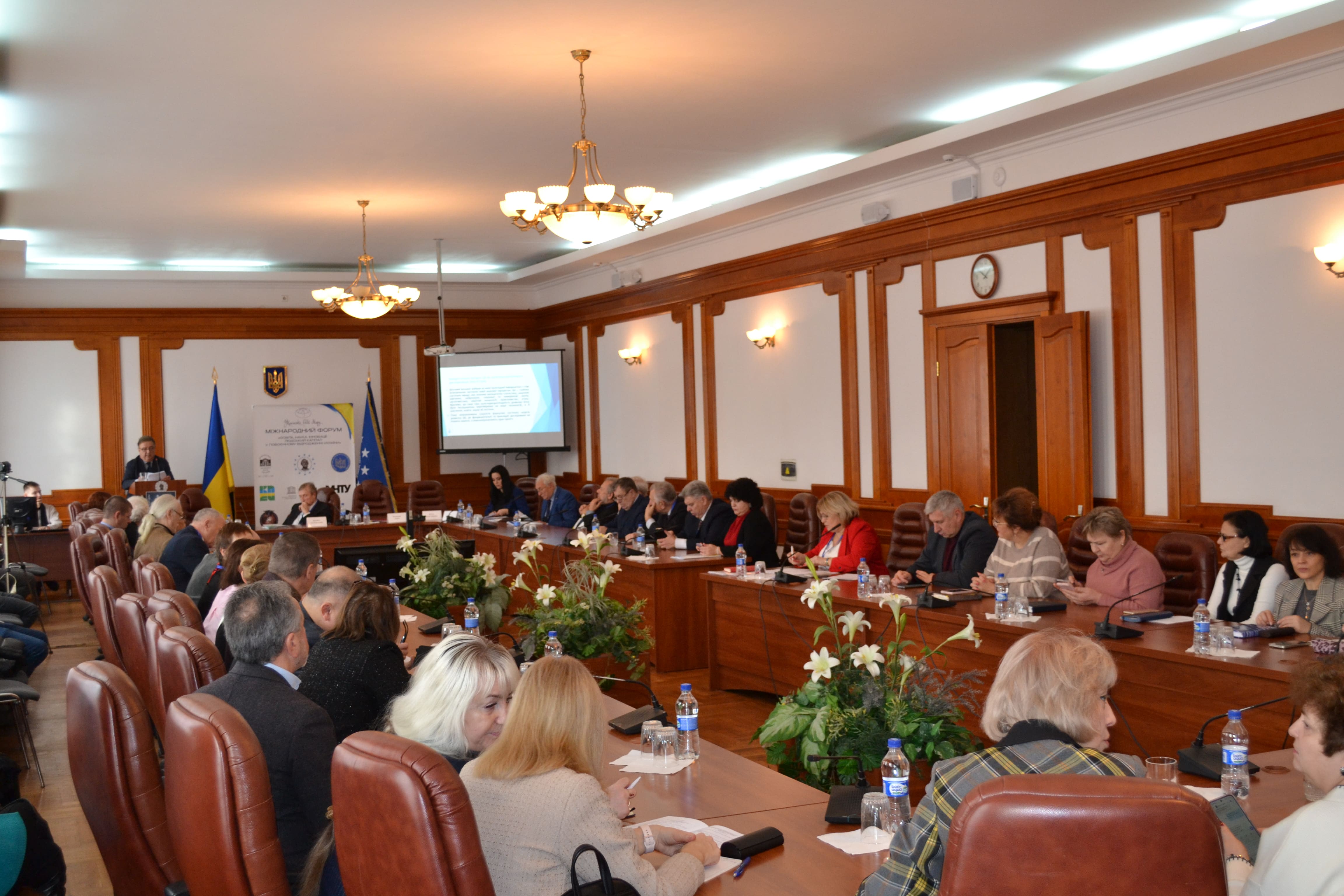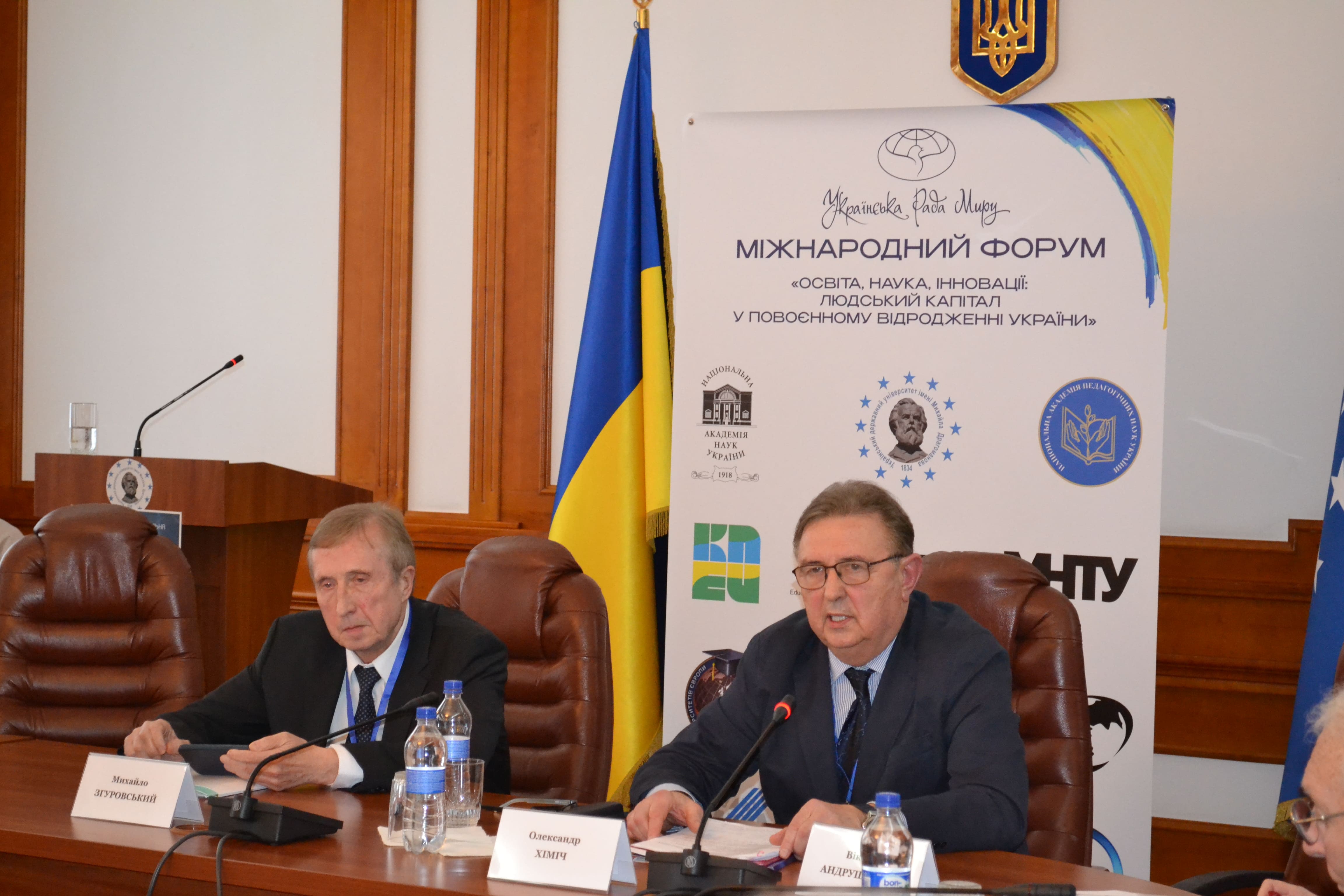
On December 11-12, 2025, the International Forum "Education, Science, Innovation: Human Capital in the Post-War Revival of Ukraine" took place in Kyiv, bringing together scientists, educators, representatives of government authorities, business, and civil society to discuss the strategic priorities of the country's development in conditions of war and future reconstruction.
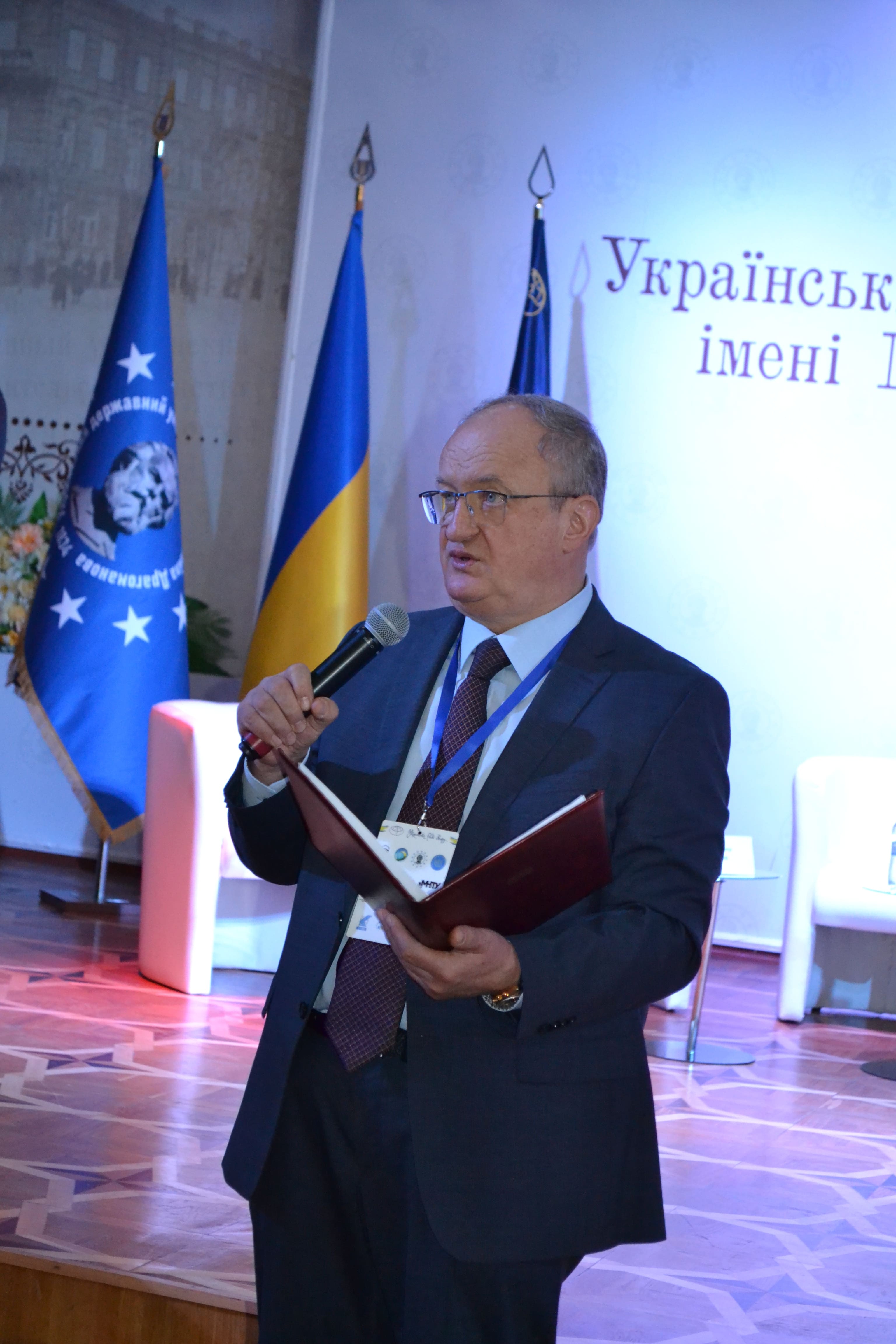
The forum opened with welcoming speeches. The participants were addressed by the Chairman of the Ukrainian Peace Council, academician of the NAS of Ukraine Mykhailo Zgurovskyi, the rector of the Mykhailo Drahomanov Ukrainian State University, corresponding member of the NAS of Ukraine, academician of the NAPS of Ukraine Viktor Andrushchenko, as well as the third President of Ukraine Viktor Yushchenko.
On behalf of the National Academy of Sciences of Ukraine, the forum participants were greeted by the Vice-President of the NAS of Ukraine, academician Oleh Rafalskyi, who conveyed greetings from the President of the NAS of Ukraine, academician Anatolii Zahorodnii, and emphasized the decisive role of science and education in shaping human capital as a key resource for sustainable development and post-war recovery of Ukraine.
After the ceremonial opening, the plenary sessions of the forum began, dedicated to strategic issues of forming and developing human capital in conditions of war and post-war reconstruction. During the first plenary session, participants focused on the transition from wartime challenges to an innovative model of state development, the preservation and development of labor potential, as well as the role of education and science in responding to modern civilizational threats.
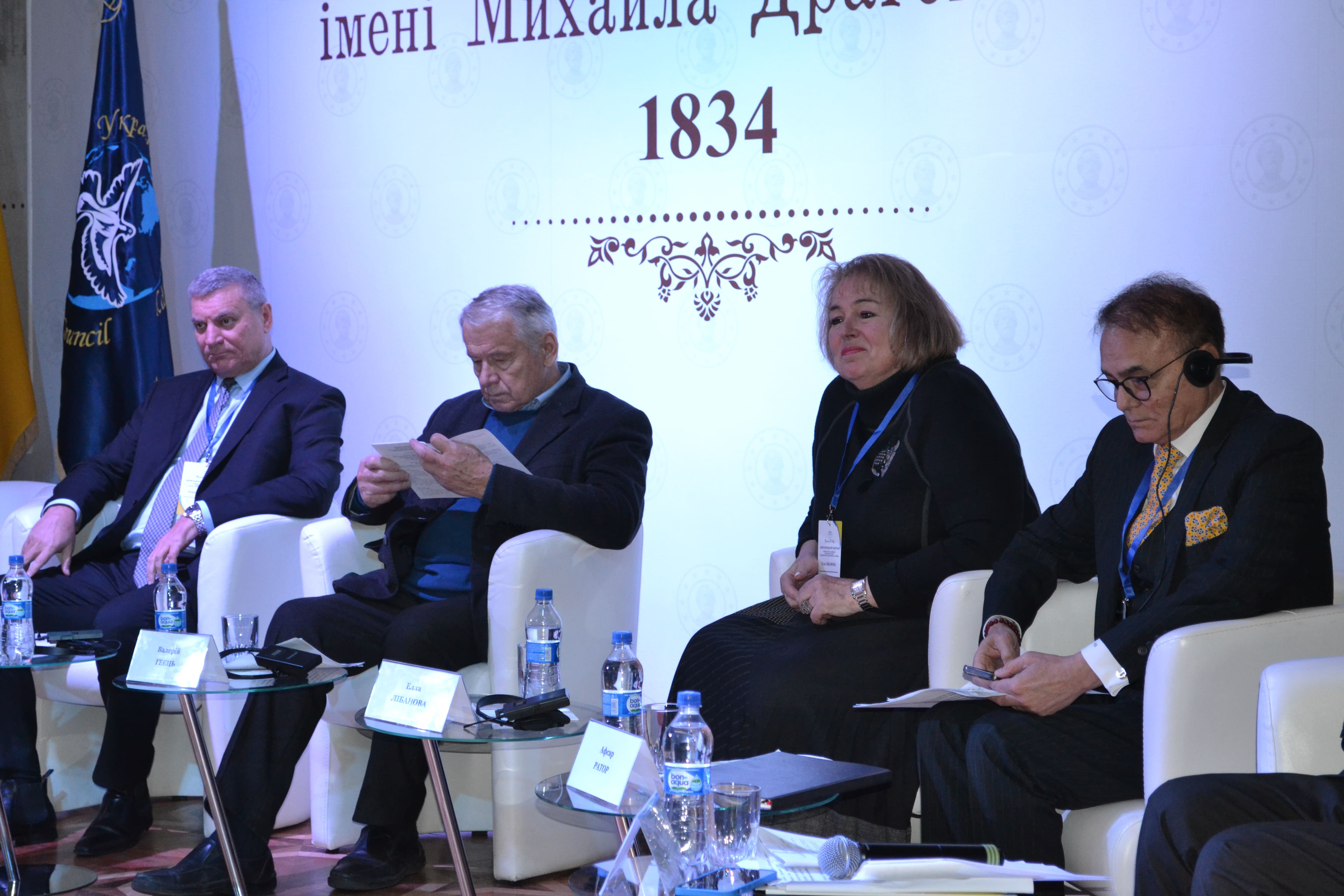
Within the framework of the second plenary session, socio-economic and demographic aspects of Ukraine's post-war recovery were discussed. The report "Demographic Challenges of Ukraine during Post-War Reconstruction: Strategy for Restoring Human Capital" was presented by the director of the Mykhailo Ptukha Institute of Demography and Social Studies of the NAS of Ukraine, academician of the NAS of Ukraine Ella Libanova. The director of the Institute of Economics and Forecasting of the NAS of Ukraine, academician of the NAS of Ukraine Valerii Heiets, spoke in his report about social quality of life issues during wartime and post-war periods, emphasizing the need for systemic economic and social solutions in reconstruction policy.
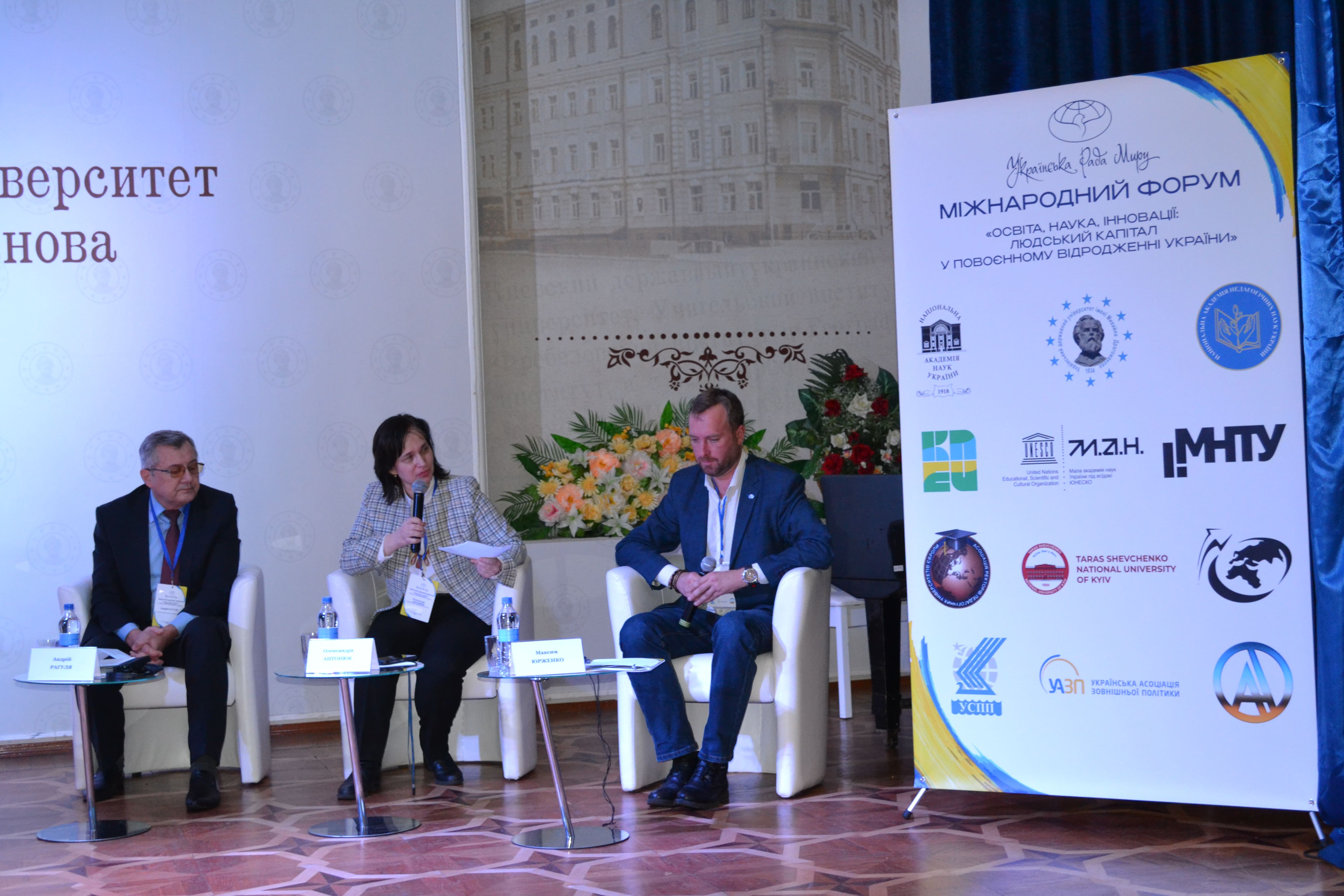
Special attention in the forum program was given to the role of science as a direct factor of innovative development and post-war revival. Within the panel discussion "Science as a Driver of Post-War Revival and Innovation," organized by the National Academy of Sciences of Ukraine, participants focused on systemic barriers to the implementation of scientific developments and the need to form long-term national programs supporting science. The discussion was moderated by the Chair of the Scientific Committee of the National Council of Ukraine on Science and Technology Development, Oleksandra Antoniuk.
The speeches emphasized that for successful reconstruction, Ukraine needs high-tech materials and solutions with long service life, and that a key prerequisite for attracting investments is the creation of its own intellectual property. The participants of the discussion noted the persistent gap between science and industry, insufficient integration of scientific results into civilian sectors of the economy, and the dominance of short-term approaches over professional and strategic ones.
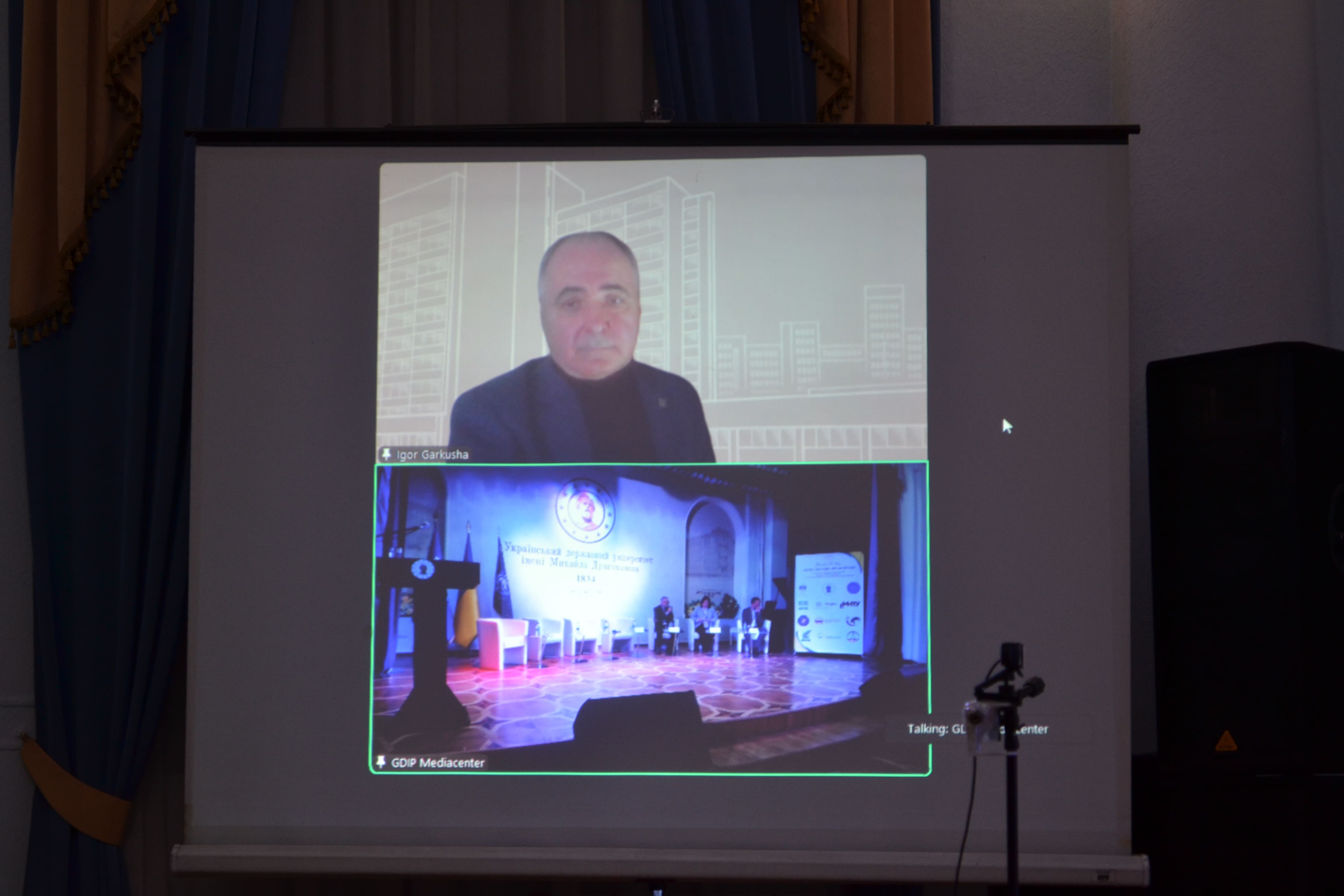
Leading scientists of the NAS of Ukraine took part in the discussion. The head of the department at the E.O. Paton Electric Welding Institute of the NAS of Ukraine, corresponding member of the NAS of Ukraine Maksym Yurzenko, emphasized the role of fundamental research in creating new technologies and materials. The deputy director of the I.M. Frantsevich Institute for Problems of Materials Science of the NAS of Ukraine, academician of the NAS of Ukraine Andrii Rahulia outlined scientific approaches to infrastructure renovation in the process of post-war reconstruction. The academic secretary of the Department of Nuclear Physics and Energy of the NAS of Ukraine, academician of the NAS of Ukraine Ihor Harkusha, spoke about state support for fundamental science and the importance of international cooperation.
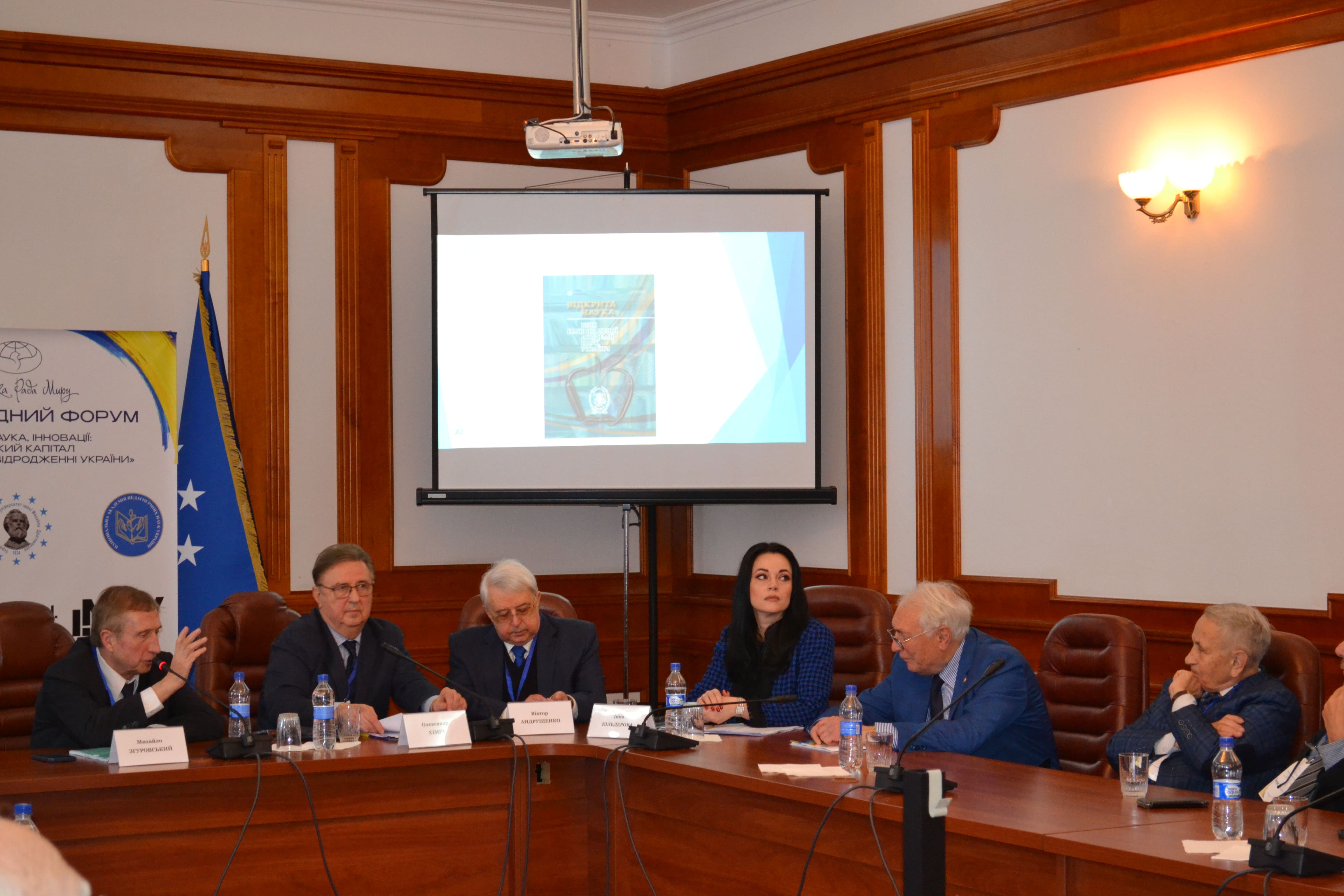
The second day of the forum was devoted to thematic panel discussions, during which participants discussed current challenges and prospects for the development of science and education in Ukraine. Among the key topics were digital technologies and artificial intelligence, whose role in the modern world is rapidly growing. In this context, special attention was drawn to the panel discussion "Artificial Intelligence: The Mind That Changes the World," organized by the National Academy of Sciences of Ukraine.
The moderator of the discussion, academic secretary of the Department of Informatics of the NAS of Ukraine, academician of the NAS of Ukraine Oleksandr Khimich, presented strategic approaches to the development and application of artificial intelligence within the system of the National Academy of Sciences of Ukraine. The discussion covered the formation of a comprehensive academic AI ecosystem—from fundamental research and interdisciplinary projects to training personnel, developing computing infrastructure, and implementing results in practice—as well as the need for coordination with state digital policies and adherence to ethical principles in the use of artificial intelligence. The chairman of the Ukrainian Peace Council, academician of the NAS of Ukraine Mykhailo Zgurovskyi, spoke about global AI development trends, as well as opportunities and challenges for Ukraine amid technological transformations.
Within this panel discussion, the textbook "Systems and Methods of Artificial Intelligence," published by the Publishing House "Akademperiodyka" of the National Academy of Sciences of Ukraine, was also presented. The publication, prepared by academician of the NAS of Ukraine Mykhailo Zgurovskyi and professor Yurii Zaichenko, is the first comprehensive Ukrainian-language textbook that systematically summarizes key directions of modern AI development and is aimed at training a new generation of specialists in computer science, systems analysis, and intelligent technologies.
Based on the forum results, participants emphasized the need to strengthen the interaction of science, education, government, and business to form human capital as the foundation for post-war recovery, economic modernization, and Ukraine's integration into the global scientific and technological space.