


A group of Ukrainian scientists has discovered new galaxies with polar rings. The results of this research were published by the international professional peer-reviewed journal “Astronomy & Astrophysics.” How do galaxies with polar rings differ from other galaxies? Why is it important to study them? And how significant is the discovery of new such objects for science? The co-authors of the publication – scientists from the Department of Extragalactic Astronomy and Astroinformatics of the Main Astronomical Observatory of the NAS of Ukraine: head of the department, corresponding member of the NAS of Ukraine, Professor Iryna Vavilova, and acting head of the Laboratory of Large-Scale Structure of the Universe of this department, Candidate of Physical and Mathematical Sciences Darya Dobrycheva – told the press service of the NAS of Ukraine about all this.

Candidate of Physical and Mathematical Sciences Darya Dobrycheva. Photo from Darya Dobrycheva’s personal archive
– Ms. Darya, how did the idea for this research arise? Why is it important to study galaxies with polar rings? What makes them special and interesting? And what kind of objects are they in general?
– There is now an enormous amount of new information about galaxies. For example, my colleagues and I used data from the Sloan Digital Sky Survey (SDSS). By the way, Alfred Sloan, after whom this project is named, was once the CEO of General Motors, amassed a great fortune, and created his eponymous charitable foundation, which now sponsors fundamental science – astronomy, biology, and other fields.
Soon one of the largest telescopes, the “Vera Rubin” telescope, will start operating, along with its database (LSST). While SDSS provided 200 gigabytes of data each night, LSST will provide 20 terabytes (!). These are colossal numbers that are hard to imagine. We will see millions of galaxies of various morphological types. Galaxies, like people, are not all the same. Each has its own characteristics. But they can be classified by main features and cataloged.
At the Main Astronomical Observatory, we also create catalogs of galaxies by studying their internal features, shapes, and morphological structure. We study the composition of their stellar populations and dust, the environment they inhabit in the large-scale distribution of galaxies, and whether they interact with other galaxies. Why? To better understand galaxy evolution and why they are the way they are. In particular, to try to predict what will happen to our own Galaxy. Astronomy is a fundamental science that studies how the Universe is structured. Later, we will find out how this will help practically.
Galaxies with polar rings are unique because there are very few of them – until now, only about 400 were counted among tens of millions, and not all of them were confirmed. After analyzing three galaxy catalogs, we found that only 80 out of 400 actually have polar rings. How did this happen? The thing is, earlier catalogs contained images with poorer resolution, and modern telescopes showed that galaxies with polar rings could have been, for example, galaxies visually overlapping each other but located at different distances from us (one obscuring the other). Or a dust lane could have been mistaken for a ring. So galaxies with polar rings turned out to be even rarer than previously thought.
– Could there also be planetary systems in the ring?
– Yes, absolutely. One theory suggests that a galaxy with a polar ring forms as a result of the merger of two galaxies at an angle. One of these galaxies is kind of “smeared” around the other, but its matter remains. This includes dust, interstellar gas, stars, and, of course, planets around those stars.
– How can you tell that these are two different galaxies? Are their stars of different ages?
– Yes, we distinguish them by composition. According to our observations, in most cases, the central part of a galaxy with a polar ring is an old elliptical galaxy. It is yellow because it has almost no gas. The “smeared” galaxy that turned into a ring is mostly a young blue galaxy. Its blue color comes from the gas from which stars later form.
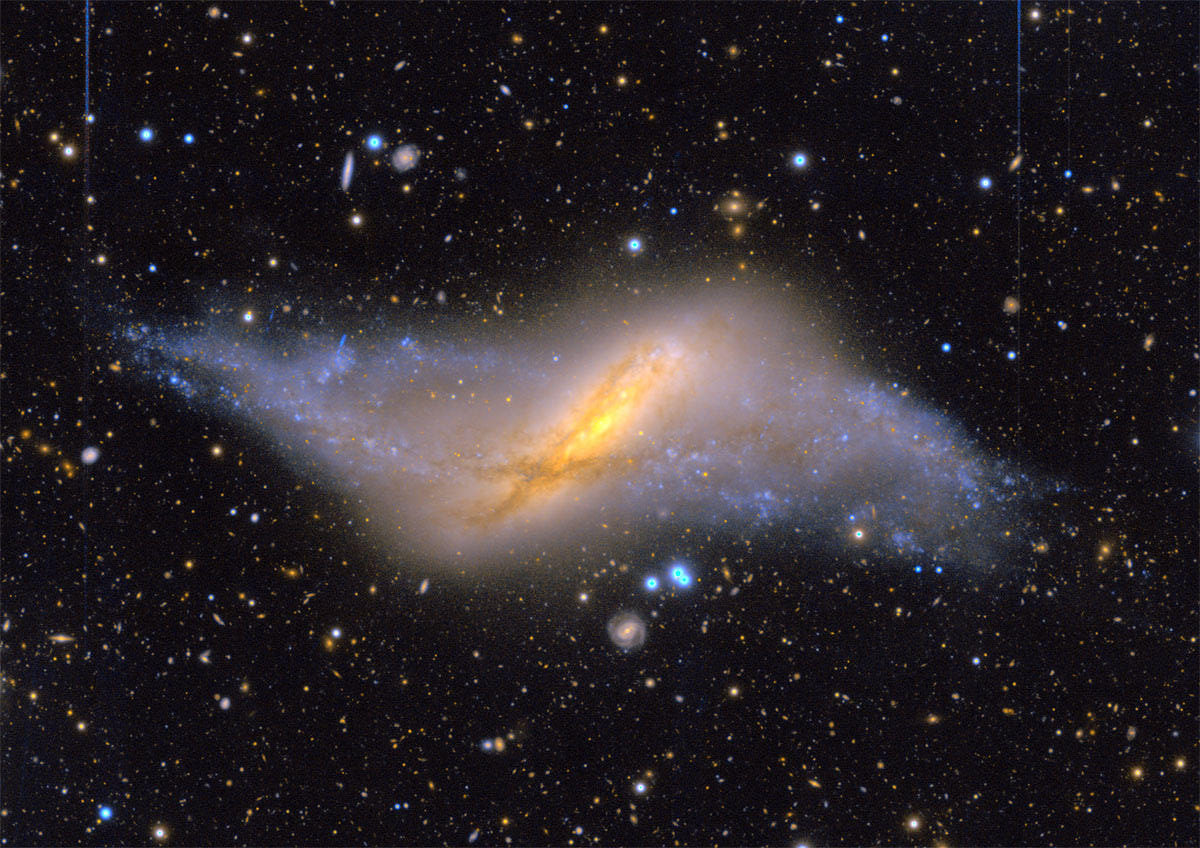
Perhaps the most popular galaxy with a polar ring on the internet – NGC 660. Photo from the Subaru telescope
According to a second theory, a galaxy with a polar ring forms not as a result of the merger of two galaxies colliding in space, but through the accretion of matter from one galaxy to another nearby galaxy. As a result, one galaxy that “takes over” and “winds” matter onto itself remains intact, while the other changes shape.
There is also a third theory. It is known that galaxies can be located in clusters that form filaments, or in voids, so-called cosmic voids. In filaments, galaxies are arranged one after another so that their appearance in the large-scale structure resembles threads. In areas where there is more gas in these threads, matter flows to a galaxy, forming a ring. The new galaxies we discovered confirm the first or second theory – about the merger of two galaxies or the flow of matter from one galaxy to another. Exactly which one is still unclear and requires detailed study.
– But all three theories can be valid?
– Yes, absolutely. The Universe is so vast that examples of different scenarios exist.
– And you and your colleagues do not a priori lean towards any one?
– There is evidence supporting each of these three theories. That is why they were proposed. Specifically, in our research, we applied multi-wavelength analysis to one galaxy – examined it in different ranges of the electromagnetic spectrum. We found that it has a turbulent past. Now it has somewhat “come to its senses,” i.e., stabilized, but long ago it was the result of a merger. But, I repeat, different scenarios are possible.
Why do we study galaxies with polar rings and why is it important? Because they are unique and very few. The question arises: why are there so few compared to galaxies of other morphological types? Maybe they break down after some time? What happens to them? That is exactly what we want to understand.
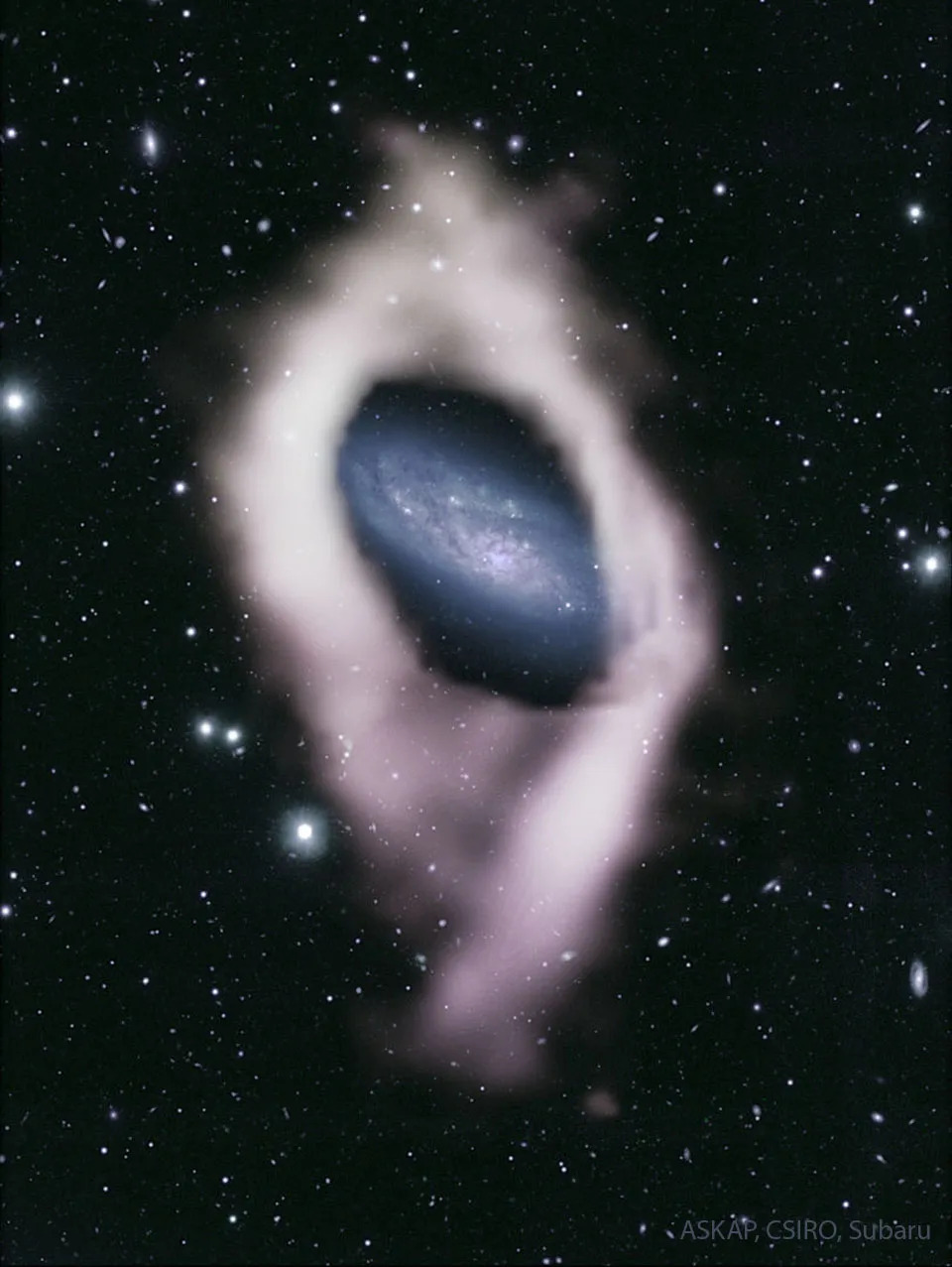
NGC 4632 – a galaxy with a hidden polar ring, which cannot be seen with optical telescopes. Image obtained using the WALLABY Survey, CSIRO / ASKAP, NAOJ / Subaru Telescope. Processing authors: Jayen Inglis (University of Manitoba, USA) and Nathan Deg (Queen’s University, Canada)
– I will ask you a somewhat naive and amateur question. Human life is very limited. Surely, we can see different galaxies at different stages of their existence. And each of them is unique. Is it fundamentally possible to reach some conclusions about their formation, evolution, and destruction?
– On the one hand, we really have very little time. On the other hand, we have already achieved a lot in this time. Broadly speaking, most areas of astronomy emerged in the last century, and before that, we did not even suspect the existence of other galaxies. We only knew about our Galaxy, and others were called nebulae (which is why the Andromeda galaxy still retains its old name “Andromeda Nebula”) and were thought to be part of the Milky Way. Now, as I said, we expect 20 terabytes of data every night from LSST. So, I think we will manage a lot, but whether everything – I don’t know.
– Is it possible to look into the past of a particular galaxy – like reconstructing geological epochs? For example, to apply some modeling to understand – even if not with 100% accuracy – how it developed and what this leads to?
– What you are talking about is called “N-body simulation.” It is computer modeling of many interconnected objects. We do cosmological modeling, while the neighboring department of star and galaxy physics does numerical modeling. They model mergers of supermassive black holes located at galaxy centers. After all, it is impossible to see these complex processes otherwise. In our case, there are so many galaxies that it is probably more interesting (and easier) to compare them by environmental features and surroundings. Although we also used a kind of modeling for our work, but of a different kind. To teach a computer program to find galaxies with polar rings among galaxies of different morphological types, real images of these objects were insufficient: fewer than a hundred – an extremely small number of samples. So we generated additional images. They do not perfectly reproduce the appearance of such galaxies in all details. We modeled only the central part and the inclined part – the polar ring itself – at different angles. In this way, we somewhat increased the number of variants the machine could find. However, this was still not enough because algorithms still found it difficult to cope with the task. At the same time, the machine memorized the ring pattern and found objects with similar details. So, we are moving in the right direction. In the end, we found four new galaxies with polar rings. This is already a great result. So overall, we managed to implement our plan.
– Will it be possible with machine learning to distinguish and automatically sort galaxies with polar rings formed by different scenarios you mentioned?
– Yes. If we have a very large number of examples. Hundreds of thousands.
– But you say there cannot be that many in principle?
– Yes. So it is easier (and better quality) to review images manually.
– Why are there so few of these galaxies? Because the Universe is expanding and the likelihood of collisions decreases? They talk about the future collision of our Galaxy with the Andromeda Nebula. Could something similar happen to us later?
– Very good question, but it is large and complex. Interestingly, while preparing for this work, in one old article (apparently from the 1960s), we and colleagues came across a suggestion that our Milky Way might also have a ring. But modern observations do not find it.
– But can we, being inside the Galaxy, see whether there is a ring or not?
– Rings come in different types. There are plenty of galaxies with rings – about 4 to 5 thousand. But these are rings located in the same plane as the galaxy itself. Such objects form during some mergers or when the galaxy’s arms twist and then evolve to separate from the central part and form an outer ring. We are interested specifically in galaxies with a ring positioned at an angle to the central part. Such stellar systems are rare. By the way, there are galaxies with not only outer but also inner rings.
– Your new article mentions three catalogs from which you and your colleagues excluded objects that, as you found out, are not actually galaxies with polar rings. Can it be said that you are on the way to compiling your own catalog?
– Yes, exactly. We will later make it freely available.
Revision is part of astronomers’ work. We visually reviewed these three catalogs of galaxies with polar rings and found that most of the objects listed do not belong to the declared type. Now, with better images, it became clear that some “polar rings” are not rings at all. Moreover, using machine learning, we found additional objects. So yes, a new catalog will definitely be created.
– Is this topic popular in global science – galaxies with polar rings? Who else, besides your team, actively studies it?
– Until recently, these galaxies were of little interest to anyone. Now they are studied more actively. For example, it was a big surprise for us that they were discussed within the program of a large international conference based on LSST data in the USA, which we joined online. This means that the Vera Rubin telescope will also search, among other things, for galaxies with polar rings. Perhaps our work contributed somewhat, as we presented the results related to these galaxies at many events.
Iryna Vavilova joins the conversation. We focus with her on the methodological foundations of this research and its significance for science.
Corresponding member of the NAS of Ukraine Iryna Vavilova at the European Space Agency (Leiden, Netherlands). Photo from Darya Dobrycheva’s personal archive
– Iryna Borysivna, why did you and your colleagues focus specifically on galaxies with polar rings? What gaps in this topic did you want to fill?
– Our Department of Extragalactic Astronomy and Astroinformatics has accumulated experience, approaches, and software codes for applying machine learning methods (or artificial intelligence in general) to various tasks related to objects of the large-scale structure of the Universe and their classification, including creating catalogs of galaxies with different properties (for example, barred galaxies, ring galaxies, interacting galaxies). We are not unique here, as we applied our experience to studying common galaxy types present in Edwin Hubble’s classification. Although we were among the first in Ukraine to do this, and this approach was reflected in Darya Dobrycheva’s PhD thesis in 2017. Since these are common objects, machine learning methods give good results with varying probability. In the era of survey telescopes that create huge maps of galaxy distribution in the sky, artificial intelligence performs the part of the work previously done by astronomers very well. But I was concerned about whether machine learning methods can find very rare galaxies with rare features among hundreds of thousands of objects (at least in the Local Universe). For example, galaxies with polar rings or galaxies called “green peas.” Dwarf galaxies with very low surface brightness are also interesting and can only be observed now thanks to the Vera Rubin telescope.
The idea to apply machine learning methods to search for rare galaxies coincided with a letter I received from Andriy Shportko from the USA. He is a Ukrainian studying at Northwestern University (Chicago, Illinois). At that time, he had just finished his first year at the Faculty of Linguistics. He wrote that he applies artificial intelligence methods to text recognition and simultaneously participated in an astronomy “sandbox” (a format for popularizing astronomy https://astrosandbox.com/) and really wanted to join astronomical research during his summer internship.
We were working on other tasks at the time, but his appeal prompted me to pay closer attention to galaxies with polar rings. A group of young people formed (including the mentioned Andriy Shportko, then master’s student Oleksandr Hugnin and bachelor’s student Oleksandr Hetmantsev, as well as Darya Dobrycheva and Olena Kompaniiets), who are well versed in artificial intelligence – and the work began.
First, we decided to create a training sample of unique galaxies that we would then search for using machine learning. For this, it was necessary to visually review existing catalogs and understand which objects could serve as templates for the search.
In the end, we got a positive answer to our main question: yes, artificial intelligence methods managed to find three completely new galaxies with polar rings among 340 thousand galaxies. Overall, the probability of detection reached 70%. This is an amazing figure. Yes, some objects had to be filtered manually. During the process, Darya visually identified four more such galaxies.