Established in 1997; scholars of the Department of Literature, Language and Art Studies of the NAS of Ukraine are awarded the Prize for outstanding scientific publications in the field of linguistics, philosophy, language and folk art



Oleksandr Opanasovych Potebnia Prize
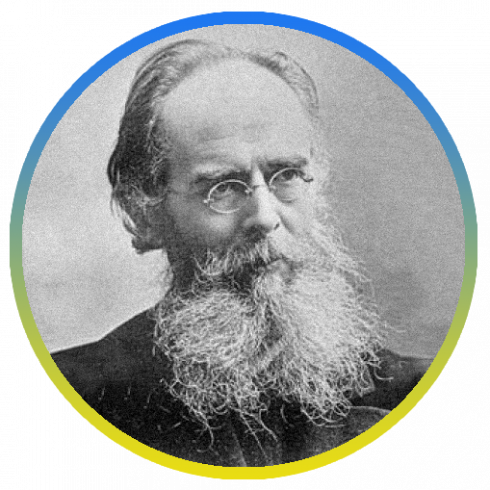
Oleksandr Opanasovych Potebnia – an outstanding Ukrainian linguist, philosopher, literary theorist, folklorist, ethnographer, one of the founders of the Kharkiv Historical and Philological Society (Potebnia headed it in 1877–1890), head of the Kharkiv philological school, founder of the psychological focus area in Slavic linguistics, teacher and public figure, corresponding member of the St. Petersburg Academy of Sciences (1875) – was born on September 10, 1835 in the village of Havrylivka (now the village of Hryshyne), Romensky district, Sumy region.
Having received a thorough general education, he entered Kharkiv University to study law, but a year later transferred to the Faculty of History and Philology. After graduating from the university, in 1856, Oleksandr Potebnia taught Russian at a gymnasium.
Since 1875, he has been a professor at the Department of Russian Language and Literature at Kharkiv University, where he worked until the end of his life.
In 1862, the scholar wrote his most famous work, “Thought and Language”, where he highlighted the relationship between language and thinking, language and nation, traced the origin of language, and developed the doctrine of the internal form of the word. His doctoral dissertation “From the Notes on Rus Grammar” (1874) became a significant contribution to science, scientist considered general issues of lexicology, morphology, syntax, and analyzed the concepts of word, grammatical form, and grammatical category.
O.O. Potebnia laid the scientific foundation for East Slavic dialectology as an independent discipline. He considered the history of the Ukrainian language in connection with the relevant aspects of the Russian language.
The scientist considered both languages to be descendants of one common ancestor language in the past (Old Rus language).
In accordance with the terminology of the time, he called the Ukrainian language a Little Russian dialect, and used the term “Russian language” for the group of East Slavic languages.
For the first time in Slavic philology, O.O. Potebnia systematized the specific features of the Ukrainian language that distinguish it from other Slavic languages. The scientist’s interests also included issues of phonetics, stress, and etymology.
O.O. Potebnia’s philosophy of language formed the focus area of his theoretical research in the field of verbal and artistic creativity and its psychology. He established an isomorphism between the word and the piece of art, the internal form of the word and the artistic image in his theory of linguistic poetics described in the publications: “From Lectures on the Theory of Literature” (1894) and “From Notes on the Theory of Literature” (1905).
He saw modeling systems derived from language in myth, folklore and literature. The scientist places language in another essential relationship – to the people and the nationality (nation). Language is a product and expression of the “folk spirit”. Мова є породженням і виявом «народного духу». It is the organic way and opportunity for every person and every community to perceive the world.
In addition to literature, O.O. Potebnia’s scientific legacy also encompasses socio-philosophical issues, in particular the theory of the nation. He interpreted nationalism as a worldview for which the national diversity of humanity is natural. “The idea of nationality,” wrote Oleksandr Potebnia, “is capable of promoting human progress if it affirms mutual respect for the right of peoples to independent existence and development, but when this idea is used to assert the superiority of one community over another, it acquires a reactionary meaning.”
Equality and mutual respect were a model of interethnic relations for O.O. Potebnia.
Under the conditions of cruel oppression by the tsarist government of the slightest manifestations of all nationalism, the scientist theoretically substantiated the inalienable right of every people to develop and realize their spiritual achievements using their native language, since “there is no language and dialect that would not be capable of becoming an instrument of unlimitedly diverse and profound thought.”
Condemning denationalization, the prominent philologist argued that all languages have inexhaustible internal potential for development.
The Institute of Linguistics of the NAS of Ukraine was named after O.O. Potebnia (1945).
Since 1977, “Potebnya Readings” have been held regularly. In the same year, a museum of the scientist was opened in the village of Hryshyne and a monument was erected to him. A street in Kyiv was named after O.O. Potebnia.