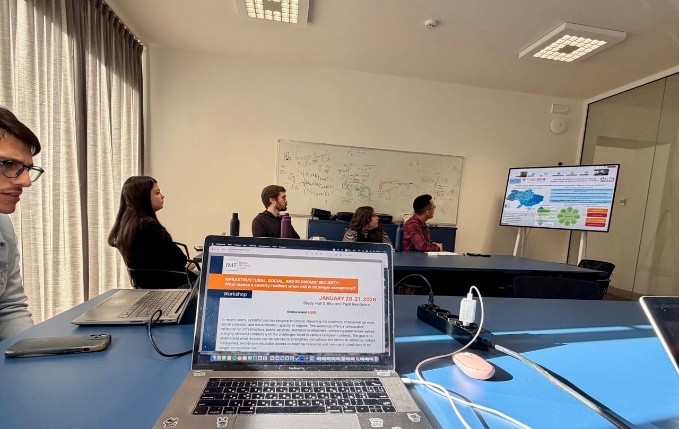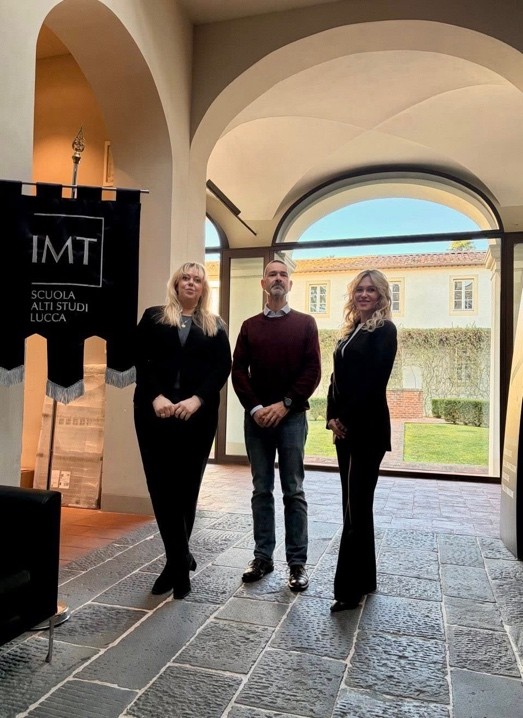
Scientists of the Research Center for Industrial Development Problems of the NAS of Ukraine participated in the international workshop "Infrastructural, Social, and Economic Security: What makes a country resilient when risk is no longer exceptional?" which took place on January 20-21, 2026 at IMT School for Advanced Studies Lucca (Italy) within the framework of the European research project SoBigData.
The event invited: the Center's director, Doctor of Economics Victoria Haustova, head of the macroeconomic analysis and forecasting sector of the Center Olga Ilyash, Doctor of Economics, head of the industrial policy and energy security department of the Center, Doctor of Economics Tetyana Salashenko.
The Academy's scientists presented reports in which they shared their own research findings and practical vision of how communities in Ukraine adapt to prolonged crisis conditions.
Victoria Haustova in the report "From destruction to reorientation: industrial changes and economic resilience of communities after the war" focused on the transformations that the local economy undergoes under the influence of war. It discussed the loss of traditional industrial specializations, business relocation, and the search for new community development models. Special attention was paid to the role of industrial and eco-industrial parks, infrastructure readiness to attract investors, as well as the need to move from reconstruction to deeper structural reorientation of industry – towards competitive, technological, and environmentally oriented models.
Tetyana Salashenko in the report "The capacity of Ukrainian communities to provide public services under conditions of war stress" spoke about the daily work of communities to ensure basic services – electricity, heat, and water supply, wastewater disposal, and waste management – despite constant attacks on critical infrastructure. She highlighted the development of own backup energy sources, implementation of digital management tools for communal facilities, modular solutions in heat supply, and inter-municipal cooperation in waste management. At the same time, it was emphasized that the effectiveness of these solutions is often limited by existing institutional and regulatory frameworks.
Olga Ilyash in the report "Administrative capacity, human resources, and labor market pressure as hidden infrastructure of community resilience" focused on the human and managerial dimension of resilience. She outlined the challenges communities face due to staff shortages, overload of administrative service centers, fragmented digitalization, demographic changes, mobilization, and integration of internally displaced persons. In this context, administrative services were characterized as a key element that allows communities to maintain continuity of other public functions in crisis conditions.
The event also included scientists from leading Italian universities and research centers, including Massimo Riccaboni (IMT School for Advanced Studies Lucca), Alessandro Rubino (University of Bari Aldo Moro), Gabriel Navarro Tilloca, Emanuele Calò (IMT School for Advanced Studies Lucca), Alfonso Damiano (University of Cagliari), Stefano Clò (University of Florence), Alessandro Sapio (University of Naples Parthenope).
The participation of Ukrainian scientists in the workshop laid the foundation for expanding further scientific cooperation with European partners. During discussions, joint work directions were outlined, including the preparation of project proposals within the Horizon Europe program (Cluster 3 Civil Security for Society), possible participation in Jean Monnet Actions initiatives for other fields of Education and Training: Learning EU, as well as conducting joint research and thematic workshops. Special attention was paid to prospects for preparing joint scientific publications and participating in international conferences.
Detailed information about the event is available on the official page of IMT School for Advanced Studies Lucca.
According to the information from the Research Center for Industrial Development Problems of the NAS of Ukraine