


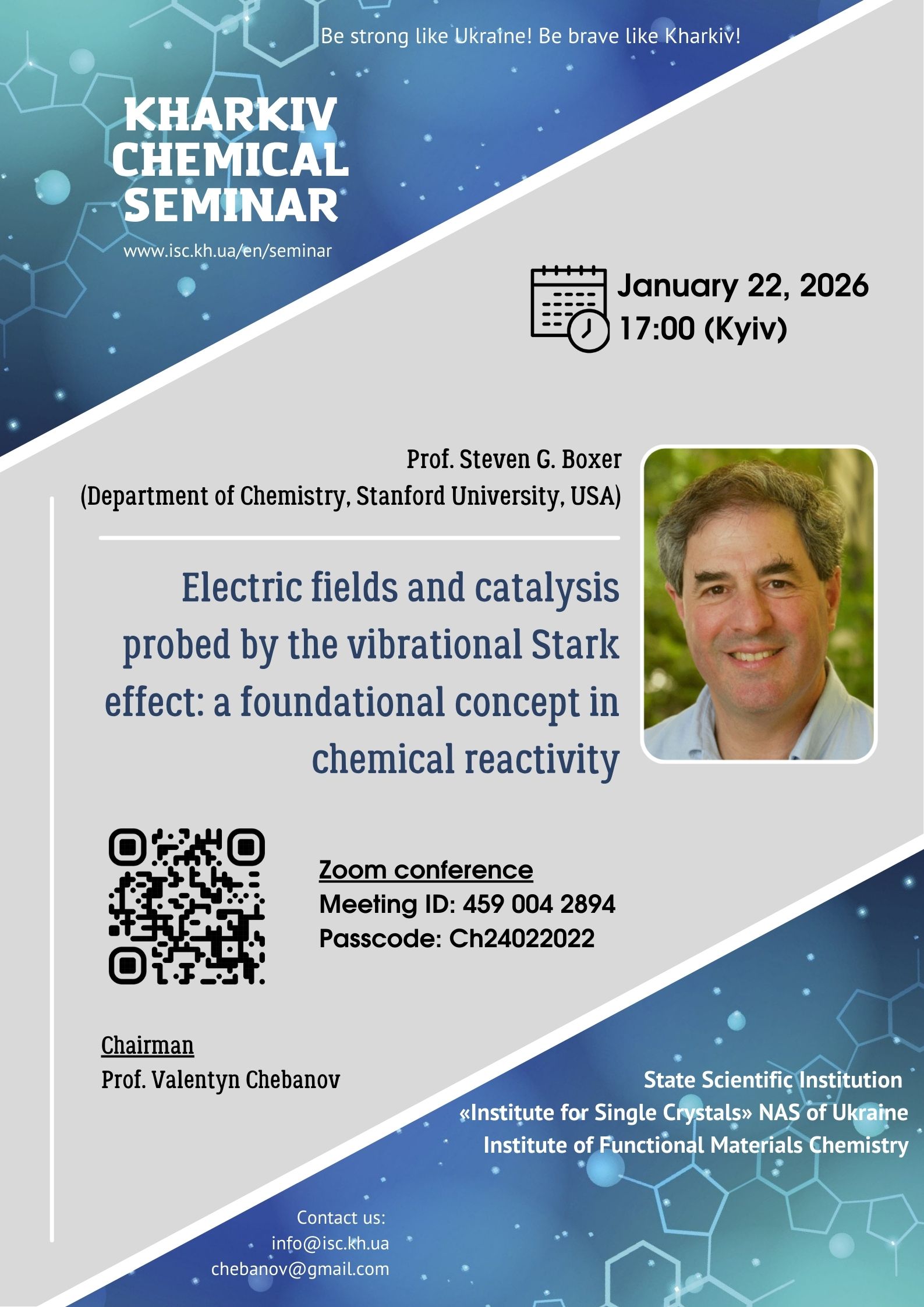
 After a short break, the Kharkiv Chemical Seminar, initiated by the Institute of Chemistry of Functional Materials of the Scientific and Technological Complex "Institute of Single Crystals" of the NAS of Ukraine, continues its work in the new year and invites all interested parties to communication and scientific discussions at the next lecture, which will take place on January 22, 2026, at 17:00 (Kyiv time). The event will be held online on the Zoom platform.
Lecturer: Professor Steven Boxer (Prof. Steven G. Boxer) – Professor of Chemistry Camille Dreyfus at the Stanford University Chemistry Department (USA). He earned his PhD in physical and physical-organic chemistry at the University of Chicago. Professor Boxer's scientific interests include photosynthesis, electrostatics and dynamics in proteins, green fluorescent proteins, Stark effect-based spectroscopy, and other areas of modern chemistry. His scientific publications have about 30,000 citations, with an h-index of 91.
Lecture topic: "Electric fields and catalysis probed by the vibrational Stark effect: a foundational concept in chemical reactivity."
Local internal electric fields created by the organized environment in complex systems, particularly in proteins, can be measured using the vibrational Stark effect (VSE). It has been found that these fields can reach very large values and significantly influence reactivity.
The lecture will present the basic physical concept and strategies for applying VSE to a wide range of systems. The general idea of electrostatic catalysis and the developed methods have proven universal and have been applied to a number of enzymes to quantitatively determine the electrostatic contribution to catalysis. This concept can also be extended to other manifestations of chemical reactivity, including drugs.
Recent work by Professor Boxer's research group addresses the question of whether larger electric fields and, accordingly, higher reaction rates can be created through enzyme design or their evolution. Using the hydride transfer enzyme liver alcohol dehydrogenase (LADH), it was shown that mutations and metal substitutions in the active site can create both larger fields and lower activation energies (and thus higher rates), and that these effects are additive, expanding and strengthening the concept of electrostatic catalysis.
This suggests that an important missing link in the search for better design of biological or non-biological catalysts may be the electric field.
Meeting ID: 459 004 2894
Passcode: Ch24022022
Event coordinator: Academician of the NAS of Ukraine Valentyn Chebanov (chebanov@gmail.com; info@isc.kh.ua).
The seminar language is English.
Traditionally, seminar participants can expect an interesting lecture and the opportunity to communicate with the speaker.
Videos of all Kharkiv Chemical Seminar lectures, as well as detailed information about the meetings, are available here.
Brief about the event:
In April 2022, scientists of the Institute of Chemistry of Functional Materials of the Scientific and Technological Complex "Institute of Single Crystals" of the NAS of Ukraine initiated and made accessible to a wide audience the Kharkiv Chemical Seminar, where leading scientists from around the world give reports and lectures. Since then, the Kharkiv Chemical Seminar has become well-known and prominent among scientists, graduate students, and students (even schoolchildren attended lectures) both in Ukraine and worldwide, and information about it can be found on the websites of leading scientific centers and on the pages of scientific publications. More than 50 seminar meetings have taken place, with attendance exceeding 40,000 (both in-person and via the corresponding YouTube channel). Notably, Nobel laureates Jean-Marie Lehn, Jean-Pierre Sauvage, Richard Roberts, Kurt Wüthrich, Dan Shechtman, Roald Hoffmann, Ferenc Krausz, Omar Yaghi, as well as leading scientists from France, Switzerland, Austria, Germany, the USA, the Netherlands, Canada, the Czech Republic, and other countries have given 10 lectures at the seminar. Among them are scientists with h-indices over 100 and even 200, including well-known researchers such as Eric Carreira, Phil Baran, Yuriy Gogotsi, Thomas Ebessen, Oliver Kappe, and many others.
According to information from the Scientific and Technological Complex "Institute of Single Crystals" of the NAS of Ukraine