


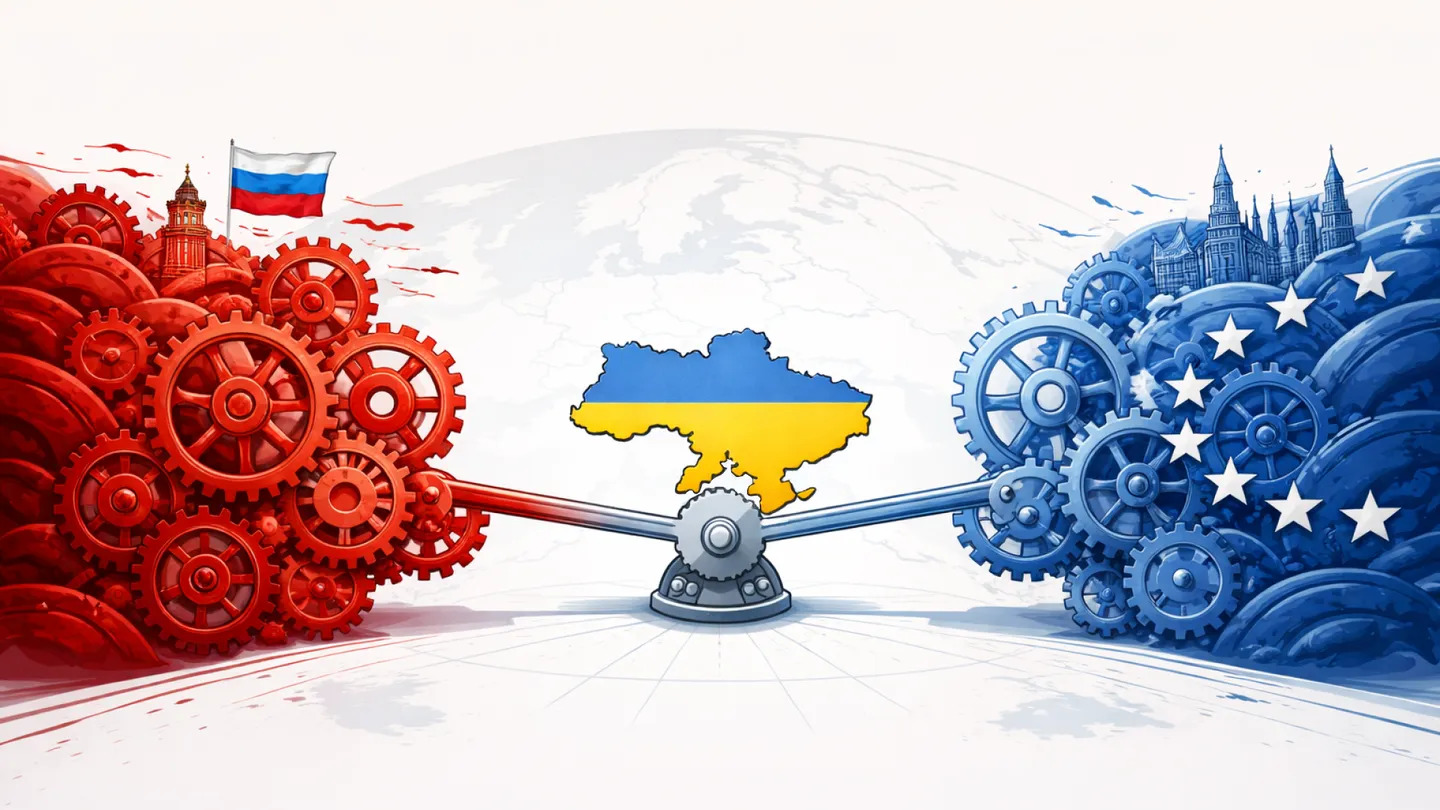
Specially for the information internet publication “LIGA.net” the Vice President of the National Academy of Sciences of Ukraine and Director of the Center for Army, Conversion, and Disarmament Studies, Valentyn Badrak, outlined three possible scenarios for the development of events in Ukraine and the world in 2026. We present to your attention the full reprint of this article with the kind permission of the information internet publication “LIGA.net”.
What 2026 will bring to Ukraine and the world – three scenarios. Forecast by Horbulin and Badrak
The world is entering 2026 without rules, but with an increasing number of stakes
Yulia Bankova
Editor-in-Chief of LIGA.net
01/05/2025 – 07:00
Contents:
Scenario One. War stops and confrontation transforms
Scenario Two. The war drags on for at least one to two years
Scenario Three. The Russian Federation attacks NATO and the EU
What yesterday seemed like an extreme scenario is today being discussed in offices and headquarters as a working plan. Ukraine has found itself at the center of a global shift – between war, a pause, and a dangerous illusion of peace. Leaders’ mistakes, autocrats’ cynicism, and democracies’ fatigue are shaping a new reality faster than diplomatic communiqués. The question is not what will happen in 2026, but which of the three scenarios the world will dare to choose.
To assess the possibilities of the coming year, it is worth looking back at how the world ended 2025.
This year became a period of approaching a large continental war in Europe and a sharp rise in tensions in the Asia-Pacific region, the persistence of military turmoil in the Middle East, and the continuation of Russia’s global genocidal war aimed at destroying the Ukrainian state.
In 2025, there was an unprecedented rapprochement of Ukraine with EU countries and European NATO, although the contours of the anti-Putin coalition remain a long way off. At the same time, it must be acknowledged that the sharp increase in military danger for European countries opened a new window of truly unique opportunities for Ukraine, and its gradual integration into Europe’s defense and defense-industrial space is already actively underway and may allow survival in the vital war and even victory.
The international policy of the Trump administration finally brought the Kremlin dictator out of isolation. Thus, the US president strengthened not only Russia’s positions but also China’s potential, whose leader since autumn has noticeably intensified rhetoric regarding Taiwan and openly threatens several neighboring countries.
As never before in recent history, in 2025 the mental characteristics of the world’s top politicians played perhaps a decisive role in discrediting the former international world order. It can be predicted that the incurable infantilism and vanity of Trump, the unwavering and persistent cynicism of Xi Jinping, and even more so Putin’s pathological devotion to the idea of destroying the surrounding world along with his traditional support for terrorism will have fundamental impacts on the construction of the future world – whether post-war or war confrontation. The quarter of the 21st century is ending amid a strange contempt for humanity and traditional human values.
China has moved to a cautious but consistent and systematic imposition of a new world order. The episodic partnership of China and Russia against the Western world in 2025 has effectively taken shape – this is vividly evidenced by the scale and quality of Russia’s supplies of dual-use Chinese products. Beijing’s tacit encouragement of the Kremlin’s offensive created for Moscow the possibility of a military alliance with North Korea and conditions for large-scale use of the potentials of Iran and Belarus, which undoubtedly strengthens the regime.
In 2025, the Russian economy faltered – noticeably for the first time. Although there are no signs of direct danger yet, the Kremlin’s vulnerable spot has become clear. And this is far from just about sanctions, but about the significant and systematic contribution of the Defense Forces to the destruction of Russia. Given the current conditions of Russia’s existence, it can still finance the war for several more years, but if pressure expands, this potential may become very fragile. Meanwhile, outside the main events of the year, there has been the beginning of open discussion in Chinese media of a scenario of absorbing a wealthy region of the Russian Federation in case of its collapse. At the same time, this is a significant symptom that under certain conditions can influence the development of future scenarios.
This year Ukraine began producing much more of its own long-range weapons, gained not only subjectivity on the continent but was also recognized as an asset of the EU (and to some extent European NATO). At the same time, under enemy pressure and unfavorable external pressure from the US, there is not only loss of territories but also coercion to capitulation.
So what scenarios might take place in 2026 and how might they affect the future of the Ukrainian nation?
Scenario One. War stops and confrontation transforms
This is the most desirable and anticipated scenario for Ukrainians at this stage, as it is caused by the exhaustion of the army and fatigue of society amid unresolved problems of unpunished corruption, a growing gap between the current government and society, as well as the absence of fair mobilization and adequate military management.
Despite optimistic reports about the development of basic security guarantees for Ukraine, the final resolution of global contradictions with Russia and the prospect of stopping the war remain an illusion for now. The issue of territories in the context of Kremlin demands to cede them remains unresolved. Moscow insists on concessions despite Russia’s urgent need for a pause – the Kremlin dictator is bluffing, but for Putin, ending the war is too risky.
Firstly, it is a mechanism for retaining power; secondly, without external assistance, it is almost impossible for Russia to return to peaceful life without internal cataclysms. So Putin’s focus today (and for 2026) is not so much Ukraine as a target but recognition of “victory,” securing territorial gains internationally, and lifting sanctions amid a return to political and economic cooperation with the world. This somewhat aligns with Beijing’s interests, for whom the status quo of Russia is neither victory nor defeat, but maintaining influence is a quite real possibility both for participating in Ukraine’s recovery with expanded economic presence and for restoring a high level of cooperation with the EU, including the technology sector.
The scenario of freezing the war could become a reality under two conditions – successes of the Defense Forces on the battlefield and more active support for Ukraine from the US. The first can be ensured by Europe, both by supplying American and its own weapons and by financial support that will cover not only weapons production but also the maintenance of Ukraine’s Defense Forces. The second means that the US, if Putin refuses compromise, will increase pressure not on Ukraine but on Russia. This includes sanctions and revising the armament nomenclature for the Defense Forces – toward strike missile weapons, continuing intelligence data supplies, and expanding cooperation with Europe.
The likelihood of the first scenario is about 50/50, and the main risks lie in the decisions of the US administration and Ukraine’s ability to carry out important internal transformations, among which the most significant are the reboot of the security and defense sector (with significant personnel decisions) and changes in attitude toward corruption.
In any case, this scenario is intermediate, as it is not a final solution to Russia’s core problem – the capture of Ukraine. Its probable implementation will be characterized by the transformation of the current war into preparation for a new one amid maximum hybrid influences of Russia on Ukrainian society, including elections and the formation of internal political conflicts. To a large extent, the resilience of the Ukrainian nation will depend on the activity and decisiveness of non-governmental institutions, which are traditionally more developed and powerful than the government.
A more sustainable and stable peace may come with the conclusion of a guarantee agreement (subject to successful negotiations), where NATO countries will “sign” an obligation to provide military protection to Ukraine if military aggression recurs. Of course, with the appropriate ratification of the agreement by parliaments. But even in this case, there will be only one guarantee – a strong, well-trained, and armed army and a resilient nation.
Scenario Two. The war drags on for at least one to two years
Putin responds negatively at the end of negotiations, and Trump again falters, possibly due to China’s tough and uncompromising position. One way or another, Washington pressures Ukraine, which cannot accept the conditions of “territorial capitulation.” The war continues under unfavorable conditions for Ukraine and Europe.
For Ukraine, it is almost impossible to make a territorial compromise with the Moscow regime. First of all, the Putin Kremlin will see such a compromise as recognition of systemic weakness and readiness to constantly make concessions. This will be presented in the Russian information space as an “undeniable victory” and an explanation to its society of the need to “crush the weak enemy” while it is in such a state. This is a subconscious position of weakness that will become a powerful psychological blow to Ukrainian society, especially to the defenders of the state. Finally, it is a perfect invitation for the dictator to go further, increasing options for terrorism and fascist manifestations of modern Russia.
The development of this scenario may be facilitated by deepening Ukraine’s internal weakness in the negotiation process. At the end of the year, this has two levels. In particular, if publications are confirmed that Secretary of the National Security and Defense Council of Ukraine Rustem Umerov asked FBI Director Kash Patel for protection from NABU in the “Mindych case” during a meeting, this would mean that the official negotiator on behalf of the Ukrainian state has become dependent on American intelligence agencies, automatically putting Ukraine in an extremely vulnerable position.
The second level of probable weakness may lie in President Zelensky’s unwillingness as Supreme Commander to reboot the entire state defense system, likely with replacements of key officials.
Both problems leave the country’s future in a zone of extreme risks.
The most important tasks in this scenario should be the immediate implementation of a number of “homework” assignments, among which two have grown into real challenges – improving mobilization and changing military management. It has come to the point that the commander of the Third Army Corps, Brigadier General Andriy Biletsky, through an article for the British “The Economist,” called for an immediate reform of the Armed Forces of Ukraine. Although Biletsky partly presents himself as a politician, he speaks very weighty, relevant, and timely things. Without focusing on numbers, it is worth noting that the brigadier general calls to turn back to the people, soldiers, and sergeants. This is about restoring initiative at the front, improving personnel policy throughout the military vertical (“paper generals” without combat experience decide human fates), rejecting illogical decisions such as turning international legions into assault troops. “A complete re-certification of the officer corps not as punishment but as a guarantee of survival” is a very frank and strong message, both a sign of deep illness and a call for change, because beyond this lies an abyss. Plus “quick removal of all barriers for the growth of capable young officers.” This is about immediate cleansing of the army.
Another very important factor is European unity. Even amid some hidden conflict between the leaders of Germany and France, which intensified due to different positions regarding the allocation of about 210 billion euros of Russian assets to finance Ukraine’s needs, the EU nevertheless made a decision unexpected for the Kremlin to provide Ukraine with 90 billion euros in 2026–2027 to support the economy, defense, and stability of the country. But the truth is that European countries have not completely rid themselves of their inherent selfishness, which also reduces Ukraine’s potential.
For example, in December it became known that partners did not grant Ukraine a license to manufacture air defense systems and began to withhold missiles for themselves. Meanwhile, Russia constantly raises the stakes in intimidating the West, and the most important goal is precisely to reduce assistance. Putin’s December rhetoric looks like he offers to exchange Europe’s security for Ukraine – this is exactly how to interpret the dictator’s threats regarding war with Europe. And this is far from just about missiles for air defense systems, including Patriot, SAMP/T, and NASAMS. European countries already have the latest ATACMS missiles in their arsenals, as well as cruise missiles for combat aircraft.
Can Russia, under this scenario, capture one of Ukraine’s regional centers or, say, realize its long-standing dream and cut Ukraine off from the sea? Very unlikely. Two countries will suffer, and the question is which one will receive more help and which one will be pressured. Agreements and arrangements in November and December, including with Britain and Germany, development of military-technical cooperation with Italy and France throughout the year indicate a higher level of interaction than ever before. Already in December, France took an unprecedented step – announced the delivery to Ukraine in 2026 of the first air defense system – the SAMP/T NG missile system. This is the very system capable of shooting down ballistic and hypersonic missiles like the “Kinzhal,” and Ukraine will be the first operator of the newest European system.
At the same time, the question remains whether Europe will retreat at the most critical moment for itself.
Scenario Three. The Russian Federation attacks NATO and the EU
This is about creating critical pressure on Europe in resolving the issue of “obtaining Ukraine” as achieving parity with Europe, even if temporary.
This scenario should not be considered fantasy because for the Kremlin such a step is calculated, though it may also arise from despair. Experienced retired US General Wesley Clark, former commander of NATO’s Allied Forces, said about an attack on NATO: “Russia will dare only when it creates conditions that give it hope for success – for example, further division between ‘new’ and ‘old’ Europe, isolation of Baltic diplomats, etc.” This approach fully fits into Putin’s traditional Chekist strategy – to make a new destructive step when the world’s response to the previous one is too weak to stop him.
It is about a calculated, well-prepared, dagger operation against one of the NATO countries to either quickly reach negotiation level with the Alliance or, if the bloc is unable to successfully and timely defend its flank, to capture one or more countries. The most realistic looks like an attack on the Baltic countries – their very small territories and the apparent ease of targets favor this, even with not loyalty from the US but at least a one-day delay in the Trump administration’s decision.
EU Defense Commissioner Andrius Kubilius emphasized that such signals should be taken very seriously: “If the Kremlin is discussing this, then such a scenario is not excluded.”
Similar views were expressed by professional military. For example, former KFOR commander (NATO-led international forces responsible for stability in Kosovo), German General Erhard Bühler does not rule out such a step: “Russia is capable of a local sudden strike and instant nuclear blackmail.” He adds a quite fair remark: “To destabilize Europe, Russia does not need to occupy it. It is enough to shake the balance, divide it.”
It is quite obvious that the main task of Putin’s aggression is to force NATO and EU countries to focus on their own defense, stopping support with weapons to Ukraine. It seems that instead of deploying a large-scale continental war, at least in 2026, crafty Moscow will rather use a hybrid blitzkrieg against the Baltic countries, primarily Estonia, and possibly Latvia. Using surprise and internal weakness of the Baltic countries amid a NATO weakened by Trump’s policies.
Experts identify powerful possibilities of “demographic weapons”: using a large group of “non-citizens” and Russian-speaking populations, for example, in Estonia’s Narva or Latvia’s Daugavpils to stage a hybrid “uprising movement” of the people against the authorities. Such a scenario may be supported by the invasion of special units, for example, Special Operations Forces, a highly mobile special group within the Russian Ministry of Defense, designated for special tasks inside and outside Russia. One can also predict the transfer of “little green men” by helicopters or motorboats to arm local “waiters” and seize administrative centers.
A multi-vector strike is not excluded; for example, an operation in the Baltics may be accompanied by simultaneous strikes on the Suwałki Corridor and along the Finnish border to tie up NATO headquarters.
Moscow’s adventurous, delicate game instead of tanks and open fronts, but with large-scale information-psychological operations, protests in cities, rapid capture of administrative hubs – this may bring Russia the desired effect. Under the guise of an “internal conflict,” Russia will try to create cover conditions for the operation to at least temporarily block a joint military response from the Alliance. It is worth recalling that Trump did not raise the Taiwan issue during the meeting with the Chinese counterpart – apparently because he fully understands the complete possibility of synchronizing Moscow’s and Beijing’s actions, while China before the Trump-Xi meeting deliberately outlined that it would absolutely “not exclude” the possibility of using force against Taiwan.
Will hybrid capture force European countries to abandon their interests in Ukraine? Much depends on Trump’s personal position. But it seems Putin may strategically miscalculate here because the US president took care of such a move in 2026 when he signed the National Defense Authorization Act (NDAA). It defines the minimum level of American troop presence in Europe during 2026. It concerns a minimum US military contingent in Europe of 76,000 people for more than 45 days. By the way, according to the Pentagon, about 100,000 American soldiers are currently in Europe. About 65,000 of them are permanently stationed, the rest are on rotational missions. So it is one thing to act against Europe, quite another against the US.
And for Beijing, a dilemma is already emerging: does it need Russia as a third pole, as a superpower and empire? The question seems rhetorical.
However, under any circumstances, the world awaits an extremely difficult and most dangerous year – at least among those already experienced in the 21st century. And God grant all players not to trigger a chain reaction leading to World War III.
Reprint from LIGA.net
Collage: Daryna Dmytrenko/LIGA.net