


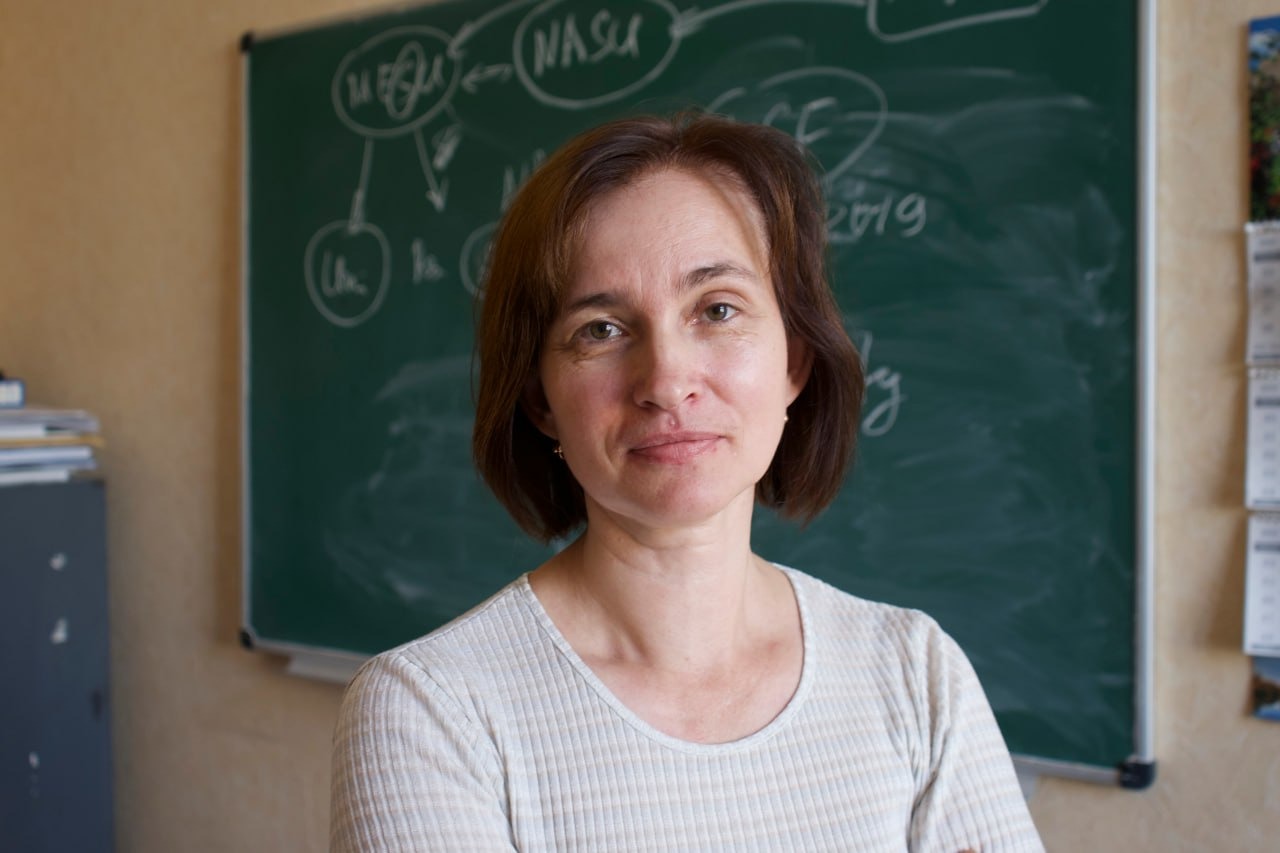
 "I am always concerned when in the highest-level documents... science is somewhere 'in the backyards.' There is no fundamental understanding that science is a component of the economy, and it is not an expense but an investment. <…> ...it is precisely thanks to the cooperation of science and business that an innovative economy can be built, that is, one based on high added value, on deep scientific research. For me, an innovation strategy is the construction of a knowledge-intensive economy based on knowledge," says the Deputy Director for Development and Innovation of the Kyiv Academic University, head of the scientific park project "Academ.City," leading research fellow of the Nonlinear Analysis Department of the Institute of Mathematics of the NAS of Ukraine, Doctor of Physical and Mathematical Sciences
Oleksandra Antonyuk, who was elected Chair of the Scientific Committee of the National Council of Ukraine on Science and Technology in October 2023. What are the advantages and disadvantages of the Strategy for the Development of Innovation Activity of Ukraine until 2030, the draft of which is currently being prepared by the Cabinet of Ministers of Ukraine? What hinders the development of public-private partnerships in our country, particularly between scientific institutions and private enterprises? What priority issues is the Scientific Committee of the National Council of Ukraine on Science and Technology currently working on? What changes does the Ukrainian scientific sphere need, and how to reform it without causing harm? What processes are taking place in the National Research Foundation of Ukraine? Is the current foreign grant support sufficient for Ukrainian scientists? Why is the scientific and technological park "Academ.City" being created in Kyiv, and at what stage is this process? The scientist spoke about all this in an interview with the newspaper "Svit."
"I am always concerned when in the highest-level documents... science is somewhere 'in the backyards.' There is no fundamental understanding that science is a component of the economy, and it is not an expense but an investment. <…> ...it is precisely thanks to the cooperation of science and business that an innovative economy can be built, that is, one based on high added value, on deep scientific research. For me, an innovation strategy is the construction of a knowledge-intensive economy based on knowledge," says the Deputy Director for Development and Innovation of the Kyiv Academic University, head of the scientific park project "Academ.City," leading research fellow of the Nonlinear Analysis Department of the Institute of Mathematics of the NAS of Ukraine, Doctor of Physical and Mathematical Sciences
Oleksandra Antonyuk, who was elected Chair of the Scientific Committee of the National Council of Ukraine on Science and Technology in October 2023. What are the advantages and disadvantages of the Strategy for the Development of Innovation Activity of Ukraine until 2030, the draft of which is currently being prepared by the Cabinet of Ministers of Ukraine? What hinders the development of public-private partnerships in our country, particularly between scientific institutions and private enterprises? What priority issues is the Scientific Committee of the National Council of Ukraine on Science and Technology currently working on? What changes does the Ukrainian scientific sphere need, and how to reform it without causing harm? What processes are taking place in the National Research Foundation of Ukraine? Is the current foreign grant support sufficient for Ukrainian scientists? Why is the scientific and technological park "Academ.City" being created in Kyiv, and at what stage is this process? The scientist spoke about all this in an interview with the newspaper "Svit."
On the reform of Ukrainian science:
"In any case, I am in favor of an evolutionary path of development. After all, the best progressive solutions, if they are too far removed from what society can accept, will not be adopted and will not be effective. <…>
My main principle: when working with people, we must remember for whom we are conducting reforms. My approach is that you cannot carry out reforms of a sector or direction without asking the people directly concerned. Especially when it comes to scientists, who are already very few in our country compared to other countries per capita. I repeat: if the reform is not accepted, it will not work.
Probably today, during the war, we all realized that the most important thing for us is the person. We understand that people are our potential that we must preserve. When it comes to reforming the National Academy of Sciences, I am against it being a formal reform, where we rearrange something and at the same time do not consider how it will affect scientists: whether their number will increase, whether the quality of scientific research will improve, whether the number of young scientists will grow, whether there will be a cause-and-effect relationship between this and that. Therefore, I question whether it is timely now to make such radical decisions?
There is another way to achieve the same result, less 'bloody' but more effective — evolutionary changes. This is an iterative process, where you start from the previous iteration, work on mistakes, draw conclusions, and then take the next step.
Since I became interested in innovation activity, I have had to read a lot of literature on crisis management in large organizations.
If you imagine a large enterprise that is performing poorly and needs to work better, the main task is that during the process of changes and reformatting it continues to operate, does not collapse, does not stop, but continues to produce the necessary products. For this, a matrix of changes is formed: first, one department is taken, then another. Under these circumstances, reforms are planned so that all production processes remain stable, so as not to destroy the enterprise entirely. After all, if it does not work and produce products, these reforms are useless. The same applies to any management processes in large systems. Quick and simple solutions are not always correct — I can say this as a mathematician. There are many obvious but wrong decisions.
When some say that we have too many scientists and need to reduce the number of institutions... Maybe institutions need to be consolidated, but compared to other countries, the number of scientists per capita in our country is very small. Therefore, when conducting reforms, the primary thought must be how to increase their number. This is a task that cannot be solved quickly because the 'birth' of a scientist takes at least 35 years. At the same time, it is very difficult to retain talented young people in science.
Today, the salary of a young scientist differs little from that of a cleaner. Therefore, the issue of proper remuneration for scientists and a fair tariff scale must be raised. And this needs to be thought about. It is no longer possible to postpone."
On control and freedom in science and business:
"Many new innovative management decisions are proposed in our country, but the control and audit system remains old, very similar to the Soviet one. For rapid economic growth, scientific decisions need to quickly become the basis of business processes.
And when private business comes to a scientific institution or university and sees these risks, it simply turns around and tries to solve its problems independently. State scientific institutions and universities are also aware of the risks from control bodies, so any initiative in the state system is based more on the enthusiasm and passion of individuals than on a system. Therefore, entrepreneurial culture is weakly developed in our country. After all, this is a culture of the right to make mistakes. Americans are not afraid to make mistakes because the system built does not punish them severely for it.
There must be a balance between control and freedom, whether in entrepreneurship or scientific creativity. Both scientists and business suffer from unreasonable inspections, which slows down our overall progressive development."
About the scientific and technological park "Academ.City":
"Our team [the team of the scientific park project 'Academ.City'] set the task of creating a scientific park, understanding that we do not have a truly developed technology transfer system, there are many limitations and problems, and you cannot just take and transfer the experience of the USA or Germany to our realities. But we are ready to 'get bruised,' to try to propose solutions in our specific circumstances, that is, within our legislative framework, with our industry and our scientists.
The Berlin technopark 'Adlershof,' on whose experience we rely, actually comes from the word 'park' in its original meaning. <…> It is a part of the city that influences its development. It is like advertising science. <…> But it is more than just advertising. There are real high-tech laboratories, leading firms want to place their offices there to be the first to learn about the latest scientific innovations and developments. Businesspeople and scientists can accidentally meet in the cafeteria, resulting in contacts and new contracts. It is a kind of ecosystem. Previously, there were barracks of the Academy of Sciences of the GDR. <…> ...the Berlin city hall invested billions of marks, and then euros, into the project [Adlershof technopark]. Moreover, the park was given land, which it sold and then made further investments.
We do not have all this, but we are looking for our own way to create such an ecosystem. The joint German-Ukrainian project, supported by the German Ministry of Education and Science, made it possible to develop a feasibility study for the creation of a scientific park. And we laid this into our roadmap. <…> Our joint project ended in December 2021, and two months later the full-scale Russian invasion began. Already in March, we realized that we needed to radically change the concept. Therefore, first of all, a grant office was created, which submitted 28 grant applications during 2022 alone, seven of which were successful. Three of them are currently being implemented by Kyiv Academic University. Others by teams of some NAS of Ukraine institutions. We try to help others as much as our capacity allows. In 2022 alone, we paid about two million hryvnias in taxes. These were EU funds that flowed into the Ukrainian economy through scientific projects. Of course, many nuances arose in the process, which allowed us to more clearly formulate the problems faced by state scientific institutions. Our team aims to generalize such experience to help others overcome such challenges.
First, we analyzed the strengths of the cluster of scientific institutions. This helps to understand which scientific expert teams are the strongest and which developments are the most promising. We also identified technologies on which this scientific park will focus: advanced materials, new energy, nanotechnologies, ecology and environmental protection, biotechnology, quantum technologies, and machine learning. One of our tasks is to constantly organize communication between scientific institutions and business, form a community of innovators, and conduct educational and outreach activities on innovation management. <…> I am convinced that only the cooperation of science and business can be the key to the success of our state."
Full text of the publication: