


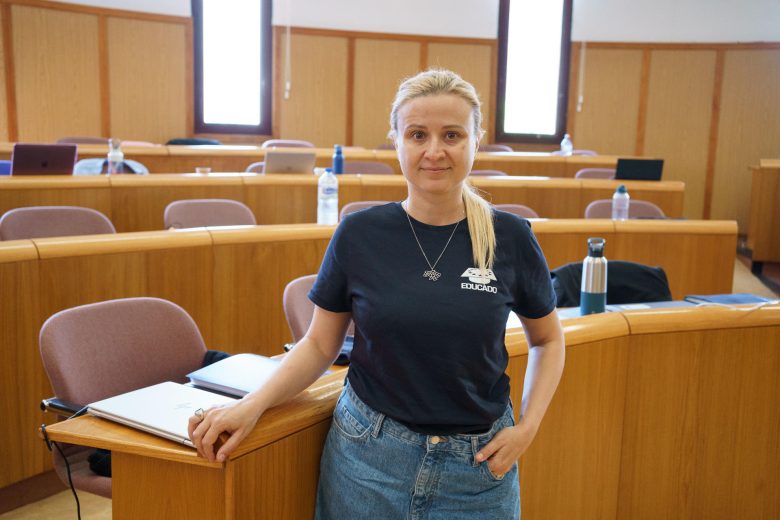
Senior Researcher of the Department of Extragalactic Astronomy and Astroinformatics at the Main Astronomical Observatory of the NAS of Ukraine, Candidate of Physical and Mathematical Sciences Darya Dobricheva spoke about her work during the war and the state of astronomy in Ukraine to the international Spanish-language news agency EFE and the Chicago Spanish-language newspaper “El Día.”
Currently, the scientist is at the Institute of Astrophysics of the Canary Islands (Santa Cruz de Tenerife, Spain) as an invited lecturer of the summer school on machine learning within the framework of the European project EDUCADO.
Darya Dobricheva’s scientific interests concern the large-scale structure of the Universe, in particular the spatial distribution and physical properties of galaxies, morphological classification of galaxies by various features of their structure, and evolution on cosmological scales. The researcher pays great attention to the application of machine learning methods in the analysis of astronomical data. Together with colleagues, Darya Dobricheva has developed automated approaches to the morphological classification of galaxies and the identification of their properties. She is currently involved in a project to search for analogs of the Milky Way galaxy using machine learning methods. She also participates in the search for exocomet transits using machine learning (according to the scientist, such research is extremely important for understanding how icy exocomets can contribute to the formation of atmospheres and, therefore, possibly the origin of life).
Darya Dobricheva also said that Ukrainian scientists have worked and continue to work despite regular Russian air raids and, as a result, power outages and damage to scientific infrastructure. “We have adapted, we have no other choice,” she says. However, this is extremely difficult because Ukrainian science is constantly underfunded from the state budget: according to legislation, 1.7% of GDP should be allocated to science in Ukraine, but only 0.17% of GDP is allocated, i.e., ten times less. This funding is enough to cover 50% of salaries. Under such conditions, scientists are forced to seek additional opportunities. International cooperation helps astronomers and astrophysicists, as does the availability of data from various telescopes around the world on the internet.
Photo: Agencia EFE