


Why is it unacceptable to concede your sovereign territories to the enemy? (Spoiler: not only for the sake of preserving dignity). Are there historical precedents for restoring the territorial integrity of states? How did Russian propaganda use the concept of the separateness of Eastern Ukraine and why should the name "Donbas" not be used? How did Donetsk and Luhansk develop at the turn of the 19th and 20th centuries and how did they differ from the western and central Ukrainian regions? What is valuable about literature written during the war, especially the voices of artists defending Ukraine? About all this and much more, leading research fellow of the Department of History of Ukraine in the second half of the 20th century at the Institute of History of Ukraine of the National Academy of Sciences of Ukraine, Doctor of Historical Sciences Olena Stiazhkina told in an interview with Voice of America.
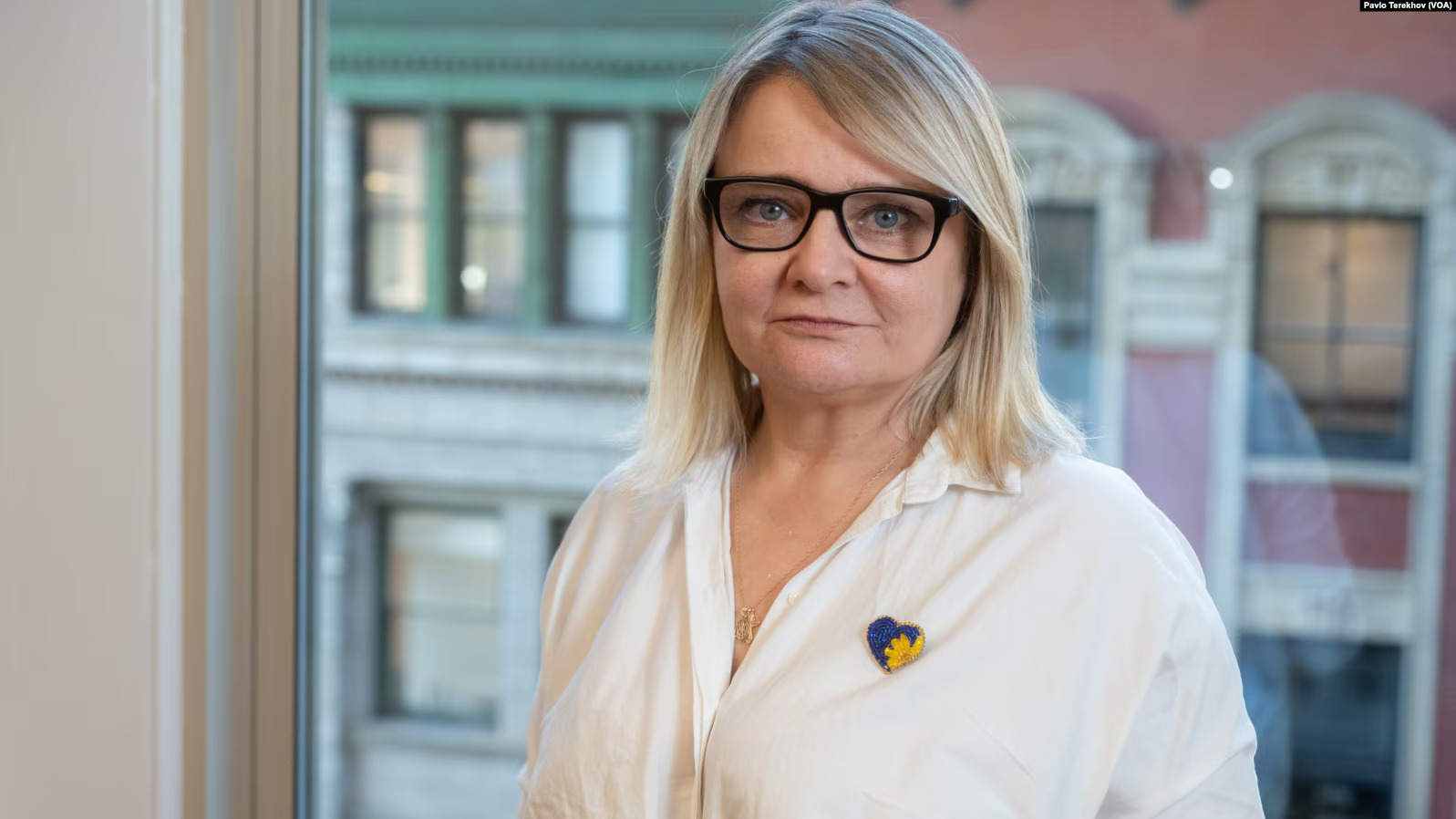
Doctor of Historical Sciences Olena Stiazhkina. Photo: www.holosameryky.com
On the chances of restoring Ukraine’s territorial integrity:
“History shows us numerous examples when it seemed that nothing existed anymore, that the territory was lost and would never be a country again, but everything changes. This can be said about Poland. At the end of the 18th century, it seemed that Poland’s fate was finally decided. The territory existed, the name did not, Poles were assimilating, and they would never exist again.
The second example closer to us is East Germany. It also emerged as a specific ethnic group, and Russia invested in this. It tried to create a different kind of German, a Soviet socialist, eastern, almost not even a German.
At the same time, as soon as the window of opportunity opened, everyone immediately forgot that there was any specific East German people. But the Kremlin’s logic was the same — everyone who wanted left. Right? They said the same thing.
The problem is political will and strategic paradigm. Do we consider it necessary to think of Ukraine as a united, single, free, democratic state?”
On the temporarily Russian-occupied Donetsk and Luhansk regions:
“The issue is not even that Donbas is Soviet. The issue is that the mythological construct supporting this term next proposes to formulate the concept of the Donbas people. That is, a certain group, an ethnic group, which could demand, for example, the creation of some state structure. That is the danger.
That is exactly why they [the Russians] invested so much in this word. And why they use it so much now. Notice that these so-called fake republics did not become a federal district or some oblast of the federation. They keep their name. That means somewhere on or under the table this map of the Donbas people can still be played. And why should we play into the enemy’s hands? <…>
There is a good term proposed by an Estonian researcher, “securitization of the past.” It is not about rewriting history, but about seeing in history the time bombs laid by propaganda. Donbas is about the security of our historical heritage. <…>
I have a good example for Europeans, maybe less so for Americans. If in Italy almost everyone could dig up the Belvedere torso or the equestrian statue of Marcus Aurelius in their garden, then in our regions almost everyone, if digging deep, could dig up a Scythian or Polovtsian statue. So we can talk about the long historical continuity of this territory, where one ethnicity layered over another. Although Ukrainian was still the leading one. It was around it that this whole history gathered. Around cultural, culinary tradition, and farming tradition. Because it proved stronger than Scythian, Polovtsian, or even Greek. <…>
…until 2022, the highest-paid and most sought-after tutor in Donetsk was a Ukrainian language tutor. And that is the main thing. It was a story about the future. People understood, children understood that their future was not here, where they were taught to be scoundrels for the sake of the Kremlin. So they almost secretly learned Ukrainian to be able to pass the Ukrainian language exam and enter Ukrainian universities. <…>
I am absolutely sure that we will all return to our cities. Not everyone will have homes. That’s true. But that these will be our cities and we will return there, I have no doubt. As long as the land is ours.”
On the specifics of the historical development of Eastern Ukraine:
“…central and western Ukraine developed according to the logic of Europe. But this eastern Ukraine developed absolutely according to the logic of America. Everyone came, brought money, started their life anew. And this story about the possibility of a new life, the possibility to build something, is very American. If you look at pictures of how Yuzivka was built and how Birmingham was built, they are just absolutely identical streets, with identical equipment. Moreover, Yuzivka is from the early 20th century, and Birmingham from 1936. And who was ahead here? At meetings in the USA, I show photos of Donetsk and Luhansk regions developed at the end of the 19th century and America. And I ask the audience to say which is which. And people do not always guess. And this is so important to me when people can confuse Seattle and, say, Mariupol. And this gives a different perspective. <…>
In Mariupol, there were their own Kennedy brothers. One of them is called the father of Asian metallurgy. He came to Mariupol to relocate and launch the plant now called the Illich plant. This plant was brought from Seattle. It was dismantled there, loaded onto ships, and brought to Mariupol. Julian Kennedy spent five years in Mariupol, then his brother Walter came, and Julian went further to India. This was the end of the 19th century. So, the Kennedy brothers, the plant from Seattle, which was later stolen by the Bolsheviks. Each such segment shows us that asphalt is not only about “Russification.” That even through this asphalt, the past that laid the foundation here breaks through. <…> …there were Belgian, French, Scottish funds here. John Hughes — the founder of our city [Donetsk] — was from Wales. Do you know how old he was when he came to this Cossack settlement — the Alexanderivka farmstead — and decided to build a plant? He was 55 years old. A person simply started a new life at 55. I don’t think it was easy, but it was possible. So we will be able to do it too.”
On the vitally necessary victory for Ukraine in the war with Russia:
“Our entire community of Donetsk, Luhansk, Crimean people who left, since 2014 we have lived in the paradigm: wouldn’t it be better to give up these territories? I got used to this paradigm, but now I have an argument. Because we stopped seemingly talking about Donetsk and Luhansk regions. We tried to do something with the Minsk agreements. We withdrew troops, showed goodwill… And where did it lead us? To Kyiv being bombed. That is, the next story, if God forbid it happens the same way through these compromises, withdrawals, and ceasefires… the next bombing will be felt by Warsaw itself. And then maybe even Berlin. So all these talks about compromises with Russia are not worth a single unit of energy resource, which we already have very little of. <…>
…practice has shown: the result of compromise is catastrophe, tragedy, pain that continues to this day.
The front stands. If our front does not stand, then the “Russian” troops with their inscriptions “to Berlin” will come to the address written on their tanks. <…>
Our task is to understand one single reality: Putin will never stop. Ukraine is part, the heart of what he sees as the Russian empire. Without Ukraine, Russia is not an empire. But bad news for Europe is that without Poland Russia is also not an empire. Without the Baltic countries… And the cherry on the cake — Berlin could also be taken. And they do not stop talking about it.
So our task is to know to whom we owe our lives, to whom we owe the opportunity to speak here calmly. It is the Ukrainian army. The front stands and we must win.
Yes, it is hard for us, we are tired. But how tired people who hold the front are is just scary to say. And if we keep burdening them with talks about what and to whom we will give… Why... The front stands, and our task is to give everything we can so that it stands and we win.”
On literature of wartime and voices of writer-soldiers:
“I and people like me write and publish on credit. And this debt is now paid by those writers, poets, directors, and artists who are on the front line. And for me, this awareness is painful and will be painful. And I will always live with this feeling of debt and guilt. I definitely understand that I will never repay this debt.
People often ask: what can they do for Ukraine if they have no money but live abroad? And I answer that we have numerous wonderful writers and poets who are now on the front line and write from there. And this is not my idea, it is the idea of the wonderful Tetyana Pylypets, who takes care of the forum of military writers. She says: “Choose a writer and read what he writes. Praise him or criticize him. Just know that he exists.” <…>
I know they say you cannot write in trauma, you can only wait. We do not have time to wait. We cannot wait. Everything is written here and now. Later our great-grandchildren will say whether we succeeded or not. But all texts written now must be written. This is a principled position because we are afraid that our last words will not be heard. And then civilized, democratic, liberal Europe and the world will ask: “Where are your writers? Where are your poets? Where are your artists?” And again we will say that they were shot, killed, burned, destroyed in Olenivka, tortured in captivity.
That is why, so that no one ever asks again where our literature is, where our music is, where our poems are, where our paintings are, that is why all this must be written. The last words cannot be measured by the standard of quality or non-quality literature. So I am grateful for every word I read from that trench or shelter or from children…”