


What will be studied at the Center for Advanced Research being established at the Kyiv Academic University with the support of the Federal Ministry of Education and Research of Germany? Why does Ukraine need its own synchrotron and is it realistically possible to build one in the foreseeable future? How are German colleagues helping Ukrainian scientists during the war? All this and much more was told by the director of Kyiv Academic University, academician Oleksandr Kordyuk, in an interview with the nationwide newspaper for scientists and educators "Svit".
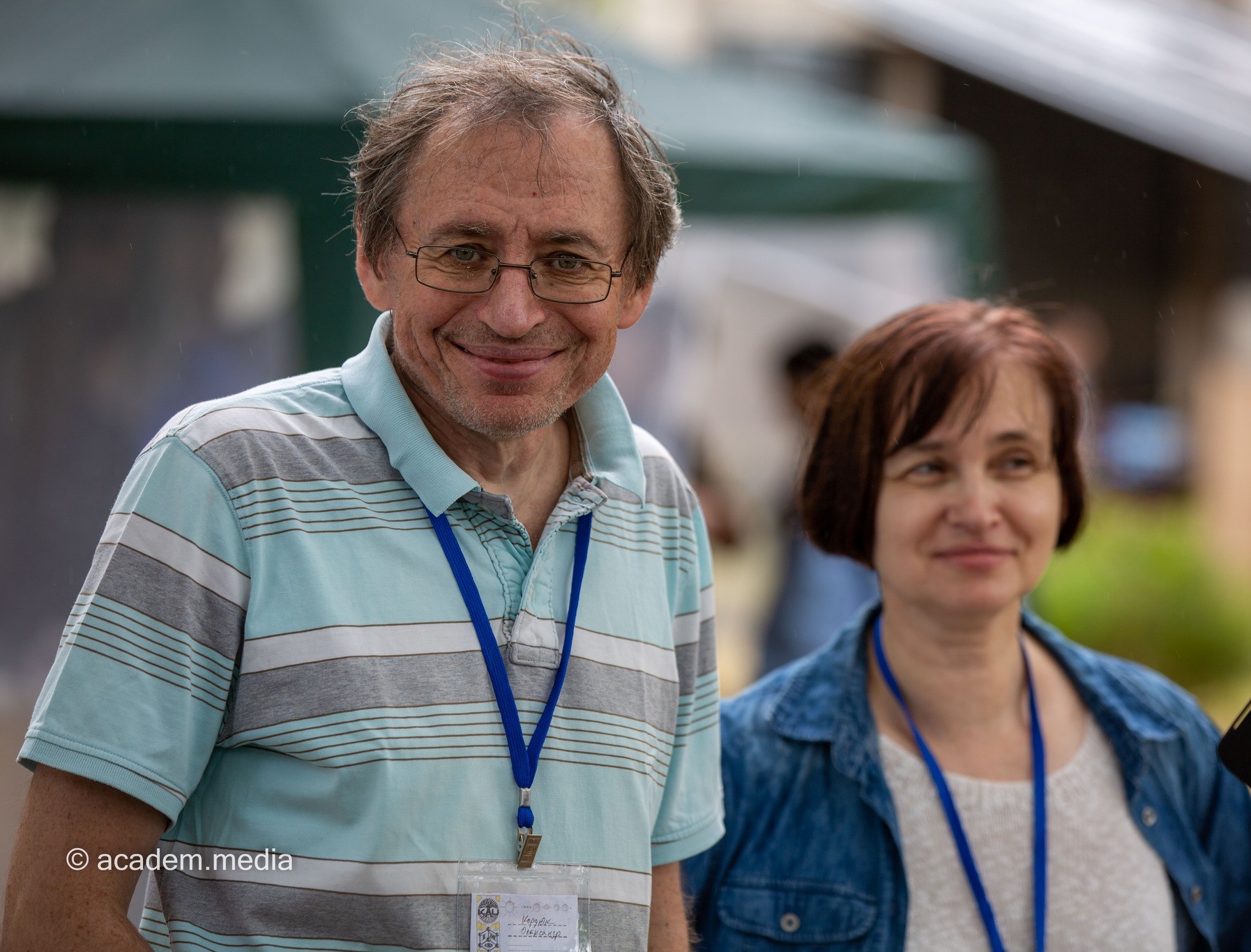
Director of Kyiv Academic University, academician Oleksandr Kordyuk, and project leader of “Academ.City,” Doctor of Physical and Mathematical Sciences Oleksandra Antonyuk
About the Center for Advanced Research at Kyiv Academic University:
“[This] project [the idea of the Ukrainian-German laboratory for searching new quantum materials GU-QuMat, which is being created at Kyiv Academic University] did not arise a year ago; it is a continuation of the history of research and collaboration, in particular within the framework of UKRATOP (a joint project of KAU and the research university in Dresden). <...>
The scientific goal of the project is the intelligent design of new quantum materials. To create such materials, new approaches to research are needed, understanding of the electronic structure of materials, and, of course, experience (sustainability of research). <...>
I would call [this Center for Advanced Research] a center of “condensation” of science and cooperation.
For young scientists to return from abroad, there must be an opportunity to work in Ukraine, so that cooperation is continuous, and one project “flows” into another.
The Center for Advanced Research should become an example of such “condensation.” So that young scientists understand that the highest quality research is conducted here and they can join these projects. Ukrainian science should be interesting. Of course, it is already interesting here, but it will be even better!”
About the future Ukrainian synchrotron:
“Today we are trying to implement the idea of building an Eastern European synchrotron in Ukraine. Colleagues from the League of European Accelerator-based Photon Sources (LEAPS) approached us and proposed to work in this direction. <...> It is about building a synchrotron specifically in Ukraine. <...>
A synchrotron is the most powerful infrastructure for material research, including quantum materials. But it is also the most interdisciplinary research infrastructure. A synchrotron allows conducting research important not only for physicists and materials scientists but also for chemists, biologists, medical professionals, agronomists, and geologists.
For comparison: X-rays can illuminate the human body, while synchrotron light illuminates materials. Synchrotron radiation is millions and billions of times more intense, allowing one to “look inside” materials. It is used, for example, to study grain quality, “decode” any molecules and proteins, and investigate material properties.
Such research is very important. Many industrial giants, from battery and modern chip manufacturers to pharmaceutical companies, cannot do without synchrotron research. It is no coincidence that all the most developed countries have built their own synchrotrons, sometimes several. <...>
Building a synchrotron is expensive; the main construction alone will cost about 300 million euros. But with the help of international partners and the “Light for Ukraine” initiative, building a synchrotron in our country is quite realistic. <...> When we build our own synchrotron, we will also relocate the Ukrainian synchrotron radiation beamline from Krakow here. <...>
The Poles are ready to share their experience in building the SOLARIS center with us. They built it for quite a long time, partly with European funds. From the desire to build a synchrotron to the start of operation took them 15 years. I am confident that Ukrainians can do it faster.”
About help from German colleagues during the war:
“Colleagues help both morally and materially. In particular, based on the UKRATOP project, the Ukrainian Scientific Scholarship Program in Dresden (UKRAPRO) was created. The goal of this project is to concentrate resources from various funds and help as many of our staff as possible. In the first year of the war, this was very serious support. Ukrainians understood what to do, where to go, and where to continue their research.
This cooperation continues today. For example, soon we will receive a magnetron sputtering system for film deposition in high vacuum. We have already prepared a special room for it.
This support motivates us to develop. It is invaluable.”
Read the full interview on the website of the “Svit” newspaper and on its Facebook page.