


On October 13, 2025, the next laureates of the Sveriges Riksbank Prize in Economic Sciences in Memory of Alfred Nobel (also known as the Nobel Prize in Economics) were announced. The head of the Department of Innovation Policy, Economics, and Organization of High Technologies at the Institute of Economics and Forecasting of the NAS of Ukraine, Corresponding Member Ihor Yehorov, tells about the researchers honored with this prestigious award and their achievements in an article specially for our Academy's website.
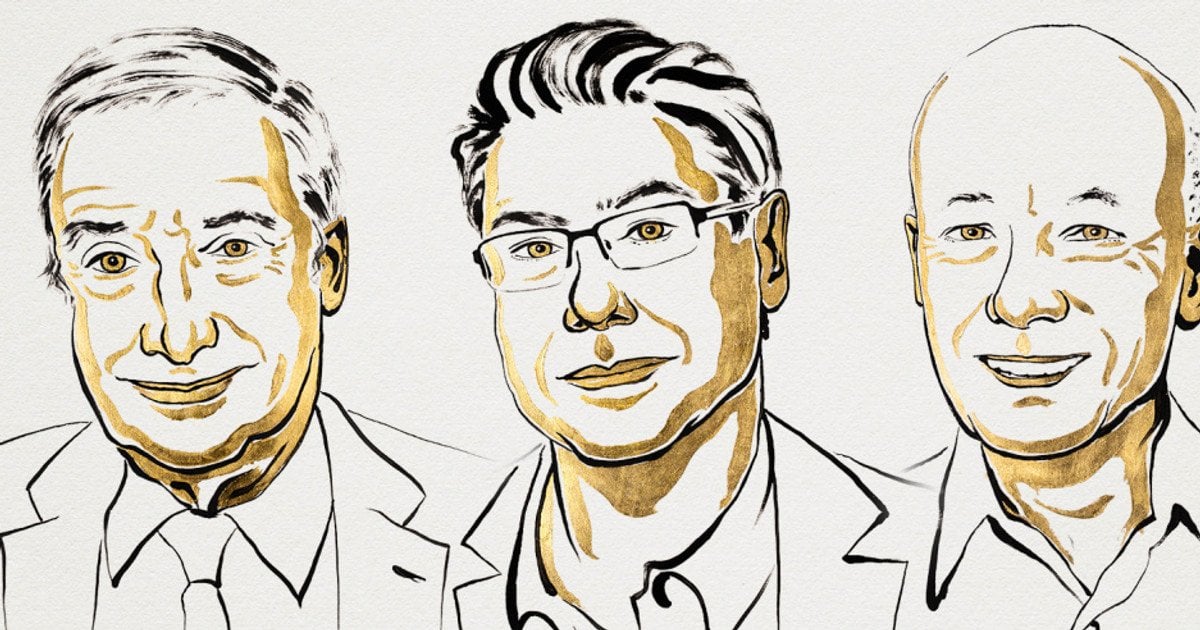
Source: www.nobelprize.org
The 2025 Nobel Prize in Economics was awarded to three scientists whose research revealed the most important mechanisms of sustainable economic growth through innovation.
Half of the prize was awarded to Professor Joel Mokyr from Northwestern University, USA – recognized for identifying the prerequisites for sustainable growth through technological progress. The other half was shared between Philippe Aghion from Collège de France and INSEAD (France) and his longtime co-author Peter Howitt from Brown University (USA). This trio received the award for "innovative work explaining how innovation contributes to long-term economic growth." The selection committee stated that their research "combines history, theory, and policy, highlighting how ideas and technological progress have shaped prosperity over centuries." It was especially emphasized that these scientists managed to combine the ideas of sustainable growth and creative destruction (the latter originally proposed by the prominent Austrian-American economist Joseph Schumpeter), according to which new and improved products displace the old. The laureates' groundbreaking research demonstrated how innovation creates a self-generating process of economic progress, but only when society has scientific explanations for why technology works and remains open to new ideas and changes.
The prize rewarded years of research (Howitt and Mokyr are already 79 years old, and Aghion is 69): their most significant works appeared in the 1990s, but in recent decades these scientists have continued to work productively in their chosen fields of economic theory. The 2025 Nobel Prize once again proved that economic science is successfully developing in the USA and the countries of "old Europe," although Israel can also fully take pride in these achievements, as Joel Mokyr is simultaneously a citizen of that country.
The key work of Aghion and Howitt was an article in the journal Econometrica in 1992 (Aghion, Philippe, and Peter Howitt. 1992. “A Model of Growth Through Creative Destruction,” Econometrica 60, no. 2: 323-351). Their ideas were so unusual for most colleagues at the time that the peer review and publication process took five (!) years. The paper proposed a three-sector model of endogenous economic growth under monopolistic competition. Based on calculations, the authors showed the possibility of sustainable economic growth driven by behavioral factors. In the model, technological progress results from the purposeful activity of economic agents investing in new technologies to earn profits. This model and its subsequent variations, later presented by Aghion, Howitt, and their followers, became a significant contribution to understanding how individual decisions affect economic growth rates and why poor countries face difficulties trying to catch up with rich ones. It showed that economic growth can be accompanied by conflicts of interest among different economic agents and that protecting the interests of producers already present in the market can slow technological progress and economic growth. The works of Aghion and Howitt helped to realize the interconnections between micro- and macroeconomics, demonstrating how macroeconomic outcomes arise at the micro level of companies and individuals. Essentially, the same theme is traced in their other major works on economic growth. By restoring the role of the innovative entrepreneur in development, they challenged the neoclassical view of technological change, which interpreted these changes as something measurable but whose sources were impossible to understand. On the contrary, Aghion and Howitt's model of "endogenous" technological change posits that the key policy issue is creating conditions for the flourishing of entrepreneurship and innovation.
The Nobel Prize confirms that the results of Aghion and Howitt have achieved the status of established theory. Therefore, now is the time for the next step – its further development, modification, and practical application.
Unlike Howitt and Aghion, Joel Mokyr practically does not use complex mathematical apparatus in his works, but the quality of his analytical conclusions is in no way diminished. The high authority of this scientist among colleagues is emphasized by the fact that he was once elected president of the American Economic Association – the largest and most influential professional organization of research economists in the USA (it has over twenty-three thousand members). Central to Mokyr's creativity is his excellently written fundamental monograph “The Lever of Riches: Technological Creativity and Economic Progress” (Oxford University Press, 1990). It has been translated into dozens of languages and has become a truly outstanding phenomenon in modern economic science.
Mokyr impresses with his knowledge of the development history of various countries, the evolution of technologies and their impact on the economy and society, and his ability to systematically analyze seemingly unrelated phenomena and trends. At the same time, he relies on many scientific sources, which gives his conclusions special persuasiveness. Mokyr's works, in style and depth of analysis, most resemble the works of Fernand Braudel, well known in Ukraine.
Studying the Industrial Revolution, Joel Mokyr showed that technological progress depends on the accumulation and application of useful knowledge. He argued that inventions become transformative when society organizes itself to implement ideas into life. The Industrial Revolution was successful because it combined scientific discoveries with engineering ingenuity, creating a continuous stream of practical innovations. A large amount of energy sources, such as coal and later electricity, scaled these innovations, but the driving force was institutional and cultural commitment to learning.
The same picture is observed in the era of digital technologies. Artificial intelligence, data analytics, and automation transform the economy through the organized use of information and knowledge, and this requires a huge amount of electricity. This again sparked debates about energy use: some believe that to conserve resources, economic growth must slow down. However, developed societies are characterized by high energy consumption because energy promotes human development. All modern welfare indicators – healthcare, education, access to technologies – depend on reliable energy supply. At the same time, Mokyr does not reduce the sources of growth in the modern economy solely to the use of technologies and knowledge, giving due credit to other, more traditional factors and considering them alongside technological progress.
Mokyr pays special attention to institutions that enable progress. Mokyr's works show that the Industrial Revolution was successful thanks to an intellectual and social environment that encouraged experimentation and tolerated uncertainty. The Renaissance created a culture in which knowledge could freely circulate and new ideas could be tested. This openness turned invention into a continuous process rather than a series of isolated breakthroughs. "Building a bridge to the present," Mokyr showed that the transition to "green" energy requires the same approach. Innovations in environmentally clean technologies will depend on institutions that value transparency, collaboration, and willingness to take risks. Regulation, monopolistic control, and rigid management can undermine progress even if good technologies exist. Successful transformations will occur where governments, researchers, and entrepreneurs create systems that link scientific discoveries with practical application. When the feedback between knowledge and implementation is strong, progress accelerates. In many ways, Mokyr's concept of the "market for ideas" serves as a model for modern energy policy. Societies must experiment with flexible regulation, public funding of research, and open data.
The 2025 Nobel laureates convincingly demonstrated that economic progress is a process, not a static state. Economic growth is driven by renewal, and open institutions allow ideas to circulate.
John Hassler, chair of the Committee for the Prize in Economic Sciences, said: "The laureates' work shows that economic growth cannot be taken for granted. We must support the mechanisms underlying creative destruction to avoid returning to stagnation."
According to information from the Institute of Economics and Forecasting of the NAS of Ukraine