Established in 1997; scholars of the Department of Physics and Astronomy of the NAS of Ukraine are awarded the Prize for outstanding scientific publications in the field of applied physics



Ivan Pavlovych Puluj Prize
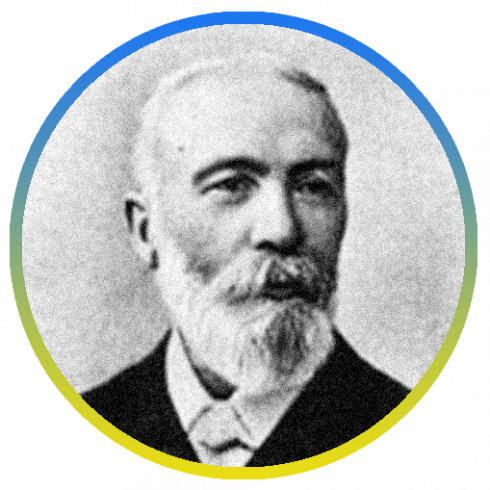
In 1856 he entered the classical gymnasium in Ternopil, and graduated with honors. Fulfilling his parents’ dreams, Ivan chose theology. At the same time, as a free student, he attended classes at the Department of Philosophy, where he listened to lectures on physics, mathematics, and astronomy. He graduated with honors from the Theological Faculty in 1869, but did not become a priest – his desire for science won out. In 1869, I.P. Puluj enrolled in the Faculty of Philosophy and the Department of Physics and Mathematics at the University of Vienna. In 1873 he graduated from the university and began working there as an assistant in experimental physics. I.P. Puluj had a great desire to teach in Lviv or Kyiv, but the tsarist police did not give him permission to work in Kyiv, considering him an insecure person.
From 1873 to 1875 he worked as an assistant lecturer at the Department of Physics and Mechanics in Fiume (now Rijeka in Croatia). In the autumn of 1875, I.P. Puluj went to Strasbourg, where he entered the Faculty of Philosophy of the local University, majoring in physics (electromechanics). Two years later, he defended his thesis with honors and received the degree of Doctor of Philosophy from the University of Strasbourg.
Here he taught new disciplines at that time – mechanical theory and kinetic theory of gases. In 1877 he returned to Vienna, where he worked as a private-docent at the Department of Physics and Mathematics. At the same time, he was an assistant in the laboratory of the Austrian physicist V. von Lang.
In 1884, the rectorate of the German Polytechnic in Prague invited I.P. Puluj to head the Department of Physics, where he worked until retirement age.
I.P. Puluj’s scientific achievements in the field of electrical engineering are significant. He improved the production of incandescent filaments for lighting lamps and received a patent, and was the first to study cold light, which we call neon today. The scientist also proposed the design of telephone exchanges and subscriber sets protected from strong electric currents. For a long time, a portable safety lamp was used in mines, and it was Puluj’s invention. The great merit of the Ukrainian scientist was the building of an AC power plant in Prague (the first one in Europe), and the launch of several DC power plants in Austria-Hungary. I.P. Puluj designed many physical and electrical devices, namely, an apparatus for determining the mechanical equivalent of heat, which received an award at the World Exhibition in Paris (1878), a phosphorescent lamp (the X-ray lamp predecessor), an electric telethermometer and fuses; he also discovered a method of carbonizing carbon fibers for electric incandescent lamps.
The scientist’s groundbreaking publication is “The Penetration of Fast X-Rays out of the Tubes”. Contrary to established statements, it was I.P. Puluj and not V.K. Roentgen, who, back in 1882, designed a tube that had the main features of modern tubes: an individual anticathode located obliquely to the beam of incident rays. I.P. Puluj was the first to take a picture of the human skeleton and proved the importance of using this development in medicine. The final results of the scientist’s research on this issue were published in the “Notes” of the Imperial Academy of Sciences in 1880–1883, and later edited in a book form. The Royal Society of London recognized this discovery as one of the most outstanding achievements of world science.
The scientist wrote more than 50 scientific and popular science papers on physics and electrical engineering. In addition, he was an expert in ancient languages and was engaged in translations from ancient Hebrew and Greek. Together with P.O. Kulish and I.S. Nechuy-Levytsky, I.P. Puluj completed a translation of the Bible into the Ukrainian language. He was a technical advisor to Emperor Franz Joseph, a consultant and forensic expert on electrical engineering in Czechia.
The scientist’s name was given to the Ternopil Instrument-Making Institute (1995), on whose basis the Ivan Puluj Ternopil State Technical University was established in 1996. A street in Kyiv is named after Ivan Puluj.