


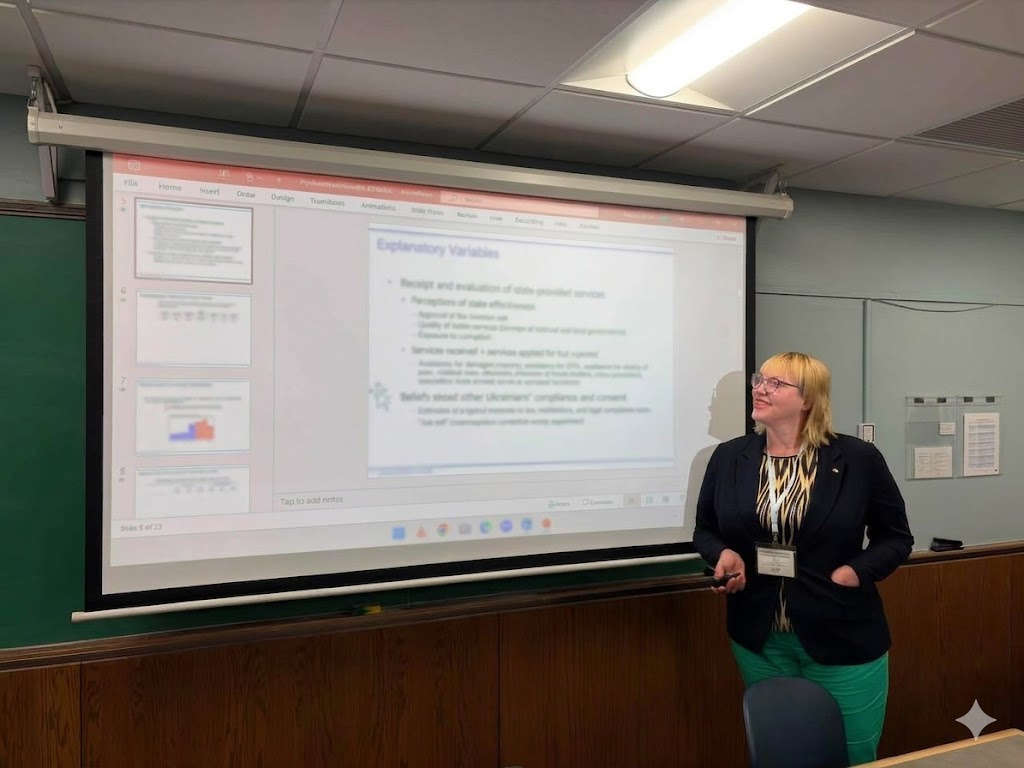
How the war affects the balance of power in Ukraine and what consequences it may have for the development of democracy after its end – these issues became the subject of research by Halyna Zelenko, Corresponding Member of the NAS of Ukraine, Deputy Director for Science of the I.F. Kuras Institute of Political and Ethnic Studies of the NAS of Ukraine, presented at the 30th World Convention of the Association for the Study of Nationalities (ASN World Convention).
The event took place on May 27-30, 2026 at Columbia University (New York, USA). The ASN World Convention is one of the most authoritative international forums in the field of research on nationalism, ethnicity, identities, migration, and political conflicts. Every year it gathers hundreds of scholars from dozens of countries around the world and brings together representatives of various social and humanitarian disciplines.
This year, a significant part of the program was devoted to Ukrainian studies and understanding the socio-political processes taking place in Ukraine in the context of the Russian-Ukrainian war. Halyna Zelenko presented a report “The Transformation of Ukraine’s System of Checks and Balances under the Impact of the War: A Quantitative and Qualitative Analysis” at section dedicated to modern political transformations in Ukraine.
The study analyzes the impact of the Russian-Ukrainian war on the functioning of the checks and balances system and the balance of power in Ukraine. Based on a quantitative analysis of statistics on the exercise of the right of legislative initiative and presidential veto, as well as a qualitative analysis of the spheres of competence of central authorities, it is shown that the full-scale war became an important factor in the transformation of the mechanisms of interaction between the branches of government.
At the same time, as the researcher notes, the prerequisites for strengthening the positions of the presidency were formed even before the start of the full-scale invasion. They are associated both with the features of the current constitutional model of organizing state power and with the political consequences of the 2019 parliamentary elections, after which a single-party pro-presidential majority was formed in the Verkhovna Rada. It was the combination of institutional and political factors that created the conditions for the concentration of power resources even before the start of the great war.
The scientist emphasized that the current configuration of power relations is an objective reality of wartime. Although such a model limits the possibilities for the full functioning of mechanisms of mutual control between branches of power, it largely ensures the effectiveness of state administration and the maintenance of national security in wartime.
Halyna Zelenko paid special attention to the future development of the political system after the end of hostilities. In particular, the issue of the possible emergence of the so-called "worm effect" was raised, which means the gradual habituation of society to the concentration of power and the reduction of requirements for democratic procedures. At the same time, the large-scale civil mobilization, the development of the volunteer movement and the high level of public self-organization demonstrated by Ukrainians during the war, in the researcher's opinion, create significant prerequisites for the restoration and further development of democratic mechanisms in the post-war period.
Information is provided by the I.F. Kuras Institute of Political and Ethnonational Studies