


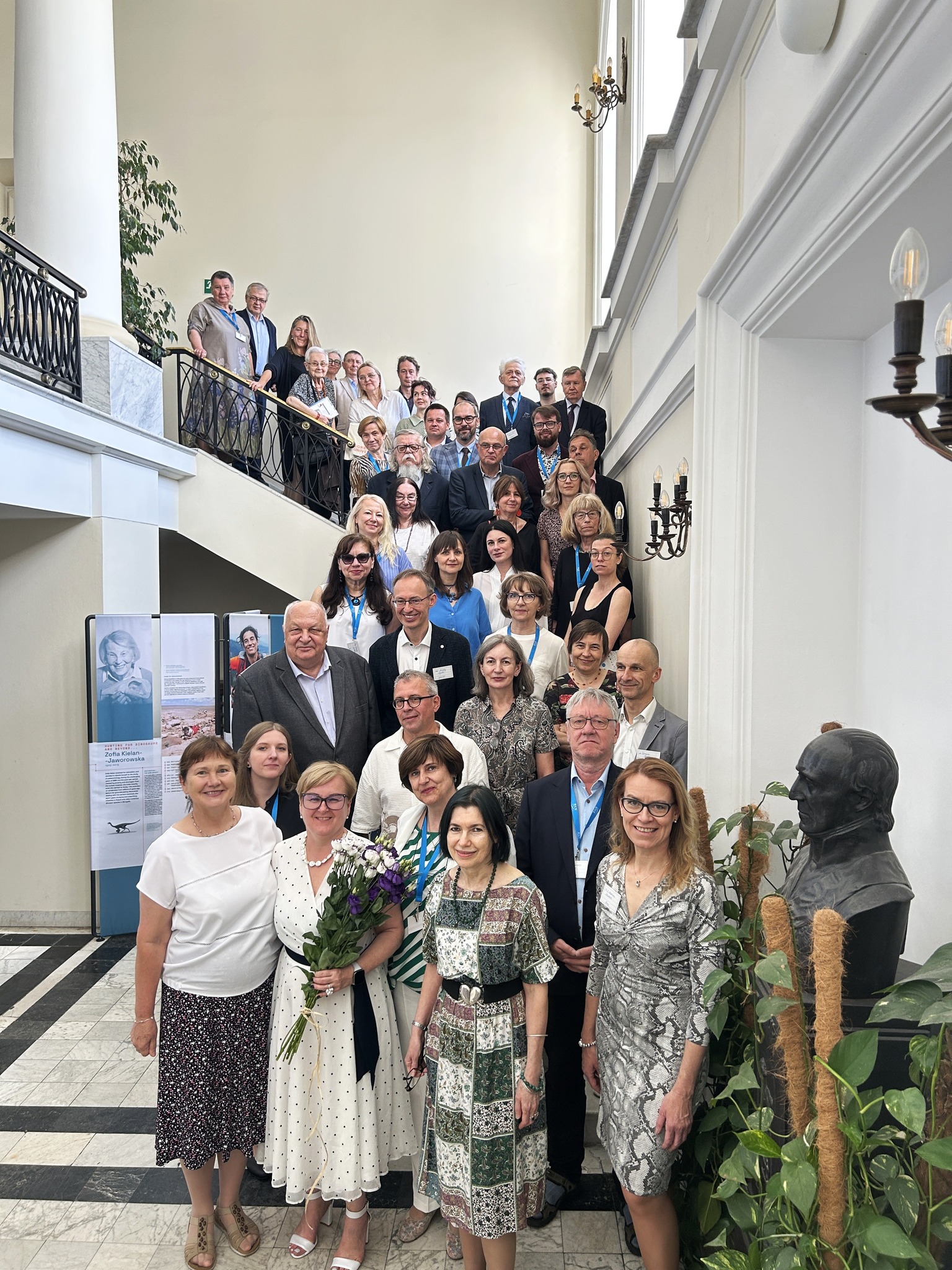
 On May 25–26, 2026, the 20th International Scientific Conference in the series "Current Problems of Dialectology" – "Dawne i współczesne kontakty językowo-kulturowe w krajach słowiańskich"/"Past and Present of Linguistic and Cultural Inter-Slavic Contacts. In Loving Memory of Professor Janusz Siatkowski" – took place at the Staszic Palace in Warsaw.
The co-organizers of this scientific forum were the Institute of Slavic Studies of the Polish Academy of Sciences, the Committee of Slavic Studies of the Polish Academy of Sciences, the Warsaw Scientific Society, the Polish Language Foundation, the State Academy of Applied Sciences in Krosno, and the I. Krypiakevych Institute of Ukrainian Studies of the National Academy of Sciences of Ukraine.
More than 50 scholars from Poland, Ukraine, the Czech Republic, Slovakia, Germany, and Serbia participated in the conference. The focus was on issues of Slavic dialectology, lexicography, language contacts, intercultural communication, the history of Slavic languages, as well as the functioning of dialect vocabulary in the contemporary cultural space.
The participation of Ukrainian scholars was significant, representing leading scientific and educational institutions: the I. Krypiakevych Institute of Ukrainian Studies of the National Academy of Sciences of Ukraine (Tetiana Yastremska, Iryna Romanina, Oksana Simovych, Maryna Demediuk, Vita Osmanova, Pavlo Kuzyk), the Institute of the Ukrainian Language of the National Academy of Sciences of Ukraine (Pavlo Hrytsenko, Nataliya Verbych, Halyna Sikora), Taras Shevchenko National University of Kyiv (Oksana Sukhoviy), Izmail State University of Humanities (Andriy Kolesnikov, Maryna Deliusto), Mykhailo Kotsiubynskyi Vinnytsia State Pedagogical University (Inna Horofianyuk), State Scientific Center for the Protection of Cultural Heritage from Technogenic Disasters (Yuriy Bidnoshyia). The reports of the Ukrainian researchers addressed issues of interlingual borrowings, Polish-Ukrainian interference, dynamics of Ukrainian dialects, preservation of Ukrainian cultural and linguistic heritage, and new approaches to compiling dialect dictionaries.
The plenary report by the director of the Institute of the Ukrainian Language of the National Academy of Sciences of Ukraine, Doctor of Philological Sciences Pavlo Hrytsenko, titled "Heuristic Potential of Slavic Dialect Localisms," was devoted to the significance of dialect localisms as carriers of valuable linguistic and extralinguistic information, revealing ancient Slavic parallels and attesting to the depth of the Ukrainian linguistic tradition.
Reports by scholars from the I. Krypiakevych Institute of Ukrainian Studies of the National Academy of Sciences of Ukraine – a co-organizer of the conference – attracted interest. At the plenary session, the deputy director for scientific work of the Institute, Doctor of Philological Sciences Tetiana Yastremska, presented a report titled "Methodological Innovations in Contemporary Dialect Lexicography," in which she introduced new approaches to forming the register of a dialect dictionary, structuring dictionary entries, recording phonetic and grammatical variability, as well as possibilities for integrating electronic lexicographic platforms. Senior Research Fellow, Candidate of Philological Sciences Oksana Simovych analyzed linguistic markers of the multicultural environment of the city of Bolekhiv and presented interethnic contacts in the oral speech of its inhabitants in the report "Borrowed Vocabulary in the Oral History of Bolekhiv as Evidence of Cultural and National Contacts." Research Fellow, Candidate of Philological Sciences Iryna Romanina addressed the issue of the functioning of Polish lexical borrowings in contemporary dialects of Galicia, their semantic adaptation, and their role in reflecting long-term Ukrainian-Polish linguistic and cultural contacts ("Polonisms in the Contemporary Dialect Speech of Galicians").
The interdisciplinary aspect of the conference was enhanced by the report of Senior Research Fellow, Candidate of Philological Sciences Maryna Demediuk, "The Image of Polish Settlements in the Folklore Memory of Volyn Polissya: Toponymic Markers and the Return of the Cultural Landscape." The researcher analyzed oral narratives of Volyn Polissya, which preserve the memory of Polish settlements as "lost landscapes," and also highlighted the role of toponyms as linguistic markers of intercultural contacts and important elements of the region's historical memory.
Postgraduate students from the Department of Ukrainian Language also presented the results of their scientific studies: Vita Osmanova gave a report titled "Lexicographic Processing of the Noun in the Trans-Dniester Dialect," in which she substantiated a model of the dictionary entry built on the principle of "word in text," with the separation of grammatical, semantic, illustrative, and phraseological zones, and Pavlo Kuzyk focused on the problems of creating an electronic dictionary of the Hutsul dialect.
The second day of the conference began with a memorial session dedicated to the first anniversary of Professor Janusz Siatkowski. Professor Dorota Krystyna Rembiszewska presented the book prepared for the conference "O Profesorze Januszu Siatkowskim (1929–2025) rodzina, bliscy, uczennice i uczniowie."
The Warsaw conference was the jubilee – twentieth – meeting of the international scientific seminar "Current Problems of Dialectology," which was founded in 1999 by the renowned linguist Natalia Khobzei at the I. Krypiakevych Institute of Ukrainian Studies of the National Academy of Sciences of Ukraine. For over two decades, this forum has united dialectologists, lexicographers, and ethnolinguists from all over Europe. Professor J. Siatkowski repeatedly participated in the conferences, and his reports, the formulation of important scientific problems, and unconventional approaches to their solutions sparked lively discussions and were memorable to the participants.
The holding of this year's (as well as the previous) session in Warsaw demonstrated not only significant support from Polish colleagues amid the Russian-Ukrainian war but also the important role of the I. Krypiakevych Institute of Ukrainian Studies of the National Academy of Sciences of Ukraine in developing international scientific cooperation in the field of Slavic linguistics.
The conference became an authoritative platform for international scientific dialogue, exchange of research experience, and discussion of current problems of Slavic dialectology and linguistic and cultural contacts in Central and Eastern Europe.
Participants and organizers expressed hope that the next session, scheduled for 2028, will again take place in Lviv – the city where this scientific forum was founded – and that Ukraine will welcome it without war.
According to information from the I. Krypiakevych Institute of Ukrainian Studies of the National Academy of Sciences of Ukraine


